

alb4366290
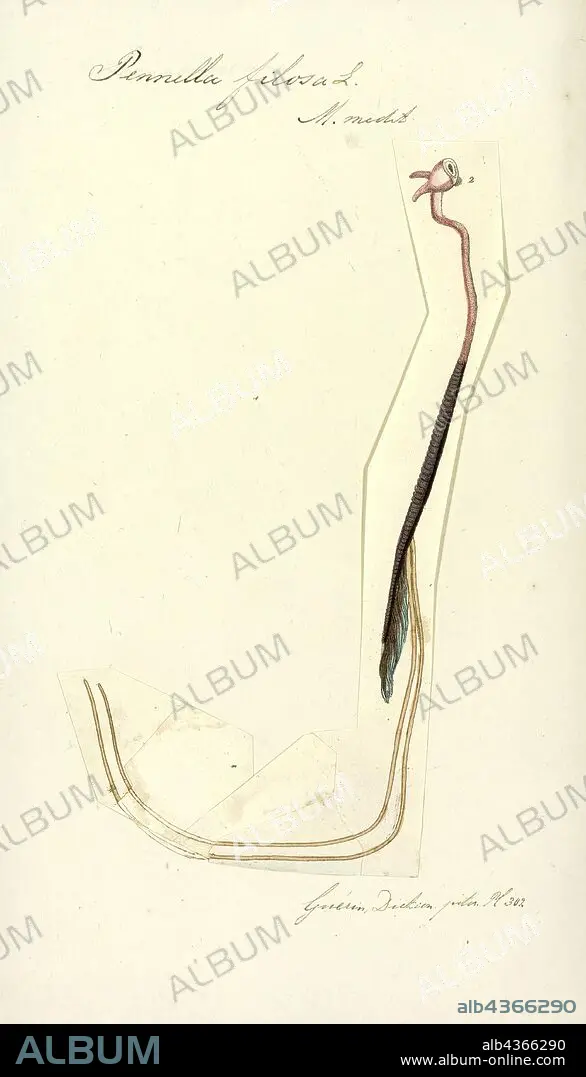
Pennella filosa, Print, Pennella is a genus of large copepods which are common parasites of large pelagic fishes. They begin their life cycle as a series of free-swimming planktonic larvae. The females metamorphose into a parasitic stage when they attach to a host and enter into its skin. The males are free swimming. Due to their large size and mesoparasitic life history there have been a number of studies of Pennella, the members of which are among the largest of the parasitic Copepoda. All species are found as adults buried into the flesh of marine bony fish, except for a single species, Pennella balaenopterae which can be found in the muscles and blubber of cetaceans and occasionally other marine mammals, and is the largest species of copepod.
| Teilen |
|---|
 Pinterest Pinterest |
 Twitter Twitter |
 Facebook Facebook |
 Link kopieren Link kopieren |
 Email Email |
|
Zu einem anderen Lightbox hinzufügen |
|
Zu einem anderen Lightbox hinzufügen |


Haben Sie bereits ein Konto? Anmelden
Sie haben kein Konto? Registrieren
Dieses Bild kaufen.
Nutzung auswählen:

Untertitel: Siehe automatische Übersetzung
Pennella filosa, Print, Pennella is a genus of large copepods which are common parasites of large pelagic fishes. They begin their life cycle as a series of free-swimming planktonic larvae. The females metamorphose into a parasitic stage when they attach to a host and enter into its skin. The males are free swimming. Due to their large size and mesoparasitic life history there have been a number of studies of Pennella, the members of which are among the largest of the parasitic Copepoda. All species are found as adults buried into the flesh of marine bony fish, except for a single species, Pennella balaenopterae which can be found in the muscles and blubber of cetaceans and occasionally other marine mammals, and is the largest species of copepod.
Pennella filosa, Print, Pennella is a genus of large copepods which are common parasites of large pelagic fishes. They begin their life cycle as a series of free-swimming planktonic larvae. The females metamorphose into a parasitic stage when they attach to a host and enter into its skin. The males are free swimming. Due to their large size and mesoparasitic life history there have been a number of studies of Pennella, the members of which are among the largest of the parasitic Copepoda. All species are found as adults buried into the flesh of marine bony fish, except for a single species, Pennella balaenopterae which can be found in the muscles and blubber of cetaceans and occasionally other marine mammals, and is the largest species of copepod.
Bildnachweis: Album / quintlox
Freigaben (Releases): ? Modellfreigabe: Nein - ? Eigentumsfreigabe: Nein
Rechtefragen?
Rechtefragen?
Bildgröße: 2758 × 4822 px | 38.0 MB
Druckgröße: 23.4 × 40.8 cm | 1085.8 × 1898.4 in (300 dpi)
