

alb5149628
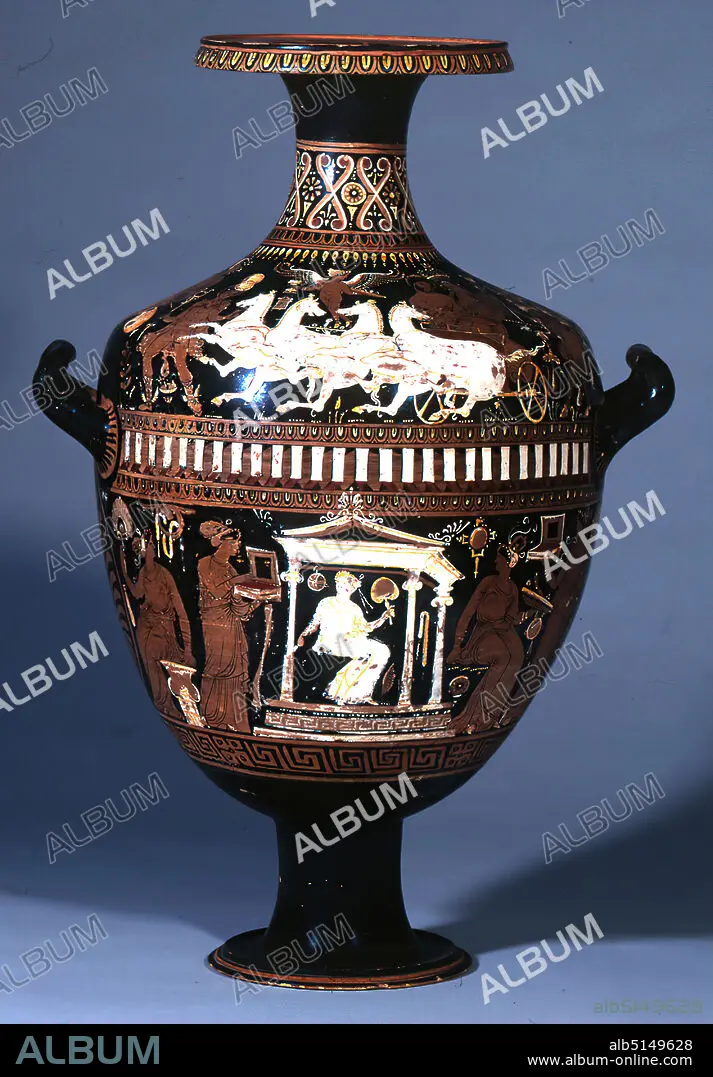
Painter of the White Caps, Hydria (shoulder: robbery of Persephone, body: Naiskos with young woman), property of the Hamburg Art Collections Foundation, clay, painted (ceramic), quickly turned, alternately fired, clay, turned and painted, Total: Height: 73.9 cm; Diameter: 40.5 cm; Muzzle diameter: 24.4 cm; Base diameter: 22.2 cm; Weight: 12.3 kg, ceramic, gods (classic. Mythology), funerary monument, Late Classical (Greek antiquity), Greek antiquity, The shape of the vessel with two horizontal and one vertical handle is called Hydria according to ancient sources. It is a transport and casting vessel for water. This monumental vase is potted without a bottom; it was therefore not intended for actual use, but served as a display object at the funeral and was given to the deceased to take with him to the grave. On the shoulder a four-man team pushing to the left is depicted. In the carriage there is a bearded man with a naked upper body and a woman in a richly decorated robe with crown and veil. While she holds on to the carriage with one hand and lifts her veil with the other, the man has his arms wrapped around the woman in a possessive manner. Above the carriage hovers an Eros with incense burner and bowl in her hands. On the left side of the carriage the god Hermes shows the way. He is recognizable by his travelling hat (Greek petasos) and herald's staff (Greek kerykeion) as well as his winged shoes. Behind the vehicle there is a female figure with a coat, trousers and a knee-length robe. She also has a hat and holds a torch in each hand. It is the goddess Hekate, who illuminated the way to the underworld for the deceased. The entire scene is flanked on the left and right by a female figure in a long robe and hood sitting on an overturned hydria. The scene shows the robbery of Persephone by Hades, the ruler of the underworld. He fell in love with the daughter of Zeus and abducted her on his four-in-hand carriage into the underworld, in order to marry her there and.
| Teilen |
|---|
 Pinterest Pinterest |
 Twitter Twitter |
 Facebook Facebook |
 Link kopieren Link kopieren |
 Email Email |
|
Zu einem anderen Lightbox hinzufügen |
|
Zu einem anderen Lightbox hinzufügen |


Haben Sie bereits ein Konto? Anmelden
Sie haben kein Konto? Registrieren
Dieses Bild kaufen.
Nutzung auswählen:

Untertitel: Siehe automatische Übersetzung
Painter of the White Caps, Hydria (shoulder: robbery of Persephone, body: Naiskos with young woman), property of the Hamburg Art Collections Foundation, clay, painted (ceramic), quickly turned, alternately fired, clay, turned and painted, Total: Height: 73.9 cm; Diameter: 40.5 cm; Muzzle diameter: 24.4 cm; Base diameter: 22.2 cm; Weight: 12.3 kg, ceramic, gods (classic. Mythology), funerary monument, Late Classical (Greek antiquity), Greek antiquity, The shape of the vessel with two horizontal and one vertical handle is called Hydria according to ancient sources. It is a transport and casting vessel for water. This monumental vase is potted without a bottom; it was therefore not intended for actual use, but served as a display object at the funeral and was given to the deceased to take with him to the grave. On the shoulder a four-man team pushing to the left is depicted. In the carriage there is a bearded man with a naked upper body and a woman in a richly decorated robe with crown and veil. While she holds on to the carriage with one hand and lifts her veil with the other, the man has his arms wrapped around the woman in a possessive manner. Above the carriage hovers an Eros with incense burner and bowl in her hands. On the left side of the carriage the god Hermes shows the way. He is recognizable by his travelling hat (Greek petasos) and herald's staff (Greek kerykeion) as well as his winged shoes. Behind the vehicle there is a female figure with a coat, trousers and a knee-length robe. She also has a hat and holds a torch in each hand. It is the goddess Hekate, who illuminated the way to the underworld for the deceased. The entire scene is flanked on the left and right by a female figure in a long robe and hood sitting on an overturned hydria. The scene shows the robbery of Persephone by Hades, the ruler of the underworld. He fell in love with the daughter of Zeus and abducted her on his four-in-hand carriage into the underworld, in order to marry her there and
Painter of the White Caps, Hydria (shoulder: robbery of Persephone, body: Naiskos with young woman), property of the Hamburg Art Collections Foundation, clay, painted (ceramic), quickly turned, alternately fired, clay, turned and painted, Total: Height: 73.9 cm; Diameter: 40.5 cm; Muzzle diameter: 24.4 cm; Base diameter: 22.2 cm; Weight: 12.3 kg, ceramic, gods (classic. Mythology), funerary monument, Late Classical (Greek antiquity), Greek antiquity, The shape of the vessel with two horizontal and one vertical handle is called Hydria according to ancient sources. It is a transport and casting vessel for water. This monumental vase is potted without a bottom; it was therefore not intended for actual use, but served as a display object at the funeral and was given to the deceased to take with him to the grave. On the shoulder a four-man team pushing to the left is depicted. In the carriage there is a bearded man with a naked upper body and a woman in a richly decorated robe with crown and veil. While she holds on to the carriage with one hand and lifts her veil with the other, the man has his arms wrapped around the woman in a possessive manner. Above the carriage hovers an Eros with incense burner and bowl in her hands. On the left side of the carriage the god Hermes shows the way. He is recognizable by his travelling hat (Greek petasos) and herald's staff (Greek kerykeion) as well as his winged shoes. Behind the vehicle there is a female figure with a coat, trousers and a knee-length robe. She also has a hat and holds a torch in each hand. It is the goddess Hekate, who illuminated the way to the underworld for the deceased. The entire scene is flanked on the left and right by a female figure in a long robe and hood sitting on an overturned hydria. The scene shows the robbery of Persephone by Hades, the ruler of the underworld. He fell in love with the daughter of Zeus and abducted her on his four-in-hand carriage into the underworld, in order to marry her there and
Bildnachweis: Album / quintlox
Freigaben (Releases): ? Modellfreigabe: Nein - ? Eigentumsfreigabe: Nein
Rechtefragen?
Rechtefragen?
Bildgröße: 3010 × 4320 px | 37.2 MB
Druckgröße: 25.5 × 36.6 cm | 1185.0 × 1700.8 in (300 dpi)
Schlüsselwörter: ALLGEMEIN • ANHAENGER (SCHMUCK) • ANHAENGER, SCHMUCK • ANHÄNGER (SCHMUCK) • ANHÄNGER • ARGOLLA • BEERDIGUNG • BEGRAEBNIS • BEGRÄBNIS • BESTATTUNG • CROWN • EINGANG • EINTRITT • FACKEL • FESSEL • FORM • FRAU • FRAUEN • GEBAEUDE • GEBÄUDE • GEFANGENENSCHLINGE • GESTIK • GLUECK • GLUECKSGOTT • GLÜCK • GLÜCKSGOTT • GOETTER • GOETTIN KORE • GOETTIN PERSEPHONE • GOETTIN PROSERPINA • GRIECH. GOETTIN KORE • GRIECH. GOETTIN PERSEPHONE • GÖTTER • HAENDE • HAND • HANDSCHELLE • HANDSCHELLEN • HOCHZEITSKRONE • HOSE • HOSENMODE • HÄNDE • KADAVER • KERAMIK • KOERPER • KOPF (ANATOMIE) • KOPF • KORE, GOETTIN • KORPER • KÖRPER • LEICHE • LIEBE • MALER • MANN • MANTEL • MYTHOLOGIE • NAISKOS • PALETOT • PANTALON • PENDANT, SCHMUCK • PERSEPHONE, GOETTIN • PROSERPINA, GOETTIN • REICHTUM • SCHALE • SCHLEIER • SCHMUCK: ANHAENGER • SCHULTER • SPAETKLASSISCH • SPÄTKLASSISCH • STEINGUT • STIMMUNG: LIEBE • SZENE • TOCHTER • TOD • TODESFALL • TOEPFEREI • TOEPFERWARE • TON • TRANSPORT • TRANSPORTE • TRAUERFEIER • TRAUERZUG • TÖPFEREI • UEBERFLUSS • VERHUELLUNG (KLEIDUNG) • VERHÜLLUNG (KLEIDUNG) • VIER ELEMENTE: WASSER • WASSER • WASSER, VIER ELEMENTE • WEIBCHEN • WOMAN • ÜBERFLUSS
