

alb3816997
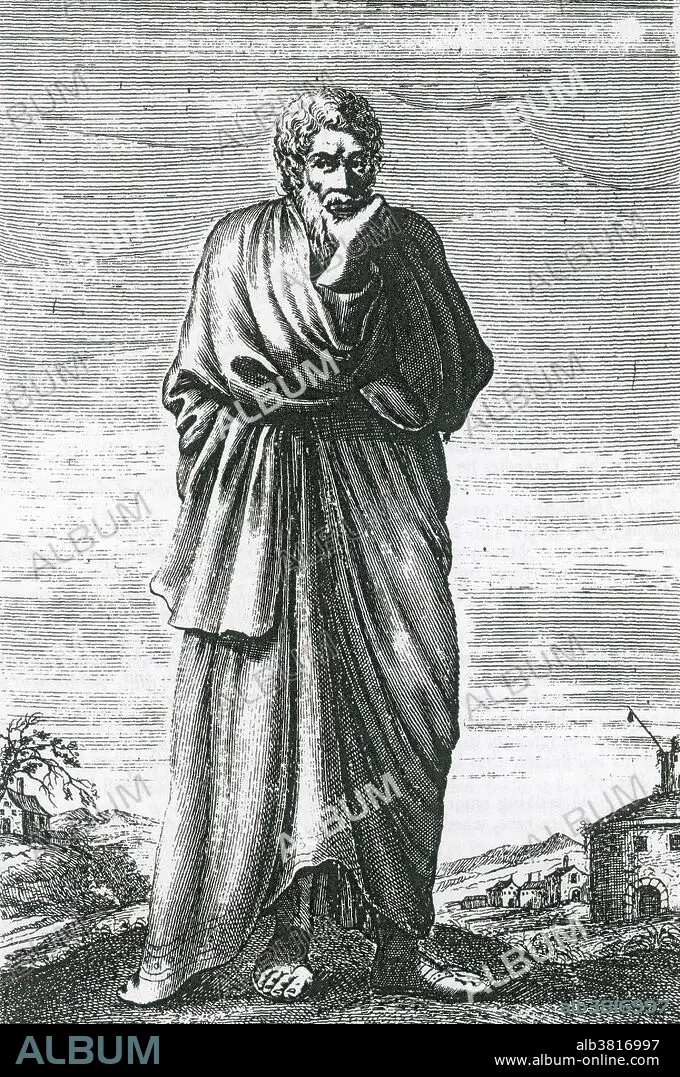
Timon of Phlius, Ancient Greek Philosopher
| Teilen |
|---|
 Pinterest Pinterest |
 Twitter Twitter |
 Facebook Facebook |
 Link kopieren Link kopieren |
 Email Email |
|
Zu einem anderen Lightbox hinzufügen |
|
Zu einem anderen Lightbox hinzufügen |


Haben Sie bereits ein Konto? Anmelden
Sie haben kein Konto? Registrieren
Dieses Bild kaufen.
Nutzung auswählen:

Titel: Timon of Phlius, Ancient Greek Philosopher
Untertitel: Siehe automatische Übersetzung
Timon of Phlius (320 BC-230 BC) was a Greek skeptic philosopher and a pupil of Pyrrho. He composed poetry, tragedies, satiric dramas, and comedies, of which very little remains. His most famous composition was his Silloi, a satirical account of famous philosophers, living and dead, in hexameter verse. The Silloi has not survived intact, but it is mentioned and quoted by several ancient authors. According to Diogenes Laertius, Timon was a one-eyed man; and he used even to make a jest of his own defect, calling himself Cyclops. No remains of his dramas have survived. Of his epic poems little is known, but it may be presumed that they were chiefly ludicrous or satirical poems in the epic form. He died at an age of almost ninety. Engraving from The History of Philosophy by Thomas Stanley published in three successive volumes between 1655 and 1661.
Timon of Phlius (320 BC-230 BC) was a Greek skeptic philosopher and a pupil of Pyrrho. He composed poetry, tragedies, satiric dramas, and comedies, of which very little remains. His most famous composition was his Silloi, a satirical account of famous philosophers, living and dead, in hexameter verse. The Silloi has not survived intact, but it is mentioned and quoted by several ancient authors. According to Diogenes Laertius, Timon was a one-eyed man; and he used even to make a jest of his own defect, calling himself Cyclops. No remains of his dramas have survived. Of his epic poems little is known, but it may be presumed that they were chiefly ludicrous or satirical poems in the epic form. He died at an age of almost ninety. Engraving from The History of Philosophy by Thomas Stanley published in three successive volumes between 1655 and 1661.
Bildnachweis: Album / Science Source
Freigaben (Releases): ? Modellfreigabe: Nein - ? Eigentumsfreigabe: Nein
Rechtefragen?
Rechtefragen?
Bildgröße: 2789 × 4200 px | 33.5 MB
Druckgröße: 23.6 × 35.6 cm | 1098.0 × 1653.5 in (300 dpi)
Schlüsselwörter: ABENDLÄNDISCH • AKADEMIKERIN • BERÜHMT • BERÜHMTE PERSÖNLICHKEIT • ILLUSTRATION • ILLUSTRATIONS • MANN • NOTABEL • PERSON • PERSöNLICHKEITEN • PERSÖNLICHKEITEN • PHILOSOPHIE • PORTRAIT • PROMINENZ • SKEPSIS • WESTERN • WESTLICH • WISSENSCH.: PHILOSOPHIE
