alb3794119
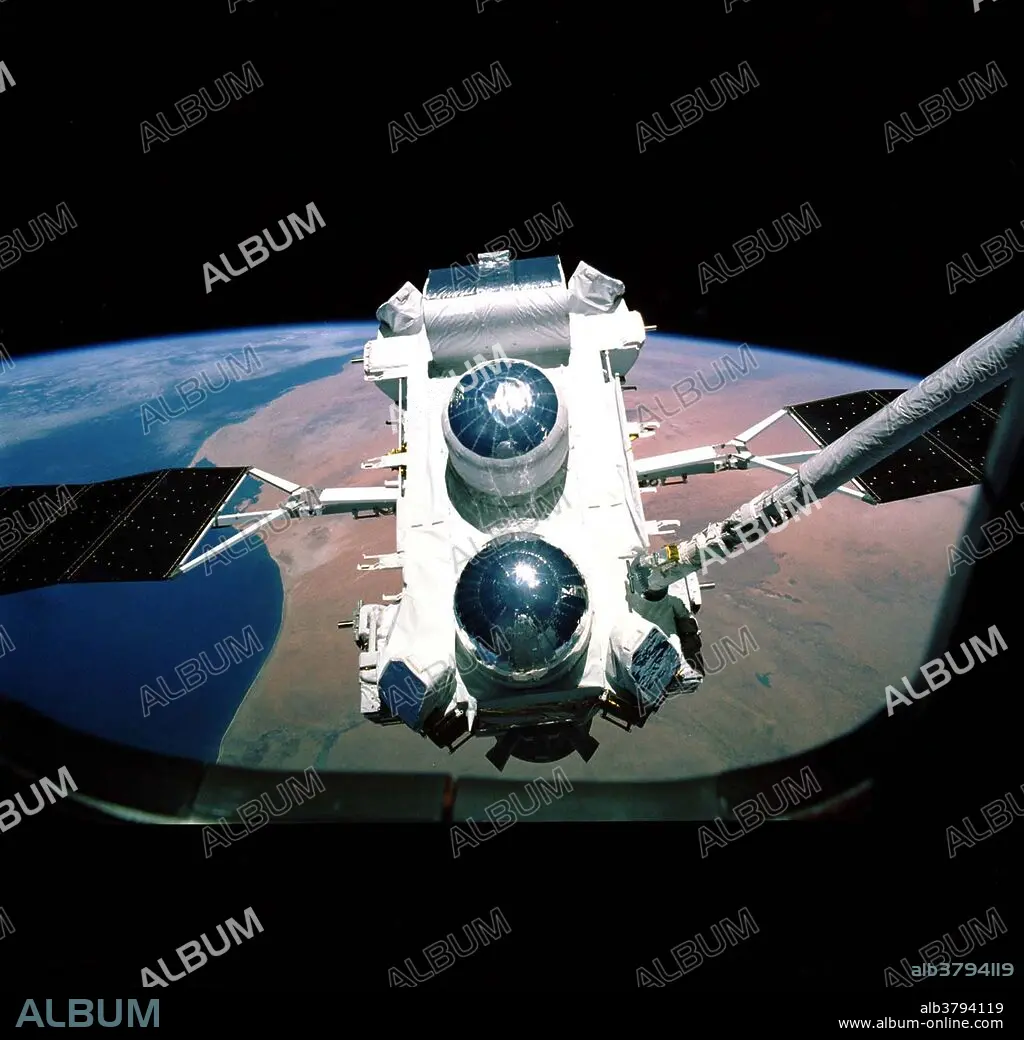
STS-37, Compton Gamma-Ray Observatory, 1991
| Teilen |
|---|
 Pinterest Pinterest |
 Twitter Twitter |
 Facebook Facebook |
 Link kopieren Link kopieren |
 Email Email |
|
Zu einem anderen Lightbox hinzufügen |
|
Zu einem anderen Lightbox hinzufügen |


Haben Sie bereits ein Konto? Anmelden
Sie haben kein Konto? Registrieren
Dieses Bild kaufen.
Nutzung auswählen:

Titel:
STS-37, Compton Gamma-Ray Observatory, 1991
Untertitel:
Siehe automatische Übersetzung
Compton Gamma-Ray Observatory (GRO) being deployed by the Remote Manipulator System (RMS) arm aboard the Space Shuttle Atlantis during STS-37 mission, April 1991. The GRO reentered Earth atmosphere and ended its successful mission in June 2000. For 9 years, the GRO Burst and Transient Source Experiment, designed and built by the Marshall Space Flight Center, kept a watch on the universe to alert scientists to the invisible, mysterious gamma-ray bursts that had puzzled them for decades. By studying gamma-rays from objects like black holes, pulsars, quasars, neutron stars, and other exotic objects, scientists could discover clues to the birth, evolution, and death of stars, galaxies, and the universe. The gamma-ray instrument was one of four major science instruments aboard the Compton. It consisted of eight detectors, or modules, located at each corner of the rectangular satellite to simultaneously scan the entire universe for bursts of gamma-rays ranging in duration from fractions of a second to minutes.
Bildnachweis:
Album / Science Source / NASA Marshall Space Flight Center
Freigaben (Releases):
Bildgröße:
3750 x 3613 px | 38.8 MB
Druckgröße:
31.8 x 30.6 cm | 12.5 x 12.0 in (300 dpi)
Schlüsselwörter:
AMERIKANER • BERÜHMT • BERÜHMTE PERSÖNLICHKEIT • EREIGNIS • NASA • NOTABEL • PROMINENZ • RAUMFAHRT • RAUMSCHIFF • SPACE SHUTTLE • TECHNOLOGIE
