alb5531064
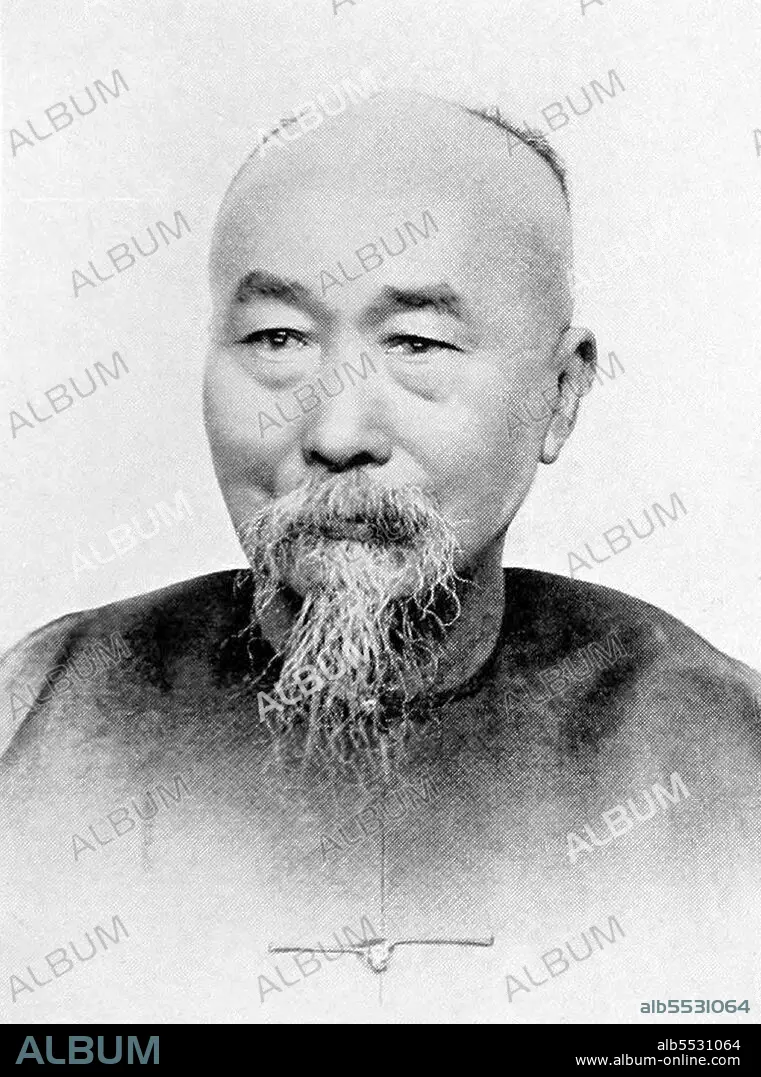
China: Li Hongzhang (Lu Hung-chang), Marquis Suyi of the Qing Empire, late 19th century.
| Teilen |
|---|
 Pinterest Pinterest |
 Twitter Twitter |
 Facebook Facebook |
 Link kopieren Link kopieren |
 Email Email |
|
Zu einem anderen Lightbox hinzufügen |
|
Zu einem anderen Lightbox hinzufügen |


Haben Sie bereits ein Konto? Anmelden
Sie haben kein Konto? Registrieren
Dieses Bild kaufen.
Nutzung auswählen:

Titel:
China: Li Hongzhang (Lu Hung-chang), Marquis Suyi of the Qing Empire, late 19th century.
Untertitel:
Siehe automatische Übersetzung
Li Hongzhang (Wade–Giles: Li Hung-chang), Marquis Suyi of the First Class (February 15, 1823 – November 7, 1901), was a Chinese civilian official who ended several major rebellions, and a leading statesman of the late Qing Empire. He served in important positions of the Imperial Court, once holding the office of the Viceroy of Zhili. Although he was best known in the West for his diplomatic negotiation skills, after the 1894 First Sino-Japanese War, Li became a symbol in China for late Qing-dynasty Chinese weakness vis-a-vis foreign powers. His image in China remains largely controversial, with criticism on one hand for his lack of political insight and failure to win a single external military campaign against foreign powers, and praise on the other hand for his role as a pioneer of industrial and military modernization, his diplomatic skills, and the success of his military campaigns against the Taiping Rebellion. For his life work the British Queen Victoria made him a Knight Grand Cross of the Royal Victorian Order.
Bildnachweis:
Album / Pictures from History/Universal Images Group
Freigaben (Releases):
Bildgröße:
3546 x 4771 px | 48.4 MB
Druckgröße:
30.0 x 40.4 cm | 11.8 x 15.9 in (300 dpi)
Schlüsselwörter:
ASIEN • ASIEN, KONTINENT • CHINESIN • CHINESISCH • FEUER, KRIEG • GESCHICHTE • HONGZHANG, LI • KONTINENT, ASIEN • KRIEG • MANDSCHU • MILITAER • MILITAR • MILITÄR • MILITÄRISCH • T'AI-P'ING-AUFSTAND • ZEITGESCHICHTE
