

alb5407343
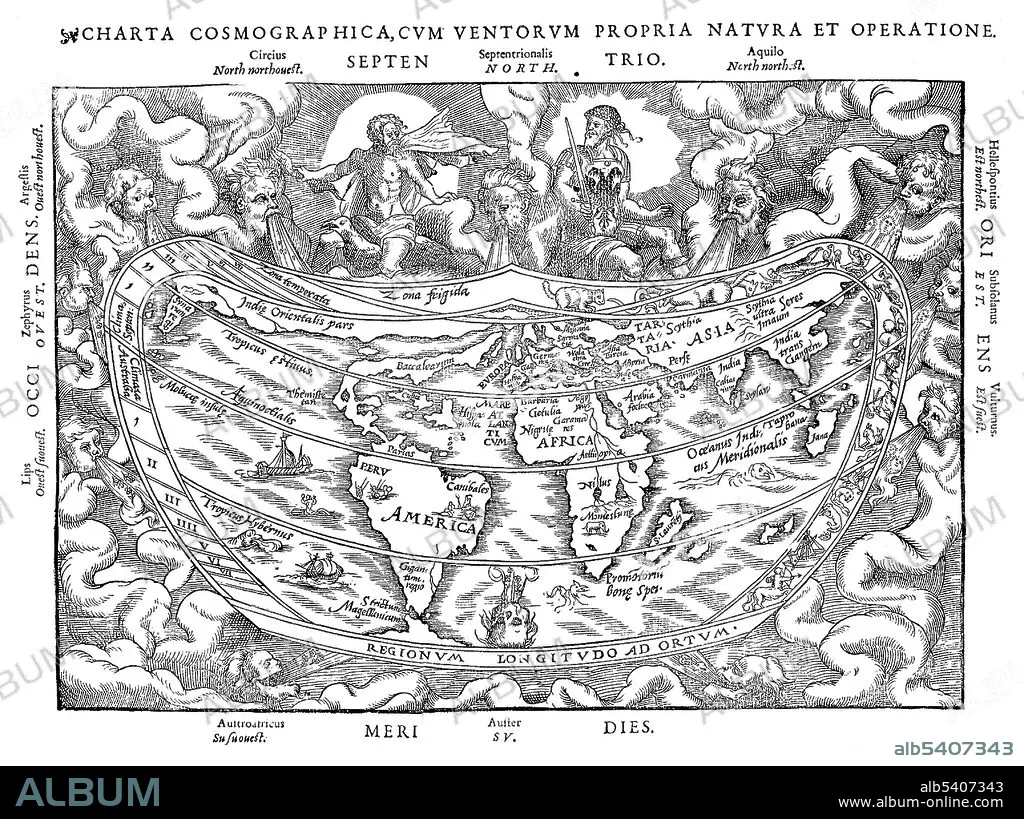
Petrus Apianus, World Map
| Teilen |
|---|
 Pinterest Pinterest |
 Twitter Twitter |
 Facebook Facebook |
 Link kopieren Link kopieren |
 Email Email |
|
Zu einem anderen Lightbox hinzufügen |
|
Zu einem anderen Lightbox hinzufügen |


Haben Sie bereits ein Konto? Anmelden
Sie haben kein Konto? Registrieren
Dieses Bild kaufen.
Nutzung auswählen:

Titel: Petrus Apianus, World Map
Untertitel: Siehe automatische Übersetzung
Apianus world map is from undated edition of Cosmographia. Mythical figures representing the winds and twelve compass points adorn the borders. The equator and tropics are marked. South America had been discovered by Europeans at this time, but North America is largely unmapped, as is the Far East and Australia. Petrus Apianus (April 16, 1495 - April 21, 1552) was a German humanist, known for his works in mathematics, astronomy and cartography. In 1524 he produced his Cosmographicus liber, a respected work on astronomy and navigation that was to see at least 30 reprints in 14 languages. In 1527 he published a variation of Pascal's triangle, and in 1534 a table of sines. In 1531, he observed a comet and discovered that a comet's tail always point away from the sun. In 1540, he printed the Astronomicum Caesareum, dedicated to Charles V who appointed him his court mathematician. He designed sundials, published manuals for astronomical instruments and crafted volvelles (Apian wheels), measuring instruments useful for calculating time and distance for astronomical and astrological applications. He died in 1552 at the age of 57.
Apianus world map is from undated edition of Cosmographia. Mythical figures representing the winds and twelve compass points adorn the borders. The equator and tropics are marked. South America had been discovered by Europeans at this time, but North America is largely unmapped, as is the Far East and Australia. Petrus Apianus (April 16, 1495 - April 21, 1552) was a German humanist, known for his works in mathematics, astronomy and cartography. In 1524 he produced his Cosmographicus liber, a respected work on astronomy and navigation that was to see at least 30 reprints in 14 languages. In 1527 he published a variation of Pascal's triangle, and in 1534 a table of sines. In 1531, he observed a comet and discovered that a comet's tail always point away from the sun. In 1540, he printed the Astronomicum Caesareum, dedicated to Charles V who appointed him his court mathematician. He designed sundials, published manuals for astronomical instruments and crafted volvelles (Apian wheels), measuring instruments useful for calculating time and distance for astronomical and astrological applications. He died in 1552 at the age of 57.
Bildnachweis: Album / Science Source
Freigaben (Releases): ? Modellfreigabe: Nein - ? Eigentumsfreigabe: Nein
Rechtefragen?
Rechtefragen?
Bildgröße: 4350 × 3254 px | 40.5 MB
Druckgröße: 36.8 × 27.6 cm | 1712.6 × 1281.1 in (300 dpi)
Schlüsselwörter: 16. JAHRHUNDERT • 16. JH. • BERÜHMT • BERÜHMTE PERSÖNLICHKEIT • DEUTSCH • KARTHOGRAFIE • KARTOGRAFIE (KARTE) • KARTOGRAPHIE • PROMINENZ • WELTKARTE • WISSENSCH.: KARTOGRAPHIE
