

alb3813698
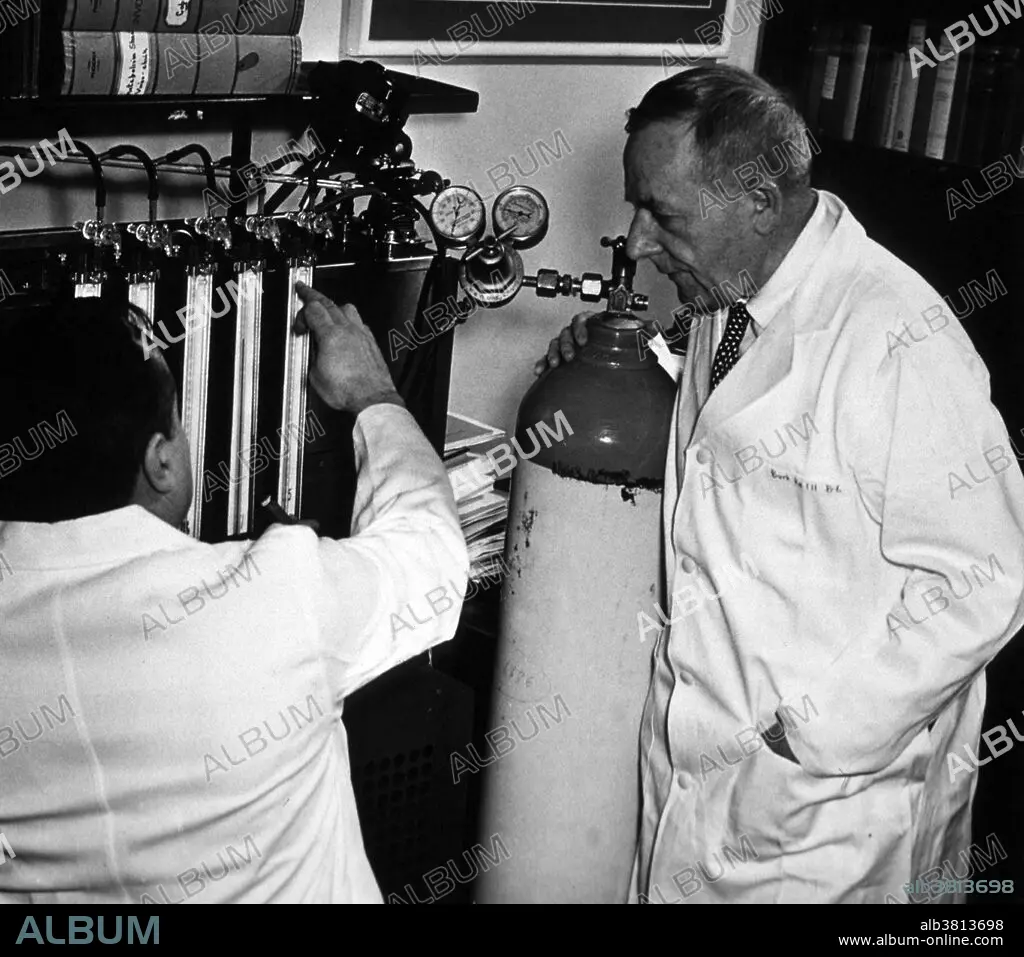
Otto Heinrich Warburg, German Physiologist
| Teilen |
|---|
 Pinterest Pinterest |
 Twitter Twitter |
 Facebook Facebook |
 Link kopieren Link kopieren |
 Email Email |
|
Zu einem anderen Lightbox hinzufügen |
|
Zu einem anderen Lightbox hinzufügen |


Haben Sie bereits ein Konto? Anmelden
Sie haben kein Konto? Registrieren
Dieses Bild kaufen.
Nutzung auswählen:

Titel: Otto Heinrich Warburg, German Physiologist
Untertitel: Siehe automatische Übersetzung
Warburg, unidentified associate, and the Warburg manometer. No date or location given. Otto Heinrich Warburg (1883-1970) was a German physician and physiologist. He served as an officer in the elite Uhlans (cavalry) on the front during the First World War where he won the Iron Cross. Towards the end of the war Albert Einstein wrote Warburg asking him to leave the army and return to academia. In 1918 Warburg was appointed Professor at the Kaiser Wilhelm Institute for Biology and later named Director of the Kaiser Wilhelm Institute for Cell Physiology. Warburg investigated the metabolism of tumors and the respiration of cells, particularly cancer cells, and in 1931 was awarded the Nobel Prize in Physiology for his "discovery of the nature and mode of action of the respiratory enzyme." In 1944, he was nominated for a second Nobel Prize in Physiology for his work on nicotinamide, the mechanism and enzymes involved in fermentation, and the discovery of flavine, but he did not win. In his later years Warburg was convinced that illness resulted from pollution and became a health advocate. He died in 1970 at the age go 86.
Warburg, unidentified associate, and the Warburg manometer. No date or location given. Otto Heinrich Warburg (1883-1970) was a German physician and physiologist. He served as an officer in the elite Uhlans (cavalry) on the front during the First World War where he won the Iron Cross. Towards the end of the war Albert Einstein wrote Warburg asking him to leave the army and return to academia. In 1918 Warburg was appointed Professor at the Kaiser Wilhelm Institute for Biology and later named Director of the Kaiser Wilhelm Institute for Cell Physiology. Warburg investigated the metabolism of tumors and the respiration of cells, particularly cancer cells, and in 1931 was awarded the Nobel Prize in Physiology for his "discovery of the nature and mode of action of the respiratory enzyme." In 1944, he was nominated for a second Nobel Prize in Physiology for his work on nicotinamide, the mechanism and enzymes involved in fermentation, and the discovery of flavine, but he did not win. In his later years Warburg was convinced that illness resulted from pollution and became a health advocate. He died in 1970 at the age go 86.
Bildnachweis: Album / NLM/Science Source
Freigaben (Releases): ? Modellfreigabe: Nein - ? Eigentumsfreigabe: Nein
Rechtefragen?
Rechtefragen?
Bildgröße: 3300 × 2912 px | 27.5 MB
Druckgröße: 27.9 × 24.7 cm | 1299.2 × 1146.5 in (300 dpi)
Schlüsselwörter: BERÜHMT • BERÜHMTE PERSÖNLICHKEIT • DEUTSCH • ENTDECKER • EUROPAEER (F M) • EUROPAEER • EUROPÄER (F M) • EUROPÄER • EUROPÄISCH • FORSCHER • LABOR • LABORATORIUM • MANN • MANOMETER • NOBEL • NOBELPREIS • NOBELPREISTRAEGER • NOBELPREISTRÄGER • NOTABEL • PERSON • PERSöNLICHKEITEN • PERSÖNLICHKEITEN • PHYSIOLOGIE • PORTRAIT • PROMINENZ • WISSENSCH.: LABORATORIUM • WISSENSCHAFT: ENTDECKER • WISSENSCHAFT: FORSCHER
