

alb9110092
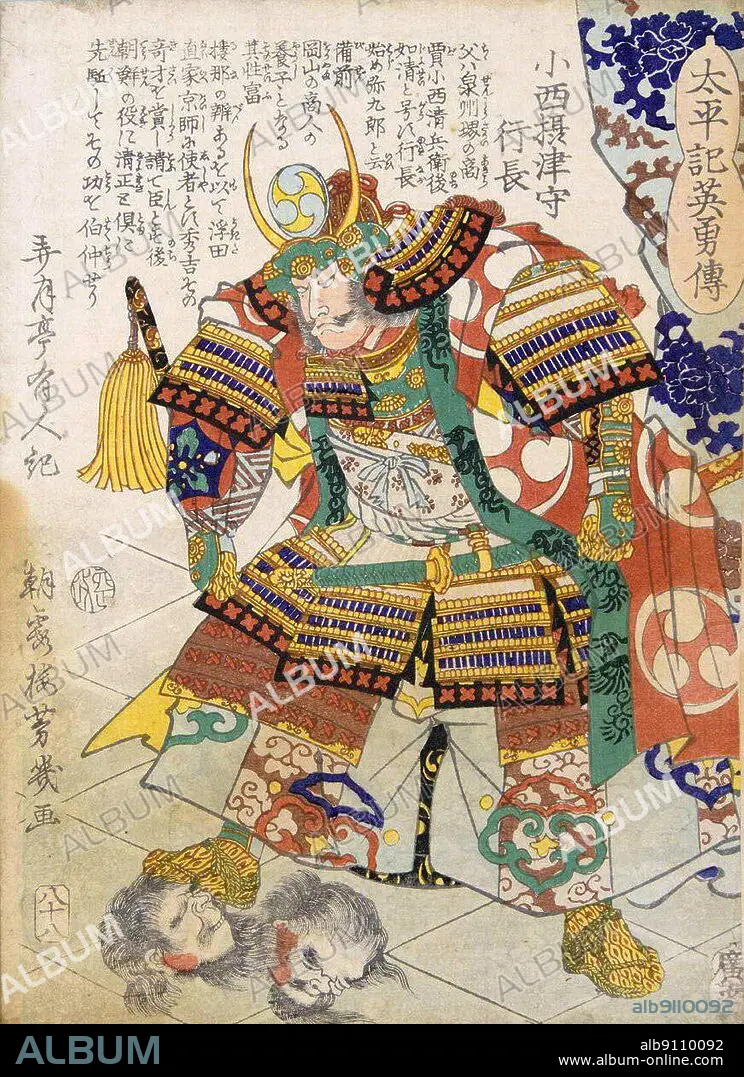
Daimyo Konishi
| Teilen |
|---|
 Pinterest Pinterest |
 Twitter Twitter |
 Facebook Facebook |
 Link kopieren Link kopieren |
 Email Email |
|
Zu einem anderen Lightbox hinzufügen |
|
Zu einem anderen Lightbox hinzufügen |


Haben Sie bereits ein Konto? Anmelden
Sie haben kein Konto? Registrieren
Dieses Bild kaufen.
Nutzung auswählen:

Titel: Daimyo Konishi
Untertitel: Siehe automatische Übersetzung
Konishi Yukinaga (1555 - 1600 ) Japanese samurai and daimyo under the command of Toyotomi Hideyoshi during the Azuchi-Momoyama period of Japanese history . In 1587, during the invasion of Kyushu, he quelled a local revolt in the province of Figa so he was rewarded with a fief in that province. Yukinaga commanded the first troops sent during the Japanese invasions of Korea, where he stood out for the capture of Busan and Seoul and the defense of Pyongyang.. After Hideyoshi's death, Yukinaga joined Ishida Mitsunari 's side during the Battle of Sekigahara in 1600, where he defeated Tokugawa Ieyasu's side and had to flee to Mount Ibuki but was later captured. Having converted to Christianity, he refused to commit Seppuku (a form of Japanese ritual suicide by disembowelment, it was originally reserved for samurai in their code of honor but was also practiced by other Japanese people during the Showa period to restore honor for themselves or for their families). He was executed.
Konishi Yukinaga (1555 - 1600 ) Japanese samurai and daimyo under the command of Toyotomi Hideyoshi during the Azuchi-Momoyama period of Japanese history . In 1587, during the invasion of Kyushu, he quelled a local revolt in the province of Figa so he was rewarded with a fief in that province. Yukinaga commanded the first troops sent during the Japanese invasions of Korea, where he stood out for the capture of Busan and Seoul and the defense of Pyongyang.. After Hideyoshi's death, Yukinaga joined Ishida Mitsunari 's side during the Battle of Sekigahara in 1600, where he defeated Tokugawa Ieyasu's side and had to flee to Mount Ibuki but was later captured. Having converted to Christianity, he refused to commit Seppuku (a form of Japanese ritual suicide by disembowelment, it was originally reserved for samurai in their code of honor but was also practiced by other Japanese people during the Showa period to restore honor for themselves or for their families). He was executed.
Bildnachweis: Album / Universal History Archive/Universal Images Group
Freigaben (Releases): ? Modellfreigabe: Nein - ? Eigentumsfreigabe: Nein
Rechtefragen?
Rechtefragen?
Bildgröße: 3904 × 5372 px | 60.0 MB
Druckgröße: 33.1 × 45.5 cm | 1537.0 × 2115.0 in (300 dpi)
Schlüsselwörter: 16. JAHRHUNDERT • 16. JH. • 17. JAHRHUNDERT • 17. JH. • BESATZUNG • CHRISTENTUM • EHRE • FREITOD • INVASION • JAPAN • JAPANER • JAPANERIN • JAPANISCH • KOREANISCH • ORMNAMENT: JAPANISCH • RITUELL • SAMURAI (VOELKERKUNDE) • SAMURAI (VÖLKERKUNDE) • SELBSTMORD • SELBSTTOETUNG • SUIZID • TOD DURCH SELBSTMORD
