

alb3661540
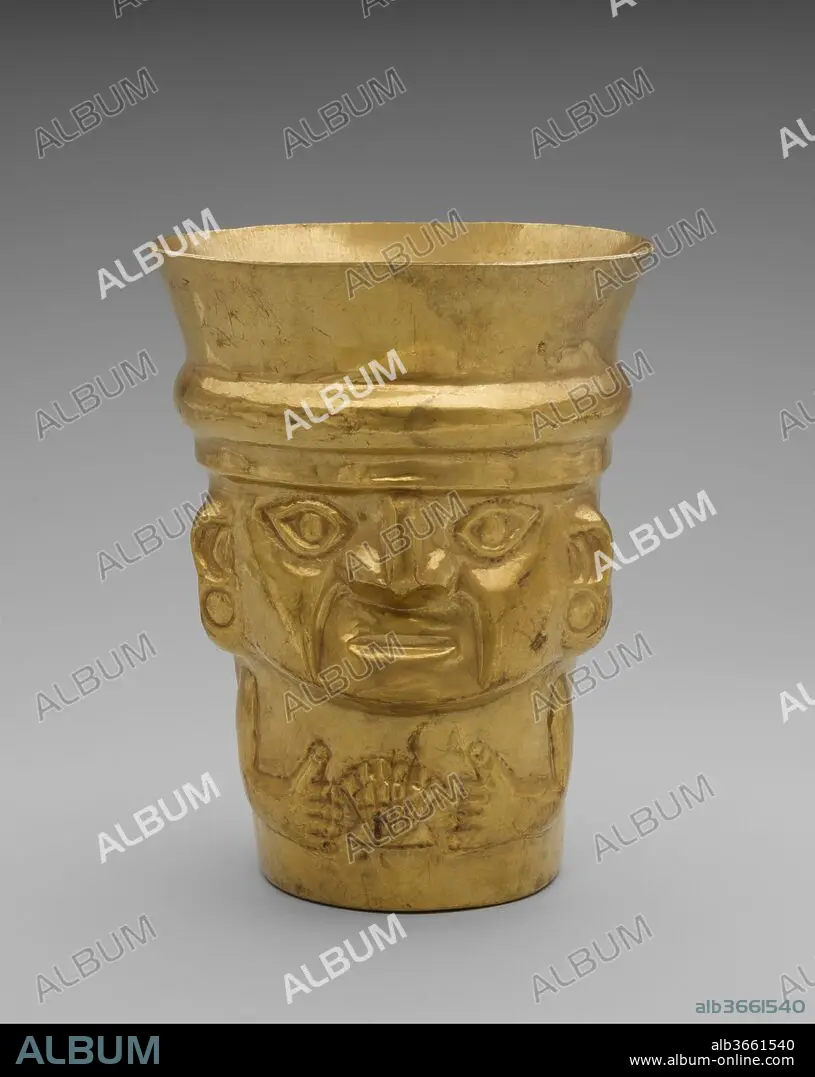
Beaker with Figure Displaying a Shell
| Teilen |
|---|
 Pinterest Pinterest |
 Twitter Twitter |
 Facebook Facebook |
 Link kopieren Link kopieren |
 Email Email |
|
Zu einem anderen Lightbox hinzufügen |
|
Zu einem anderen Lightbox hinzufügen |


Haben Sie bereits ein Konto? Anmelden
Sie haben kein Konto? Registrieren
Dieses Bild kaufen.
Nutzung auswählen:

Titel: Beaker with Figure Displaying a Shell
Untertitel: Siehe automatische Übersetzung
Beaker with Figure Displaying a Shell. Culture: Lambayeque (Sicán). Dimensions: H. 10 3/8 x Diam. 8 in. (26.4 x 20.3 cm). Date: A.D. 900-1100. These drinking vessels were likely used in ceremonial feasts before they were deposited in a high-status tomb. The beaker shows an individual clasping a Spondylus shell. Production of silver and gold objects in the Lambayeque culture reached epic proportions, and dozens, even hundreds, of vessels were placed in a single burial. Beakers were created in a centralized workshop. Estas copas de oro eran probablemente utilizadas en festines ceremoniales antes de ser colocadas en tumbas de personajes de alto rango. La producción de objetos de oro y plata en la cultura Lambayeque alcanzó proporciones históricas, con decenas o incluso centenares de vasijas colocadas en una única tumba. Sin duda las copas eran fabricadas en talleres centralizados, en los que los lingotes de dimensiones estándar eran transformados en objetos. Una de las copas presenta un personaje sujetando una concha Spondylus; la otra copa representa a una deidad en posición invertida. La orientación de la cara de la deidad se puede relacionar con prácticas rituales y con el consumo del líquido contenido en la copa. This gold drinking vessel in the shape of a figure displaying a shell comes from the Lambayeque culture of Peru's north coast and was created for use in ceremonial feasts before it was eventually deposited in the tomb of a high-status individual. This type of vessel shape originated in the south-central Andes, where tall ceramic beakers with flaring rims were popular in the earlier Tiwanaku and Wari cultures. A few examples of beakers made of precious metals and sculpted in the shape of a head are known from these southern cultures, but they do not appear to have been made in large quantities. After the ninth century A.D., however, vessels made of precious metals were made in greater numbers farther north, in the Lambayeque region, near the modern city of Chiclayo. Prior to this time, ritual vessels on the north coast were made in the shape of goblets, and probably exclusively of fired clay. By the beginning of the Late Intermediate period, or around 1000 A.D., production of objects of silver and gold reached epic proportions. As many as 176 gold beakers were said to have been found in a single tomb at the site of Batán Grande, a large ritual center of the Lambayeque culture (also known as Sicán) in the La Leche River Valley. Reportedly arranged in groups of ten according to size, shape, and iconography, the beakers were undoubtedly created in a centralized workshop, using standard-size ingots or blanks that were then shaped over a form. The sheer number and quality of the works speak to the Lambayeque lords' prodigious workshops and their control over resources. Great skill would have been required to create this embossed beaker. Fashioned from a single sheet of an alloy of gold, silver, and copper, it was carefully shaped over a wood form, taking care to prevent cracking as the metal was stretched and manipulated. Some forms included facial features, but specific details could also be enhanced by working the vessel freehand. Beakers were made in multiples, and vessels with highly similar, although not identical, imagery are known both in gold (66.196.27) and in silver (Brooklyn Museum, Dallas Museum of Fine Arts, Saint Louis Art Museum). This vessel was worked in high relief in the shape of the torso and large head of an individual wearing a cap (terminating in the flaring rim of the vessel), and shown with a shell between the hands. One side of the beaker features the embossed face and hands, while the other side is rendered as the back of the individual's head, conveying the impression that the body is the vessel. The almond-shaped eyes are less stylized that other Lambayeque faces (see 1974.271.35), suggesting the possibility that the individual depicted may be more human than divine. The figure is shown wearing round ear ornaments, a characteristic feature of high-status individuals. The hair is rendered at the back of the vessel in two layers; the longer layer is decorated at the bottom with a row of disks. Wide bands with a chevron pattern hang down from the cap over the hair, meeting in a central medallion of two concentric circles surrounded by seven smaller ones. The shell between the figure's hands is most likely Spondylus, a bivalve found in the warm tropical waters north of the Santa Elena Peninsula in Ecuador. This spiky shell, often called the thorny oyster, was prized for its rich color (ranging from red to orange to purple) and used to create exquisite ornaments (see 2003.169). The shell was closely associated with ideas of fertility and abundance, and valves have been found as offerings in agricultural fields as well as in tombs. According to accounts from the early colonial period, the royal courts on the north coast of Peru included a courtier whose task it was to scatter shell dust where the ruler was to walk. Vessels with Spondylus imagery may speak to the holder's ability to obtain this precious shell, and through it the blessings of abundance for a broader community. The substantial size of this vessel suggests that it could have once contained a significant amount of liquid. Such beakers were presumably designed for the consumption of chicha, a maize beer that was at the heart of ceremonial activities. Vessels of precious metals were undoubtedly restricted to the highest echelons of Lambayeque society--both men and women--and were critical components in the maintenance of rulership on Peru's north coast through the early colonial period. Joanne Pillsbury, Andrall E. Pearson Curator, 2015
Beaker with Figure Displaying a Shell. Culture: Lambayeque (Sicán). Dimensions: H. 10 3/8 x Diam. 8 in. (26.4 x 20.3 cm). Date: A.D. 900-1100. These drinking vessels were likely used in ceremonial feasts before they were deposited in a high-status tomb. The beaker shows an individual clasping a Spondylus shell. Production of silver and gold objects in the Lambayeque culture reached epic proportions, and dozens, even hundreds, of vessels were placed in a single burial. Beakers were created in a centralized workshop. Estas copas de oro eran probablemente utilizadas en festines ceremoniales antes de ser colocadas en tumbas de personajes de alto rango. La producción de objetos de oro y plata en la cultura Lambayeque alcanzó proporciones históricas, con decenas o incluso centenares de vasijas colocadas en una única tumba. Sin duda las copas eran fabricadas en talleres centralizados, en los que los lingotes de dimensiones estándar eran transformados en objetos. Una de las copas presenta un personaje sujetando una concha Spondylus; la otra copa representa a una deidad en posición invertida. La orientación de la cara de la deidad se puede relacionar con prácticas rituales y con el consumo del líquido contenido en la copa. This gold drinking vessel in the shape of a figure displaying a shell comes from the Lambayeque culture of Peru's north coast and was created for use in ceremonial feasts before it was eventually deposited in the tomb of a high-status individual. This type of vessel shape originated in the south-central Andes, where tall ceramic beakers with flaring rims were popular in the earlier Tiwanaku and Wari cultures. A few examples of beakers made of precious metals and sculpted in the shape of a head are known from these southern cultures, but they do not appear to have been made in large quantities. After the ninth century A.D., however, vessels made of precious metals were made in greater numbers farther north, in the Lambayeque region, near the modern city of Chiclayo. Prior to this time, ritual vessels on the north coast were made in the shape of goblets, and probably exclusively of fired clay. By the beginning of the Late Intermediate period, or around 1000 A.D., production of objects of silver and gold reached epic proportions. As many as 176 gold beakers were said to have been found in a single tomb at the site of Batán Grande, a large ritual center of the Lambayeque culture (also known as Sicán) in the La Leche River Valley. Reportedly arranged in groups of ten according to size, shape, and iconography, the beakers were undoubtedly created in a centralized workshop, using standard-size ingots or blanks that were then shaped over a form. The sheer number and quality of the works speak to the Lambayeque lords' prodigious workshops and their control over resources. Great skill would have been required to create this embossed beaker. Fashioned from a single sheet of an alloy of gold, silver, and copper, it was carefully shaped over a wood form, taking care to prevent cracking as the metal was stretched and manipulated. Some forms included facial features, but specific details could also be enhanced by working the vessel freehand. Beakers were made in multiples, and vessels with highly similar, although not identical, imagery are known both in gold (66.196.27) and in silver (Brooklyn Museum, Dallas Museum of Fine Arts, Saint Louis Art Museum). This vessel was worked in high relief in the shape of the torso and large head of an individual wearing a cap (terminating in the flaring rim of the vessel), and shown with a shell between the hands. One side of the beaker features the embossed face and hands, while the other side is rendered as the back of the individual's head, conveying the impression that the body is the vessel. The almond-shaped eyes are less stylized that other Lambayeque faces (see 1974.271.35), suggesting the possibility that the individual depicted may be more human than divine. The figure is shown wearing round ear ornaments, a characteristic feature of high-status individuals. The hair is rendered at the back of the vessel in two layers; the longer layer is decorated at the bottom with a row of disks. Wide bands with a chevron pattern hang down from the cap over the hair, meeting in a central medallion of two concentric circles surrounded by seven smaller ones. The shell between the figure's hands is most likely Spondylus, a bivalve found in the warm tropical waters north of the Santa Elena Peninsula in Ecuador. This spiky shell, often called the thorny oyster, was prized for its rich color (ranging from red to orange to purple) and used to create exquisite ornaments (see 2003.169). The shell was closely associated with ideas of fertility and abundance, and valves have been found as offerings in agricultural fields as well as in tombs. According to accounts from the early colonial period, the royal courts on the north coast of Peru included a courtier whose task it was to scatter shell dust where the ruler was to walk. Vessels with Spondylus imagery may speak to the holder's ability to obtain this precious shell, and through it the blessings of abundance for a broader community. The substantial size of this vessel suggests that it could have once contained a significant amount of liquid. Such beakers were presumably designed for the consumption of chicha, a maize beer that was at the heart of ceremonial activities. Vessels of precious metals were undoubtedly restricted to the highest echelons of Lambayeque society--both men and women--and were critical components in the maintenance of rulership on Peru's north coast through the early colonial period. Joanne Pillsbury, Andrall E. Pearson Curator, 2015
Technik/Material: GOLD
Museum: Metropolitan Museum of Art, New York, USA
Bildnachweis: Album
Freigaben (Releases): ? Modellfreigabe: Nein - ? Eigentumsfreigabe: Nein
Rechtefragen?
Rechtefragen?
Bildgröße: 3351 × 4208 px | 40.3 MB
Druckgröße: 28.4 × 35.6 cm | 1319.3 × 1656.7 in (300 dpi)
Schlüsselwörter: METROPOLITAN MUSEUM OF ART, NEW YORK, USA • PERU • PERU, NORTH COAST • SOUTH AMERICA
