

alb3674111
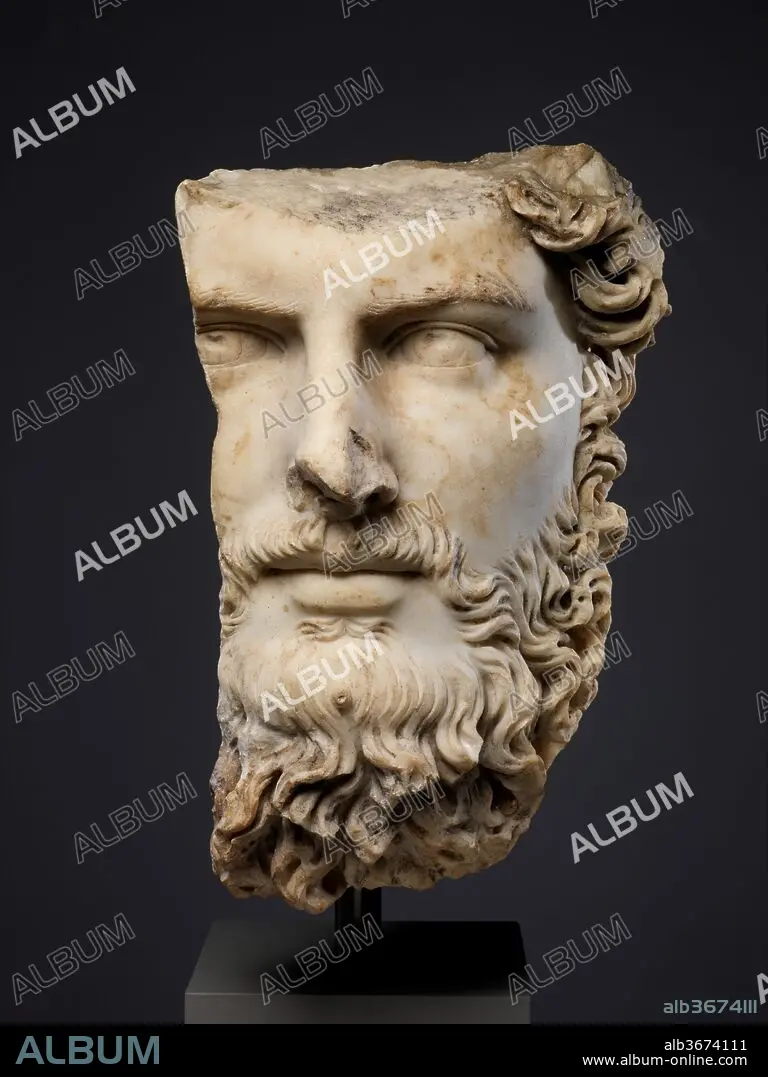
Marble portrait of the co-emperor Lucius Verus
| Teilen |
|---|
 Pinterest Pinterest |
 Twitter Twitter |
 Facebook Facebook |
 Link kopieren Link kopieren |
 Email Email |
|
Zu einem anderen Lightbox hinzufügen |
|
Zu einem anderen Lightbox hinzufügen |


Haben Sie bereits ein Konto? Anmelden
Sie haben kein Konto? Registrieren
Dieses Bild kaufen.
Nutzung auswählen:

Titel: Marble portrait of the co-emperor Lucius Verus
Untertitel: Siehe automatische Übersetzung
Marble portrait of the co-emperor Lucius Verus. Culture: Roman. Dimensions: H. 14 1/2 in. (36.8 cm). Date: A.D. 161-169. This fragmentary head comes from an over-life-sized portrait bust or statue of Lucius Verus, co-emperor with Marcus Aurelius (r. A.D. 161-180). At the beginning of his reign, Verus was sent to the East to direct military operations against the Parthians, and although the war was concluded successfully in A.D. 166, his returning troops brought back the plague, which ravaged the Empire for several years thereafter. He is compared unfavorably with Marcus Aurelius by the ancient sources, but the portrait shown here has a leonine majesty that gives little indication of his reputation as an idle and dissolute ruler. It is typical of Antonine style in its use of luxuriant drillwork in the hair and engraved eyes to dramatize the basically naturalistic image.
Marble portrait of the co-emperor Lucius Verus. Culture: Roman. Dimensions: H. 14 1/2 in. (36.8 cm). Date: A.D. 161-169. This fragmentary head comes from an over-life-sized portrait bust or statue of Lucius Verus, co-emperor with Marcus Aurelius (r. A.D. 161-180). At the beginning of his reign, Verus was sent to the East to direct military operations against the Parthians, and although the war was concluded successfully in A.D. 166, his returning troops brought back the plague, which ravaged the Empire for several years thereafter. He is compared unfavorably with Marcus Aurelius by the ancient sources, but the portrait shown here has a leonine majesty that gives little indication of his reputation as an idle and dissolute ruler. It is typical of Antonine style in its use of luxuriant drillwork in the hair and engraved eyes to dramatize the basically naturalistic image.
Technik/Material: Marble
Zeitraum: Mid-Imperial, Antonine
Museum: Metropolitan Museum of Art, New York, USA
Standort: ROMAN EMPIRE
Bildnachweis: Album
Freigaben (Releases): ? Modellfreigabe: Nein - ? Eigentumsfreigabe: Nein
Rechtefragen?
Rechtefragen?
Bildgröße: 3202 × 4268 px | 39.1 MB
Druckgröße: 27.1 × 36.1 cm | 1260.6 × 1680.3 in (300 dpi)
Schlüsselwörter: FELSEN • GESTEIN • MARMOR • METROPOLITAN MUSEUM OF ART, NEW YORK, USA • ROMAN EMPIRE • STEIN
