

alb3658214
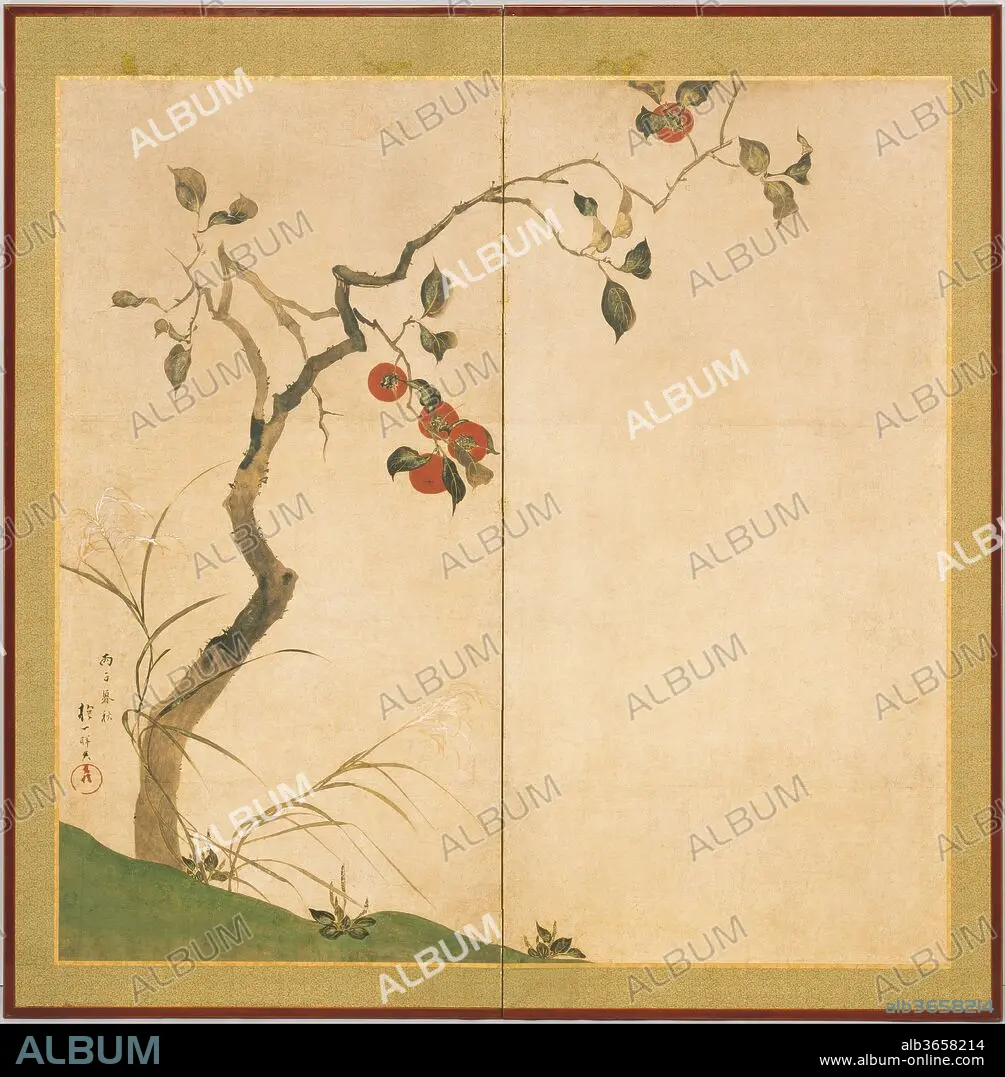
SAKAI HOITSU. Persimmon Tree
| Teilen |
|---|
 Pinterest Pinterest |
 Twitter Twitter |
 Facebook Facebook |
 Link kopieren Link kopieren |
 Email Email |
|
Zu einem anderen Lightbox hinzufügen |
|
Zu einem anderen Lightbox hinzufügen |


Haben Sie bereits ein Konto? Anmelden
Sie haben kein Konto? Registrieren
Dieses Bild kaufen.
Nutzung auswählen:

Autor: SAKAI HOITSU (1761-1828)
Titel: Persimmon Tree
Untertitel: Siehe automatische Übersetzung
Persimmon Tree. Artist: Sakai Hoitsu (Japanese, 1761-1828). Culture: Japan. Dimensions: Image: 56 9/16 x 56 5/8 in. (143.7 x 143.8 cm) Overall: 65 1/4 x 64 in. (165.7 x 162.6 cm). Date: 1816. This painting, while exhibiting the trademark mottled-ink (tarashikomi) technique of the Rinpa school, reflects the artist's interest in Western-style realism, which is combined with sophisticated, graceful forms. The intricately curling leaves of the tree and grass evoke the cold sky of the clear fall day alluded to in the inscription, which dates the screen to late autumn 1816. Hoitsu was born into a wealthy, influential samurai family and had all the advantages of the finest education, including the opportunity to study many of the painting styles available to artists in Edo Japan. He became a monk in 1797 and adopted the priestly name Monsen Kishin, which appears in the seal and signature on this screen.
Persimmon Tree. Artist: Sakai Hoitsu (Japanese, 1761-1828). Culture: Japan. Dimensions: Image: 56 9/16 x 56 5/8 in. (143.7 x 143.8 cm) Overall: 65 1/4 x 64 in. (165.7 x 162.6 cm). Date: 1816. This painting, while exhibiting the trademark mottled-ink (tarashikomi) technique of the Rinpa school, reflects the artist's interest in Western-style realism, which is combined with sophisticated, graceful forms. The intricately curling leaves of the tree and grass evoke the cold sky of the clear fall day alluded to in the inscription, which dates the screen to late autumn 1816. Hoitsu was born into a wealthy, influential samurai family and had all the advantages of the finest education, including the opportunity to study many of the painting styles available to artists in Edo Japan. He became a monk in 1797 and adopted the priestly name Monsen Kishin, which appears in the seal and signature on this screen.
Technik/Material: Two-panel folding screen; ink and color on paper
Zeitraum: Edo period (1615-1868)
Museum: Metropolitan Museum of Art, New York, USA
Bildnachweis: Album
Bildgröße: 3837 × 3908 px | 42.9 MB
Druckgröße: 32.5 × 33.1 cm | 1510.6 × 1538.6 in (300 dpi)
Schlüsselwörter: ASIA • ASIATISCHE KUNST • JAPAN • METROPOLITAN MUSEUM OF ART, NEW YORK, USA • SAKAI HOITSU • TINTE
