

alb3817345
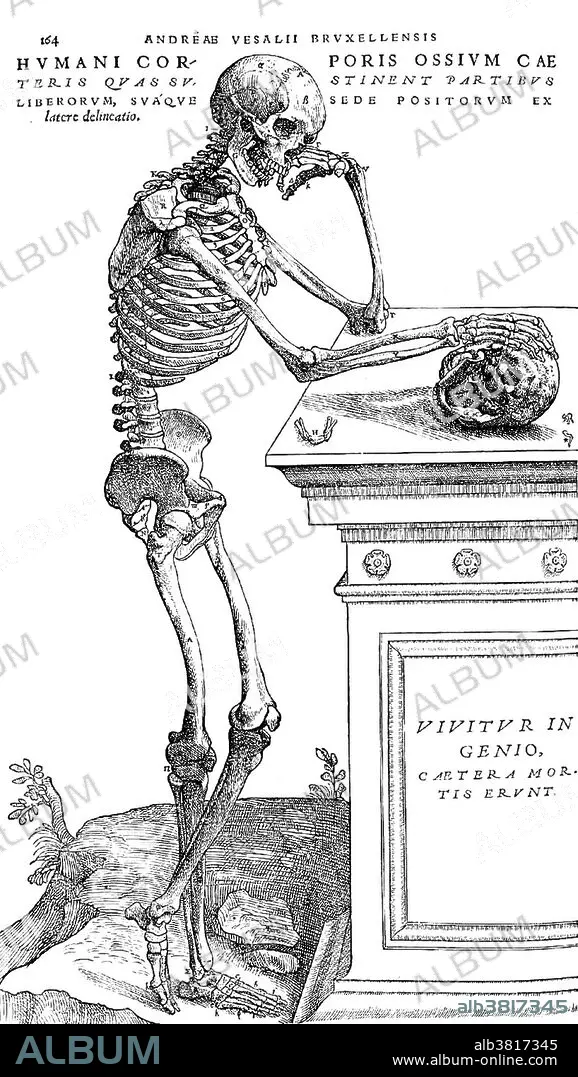
Skeletal Anatomy, Vesalius, 16th Century
| Teilen |
|---|
 Pinterest Pinterest |
 Twitter Twitter |
 Facebook Facebook |
 Link kopieren Link kopieren |
 Email Email |
|
Zu einem anderen Lightbox hinzufügen |
|
Zu einem anderen Lightbox hinzufügen |


Haben Sie bereits ein Konto? Anmelden
Sie haben kein Konto? Registrieren
Dieses Bild kaufen.
Nutzung auswählen:

Titel: Skeletal Anatomy, Vesalius, 16th Century
Untertitel: Siehe automatische Übersetzung
A skeleton appears to be contemplating human mortality. With elbow resting on top of a tomb, head leaning on one hand, the skeleton grasps a skull with its other hand in a contemplative pose. De Humani Corporis Fabrica (On the Fabric of the Human Body) is one of the most influential works in the history of Western medicine. It was conceived and written by 28 year old Andreas Vesalius (December 31, 1514 - October 15, 1564) a Belgian anatomist and physician. He was a professor at the University of Padua and later became Imperial physician at the court of Emperor Charles V. He was both a gifted dissector and a learned scholar whose great contribution was to apply to anatomy the critical methods developed by the Renaissance humanist scholars. In 1564 he went on a pilgrimage to the Holy Land. When he reached Jerusalem, he received a message requesting he again accept the Paduan professorship, which had become vacant. The ship he sailed on was wrecked on the island of Zakynthos. Here he soon died in such debt that a benefactor paid for his funeral. He was 49 years old.
A skeleton appears to be contemplating human mortality. With elbow resting on top of a tomb, head leaning on one hand, the skeleton grasps a skull with its other hand in a contemplative pose. De Humani Corporis Fabrica (On the Fabric of the Human Body) is one of the most influential works in the history of Western medicine. It was conceived and written by 28 year old Andreas Vesalius (December 31, 1514 - October 15, 1564) a Belgian anatomist and physician. He was a professor at the University of Padua and later became Imperial physician at the court of Emperor Charles V. He was both a gifted dissector and a learned scholar whose great contribution was to apply to anatomy the critical methods developed by the Renaissance humanist scholars. In 1564 he went on a pilgrimage to the Holy Land. When he reached Jerusalem, he received a message requesting he again accept the Paduan professorship, which had become vacant. The ship he sailed on was wrecked on the island of Zakynthos. Here he soon died in such debt that a benefactor paid for his funeral. He was 49 years old.
Bildnachweis: Album / NLM/Science Source
Freigaben (Releases): ? Modellfreigabe: Nein - ? Eigentumsfreigabe: Nein
Rechtefragen?
Rechtefragen?
Bildgröße: 3000 × 5311 px | 45.6 MB
Druckgröße: 25.4 × 45.0 cm | 1181.1 × 2090.9 in (300 dpi)
Schlüsselwörter: 16. JAHRHUNDERT • 16. JH. • ANATOMIE • BERÜHMT • BERÜHMTE PERSÖNLICHKEIT • BIOLOGIE • BLOCK-DRUCK • GEM • GEMME • HOLZARBEIT: SCHNITZEREI • ILLUSTRATION • ILLUSTRATIONS • KAMEE • NOTABEL • PROMINENZ • SCHNITZEREI: HOLZ • TECHNIK: HOLZSCHNITT
