

alb3602534
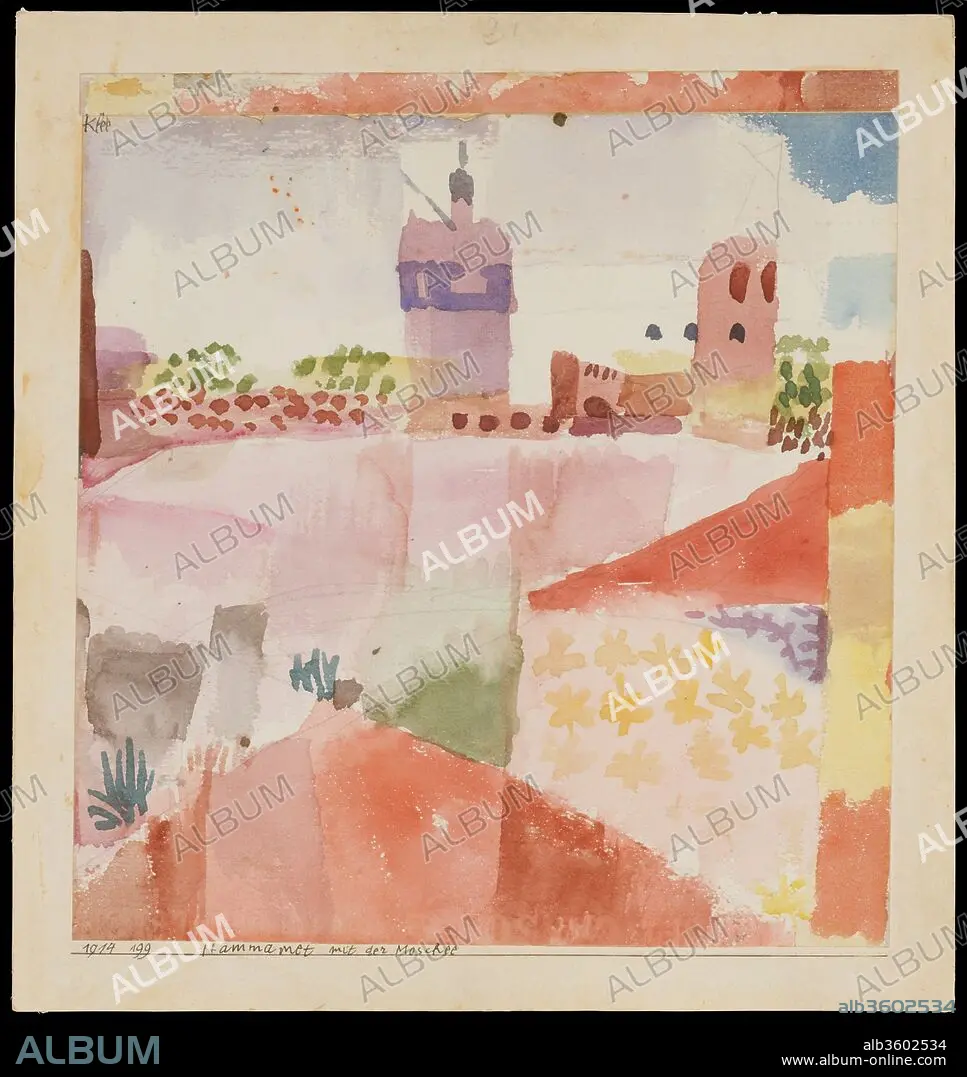
PAUL KLEE. Hammamet with Its Mosque
| Teilen |
|---|
 Pinterest Pinterest |
 Twitter Twitter |
 Facebook Facebook |
 Link kopieren Link kopieren |
 Email Email |
|
Zu einem anderen Lightbox hinzufügen |
|
Zu einem anderen Lightbox hinzufügen |


Haben Sie bereits ein Konto? Anmelden
Sie haben kein Konto? Registrieren
Dieses Bild kaufen.
Nutzung auswählen:

Autor: Paul Klee (1879-1940)
Titel: Hammamet with Its Mosque
Untertitel: Siehe automatische Übersetzung
Hammamet with Its Mosque. Artist: Paul Klee (German (born Switzerland), Münchenbuchsee 1879-1940 Muralto-Locarno). Dimensions: 9 3/8 × 8 3/4 in. (23.8 × 22.2 cm). Date: 1914. Klee's artistic training, which began in 1898, when he went to Munich for three years to learn to draw and paint, can be said to have lasted until 1914, when he visited Tunisia. The light of North Africa aroused in him a sense of color, and there Klee made his now-famous statement: "Color and I are one. I am a painter." On April 14, 1914, Klee visited Hammamet, a small town on the Mediterranean, northwest of Tunis. He captured a view of the city in Hammamet with Its Mosque, a watercolor painted from outside the city walls. As happens so often in Klee's works, the picture consists of representational as well as nonrepresentational elements. The upper part shows the mosque surrounded by two towers and gardens; the lower area is made up of translucent color planes, following Robert Delaunay's (1885-1941) example of making pure color and its contrasts the sole subject of a picture. With Heinz Berggruen's gift of ninety works by Paul Klee, the Museum became an important center for the study of the artist. The outstanding examples that Berggruen gathered span Klee's entire career, from his student days in Bern during the 1890s until his death in 1940. Comprehensive in its variety and extraordinary in its quality, The Berggruen Klee Collection comprises eleven oil paintings, seventy-one watercolors, and eight black-on-white drawings.
Hammamet with Its Mosque. Artist: Paul Klee (German (born Switzerland), Münchenbuchsee 1879-1940 Muralto-Locarno). Dimensions: 9 3/8 × 8 3/4 in. (23.8 × 22.2 cm). Date: 1914. Klee's artistic training, which began in 1898, when he went to Munich for three years to learn to draw and paint, can be said to have lasted until 1914, when he visited Tunisia. The light of North Africa aroused in him a sense of color, and there Klee made his now-famous statement: "Color and I are one. I am a painter." On April 14, 1914, Klee visited Hammamet, a small town on the Mediterranean, northwest of Tunis. He captured a view of the city in Hammamet with Its Mosque, a watercolor painted from outside the city walls. As happens so often in Klee's works, the picture consists of representational as well as nonrepresentational elements. The upper part shows the mosque surrounded by two towers and gardens; the lower area is made up of translucent color planes, following Robert Delaunay's (1885-1941) example of making pure color and its contrasts the sole subject of a picture. With Heinz Berggruen's gift of ninety works by Paul Klee, the Museum became an important center for the study of the artist. The outstanding examples that Berggruen gathered span Klee's entire career, from his student days in Bern during the 1890s until his death in 1940. Comprehensive in its variety and extraordinary in its quality, The Berggruen Klee Collection comprises eleven oil paintings, seventy-one watercolors, and eight black-on-white drawings.
Technik/Material: Watercolor and graphite on paper mounted on cardboard
Museum: Metropolitan Museum of Art, New York, USA
Bildnachweis: Album
Bildgröße: 3645 × 3860 px | 40.3 MB
Druckgröße: 30.9 × 32.7 cm | 1435.0 × 1519.7 in (300 dpi)
Schlüsselwörter: EUROPA (KONTINENT) • GERMANY • METROPOLITAN MUSEUM OF ART, NEW YORK, USA • PAUL KLEE • ZEICHNUNGEN
