

alb3647694
CHARLES MARVILLE. La Bievre
| Teilen |
|---|
 Pinterest Pinterest |
 Twitter Twitter |
 Facebook Facebook |
 Link kopieren Link kopieren |
 Email Email |
|
Zu einem anderen Lightbox hinzufügen |
|
Zu einem anderen Lightbox hinzufügen |


Haben Sie bereits ein Konto? Anmelden
Sie haben kein Konto? Registrieren
Dieses Bild kaufen.
Nutzung auswählen:

Titel: La Bievre
Untertitel: Siehe automatische Übersetzung
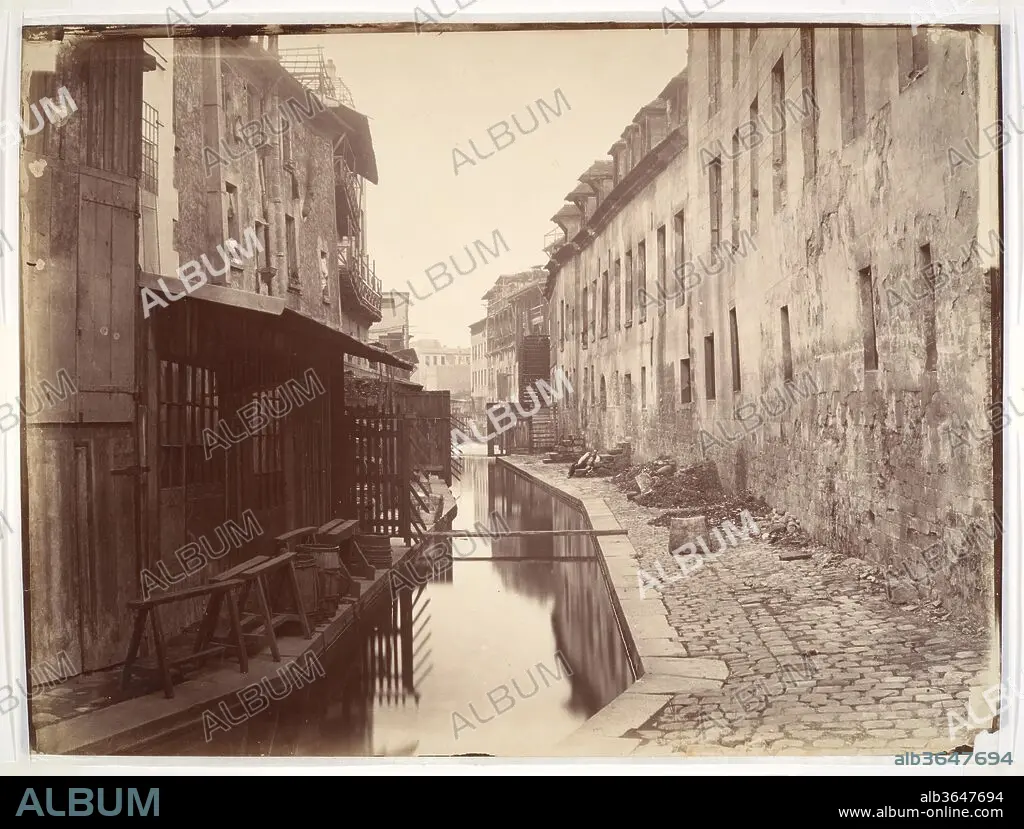
La Bièvre. Artist: Charles Marville (French, Paris 1813-1879 Paris). Dimensions: 27.8 x 37.6 cm. (10 15/16 x 14 13/16 in.). Date: ca. 1865. As the official "photographer of the city of Paris," Charles Marville was charged with documenting the massive transformation of the city brought about by Napoleon III and his city planner, Baron Haussmann. In the early 1850s the Emperor proposed a network of grand boulevards that would plow through the narrow winding streets and overcrowded slums of Paris. Marville methodically recorded the streets and buildings slated for demolition, preserving an image for future generations. Although we may now look back at pictures like this one with nostalgia for a lost Paris, to Marville and his audience such scenes evoked a less bucolic reality-the Bièvre was essentially a waste system for twenty-four tanneries, twenty-one leather factories, nine starch and three dye manufacturers, a paper mill, two cotton and two flour mills, four laundries, a soap and candle factory, and assorted other industries. Shortly after Marville made this photograph, the Bièvre was simply covered over and tied into the Paris sewer system. One motivation for Napoleon III's urban plan was to ease military movement and make it more difficult for revolutionaries to barricade narrow streets and control sections of Paris, but many of his efforts were genuinely geared toward transforming Paris into a safer, healthier, more modern city.
La Bièvre. Artist: Charles Marville (French, Paris 1813-1879 Paris). Dimensions: 27.8 x 37.6 cm. (10 15/16 x 14 13/16 in.). Date: ca. 1865. As the official "photographer of the city of Paris," Charles Marville was charged with documenting the massive transformation of the city brought about by Napoleon III and his city planner, Baron Haussmann. In the early 1850s the Emperor proposed a network of grand boulevards that would plow through the narrow winding streets and overcrowded slums of Paris. Marville methodically recorded the streets and buildings slated for demolition, preserving an image for future generations. Although we may now look back at pictures like this one with nostalgia for a lost Paris, to Marville and his audience such scenes evoked a less bucolic reality-the Bièvre was essentially a waste system for twenty-four tanneries, twenty-one leather factories, nine starch and three dye manufacturers, a paper mill, two cotton and two flour mills, four laundries, a soap and candle factory, and assorted other industries. Shortly after Marville made this photograph, the Bièvre was simply covered over and tied into the Paris sewer system. One motivation for Napoleon III's urban plan was to ease military movement and make it more difficult for revolutionaries to barricade narrow streets and control sections of Paris, but many of his efforts were genuinely geared toward transforming Paris into a safer, healthier, more modern city.
Technik/Material: Albumen silver print from glass negative
Museum: Metropolitan Museum of Art, New York, USA
Bildnachweis: Album
Bildgröße: 4166 × 3158 px | 37.6 MB
Druckgröße: 35.3 × 26.7 cm | 1640.2 × 1243.3 in (300 dpi)
Schlüsselwörter: CHARLES MARVILLE • EUROPA (KONTINENT) • FRANKREICH • METROPOLITAN MUSEUM OF ART, NEW YORK, USA
