

alb3803051
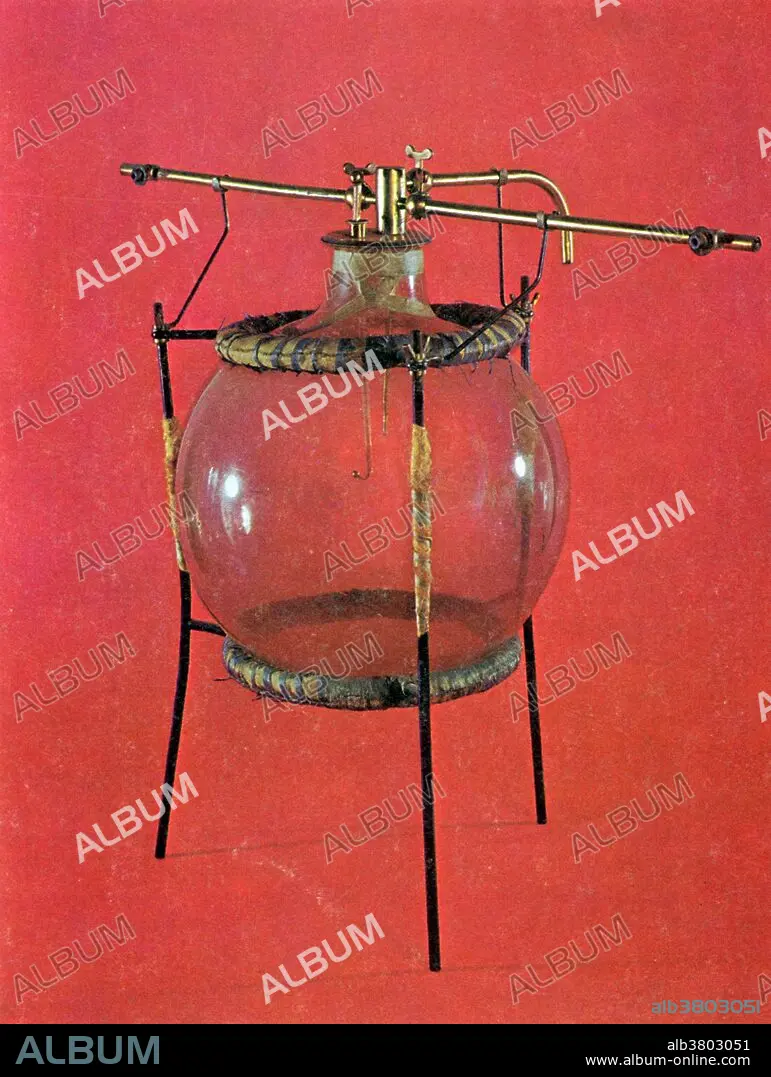
Lavoisier Laboratory Device
| Teilen |
|---|
 Pinterest Pinterest |
 Twitter Twitter |
 Facebook Facebook |
 Link kopieren Link kopieren |
 Email Email |
|
Zu einem anderen Lightbox hinzufügen |
|
Zu einem anderen Lightbox hinzufügen |


Haben Sie bereits ein Konto? Anmelden
Sie haben kein Konto? Registrieren
Dieses Bild kaufen.
Nutzung auswählen:

Titel: Lavoisier Laboratory Device
Untertitel: Siehe automatische Übersetzung
Water was shown to be a chemical compound of two gases, oxygen and hydrogen in this laboratory device built by Lavoisier. The two gases entered the flask through the brass tubes, and united chemically when exploded with an electric spark: there was a bang and drops of water were collected on the sides. Antoine-Laurent Lavoisier (August 26, 1743 - May 8, 1794) was a French chemist. He recognized and named oxygen and hydrogen, helped construct the metric system, wrote the first extensive list of elements, and helped to reform chemical nomenclature. He was the first to establish that sulfur was an element rather than a compound. He discovered that, although matter may change its form or shape, its mass always remains the same. His book Methods of Chemical Nomenclature of 1787 set the method of naming substances by their composition of elements, which is still used today. He was branded a traitor by the Convention under Robespierre during the Reign of Terror. He was tried, convicted, and guillotined on May 8, 1794, at the age of 50. A year and a half after his death, he was exonerated by the French government. When his private belongings were delivered to his widow, a brief note was included, reading "To the widow of Lavoisier, who was falsely convicted".
Water was shown to be a chemical compound of two gases, oxygen and hydrogen in this laboratory device built by Lavoisier. The two gases entered the flask through the brass tubes, and united chemically when exploded with an electric spark: there was a bang and drops of water were collected on the sides. Antoine-Laurent Lavoisier (August 26, 1743 - May 8, 1794) was a French chemist. He recognized and named oxygen and hydrogen, helped construct the metric system, wrote the first extensive list of elements, and helped to reform chemical nomenclature. He was the first to establish that sulfur was an element rather than a compound. He discovered that, although matter may change its form or shape, its mass always remains the same. His book Methods of Chemical Nomenclature of 1787 set the method of naming substances by their composition of elements, which is still used today. He was branded a traitor by the Convention under Robespierre during the Reign of Terror. He was tried, convicted, and guillotined on May 8, 1794, at the age of 50. A year and a half after his death, he was exonerated by the French government. When his private belongings were delivered to his widow, a brief note was included, reading "To the widow of Lavoisier, who was falsely convicted".
Bildnachweis: Album / Science Source / New York Public Library
Freigaben (Releases): ? Modellfreigabe: Nein - ? Eigentumsfreigabe: Nein
Rechtefragen?
Rechtefragen?
Bildgröße: 2700 × 3588 px | 27.7 MB
Druckgröße: 22.9 × 30.4 cm | 1063.0 × 1412.6 in (300 dpi)
Schlüsselwörter: 18. JAHRHUNDERT • 18. JH. • AUSRÜSTUNG • BERÜHMT • BERÜHMTE PERSÖNLICHKEIT • CHEMIE • CHEMIKER • EUROPAEER (F M) • EUROPAEER • EUROPÄER (F M) • EUROPÄER • EUROPÄISCH • LABOR • LABORATORIUM • NOTABEL • PROMINENZ • WISSENSCH.: CHEMIE • WISSENSCH.: LABORATORIUM
