

alb3808596
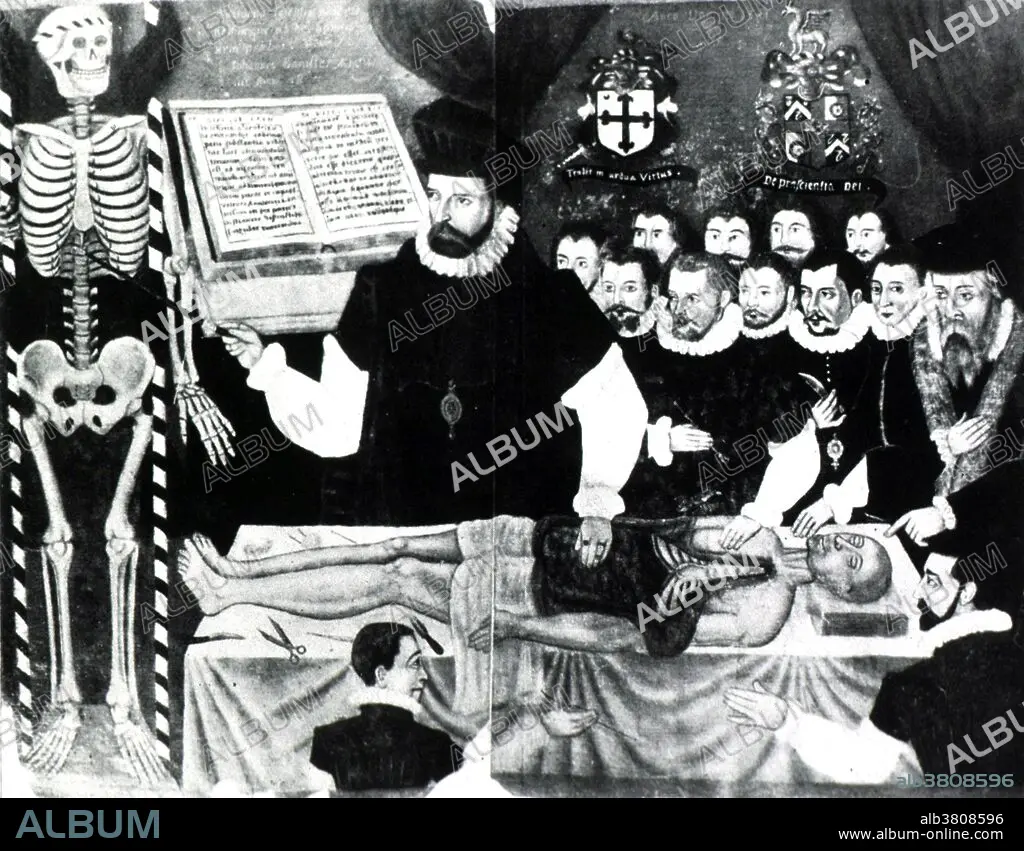
Anatomy Class Dissection, 1581
| Teilen |
|---|
 Pinterest Pinterest |
 Twitter Twitter |
 Facebook Facebook |
 Link kopieren Link kopieren |
 Email Email |
|
Zu einem anderen Lightbox hinzufügen |
|
Zu einem anderen Lightbox hinzufügen |


Haben Sie bereits ein Konto? Anmelden
Sie haben kein Konto? Registrieren
Dieses Bild kaufen.
Nutzung auswählen:

Titel: Anatomy Class Dissection, 1581
Untertitel: Siehe automatische Übersetzung
Entitled: "Dr. John Banister delivering the visceral lecture at the Barber-Surgeons' Hall in London, 1581." John Banister (1533-1610) was an English anatomist, surgeon and teacher. He published The Historie of Man, from the most approved Authorities in this Present Age in 1578. Human dissection is commonly practiced in the teaching of anatomy for students of medicine. No universal prohibition of dissection or autopsy was exercised during the Middle Ages. Rather, the era witnessed the revival of an interest in medical studies, and a renewal in human dissection and autopsy. Some European countries began legalizing the dissection of executed criminals for educational purposes in the late 13th and early 14th centuries, and Mondino de Liuzzi carried out the first recorded public dissection around 1315. Vesalius in the 16th century carried out numerous dissections in the process of performing some of the most extensive anatomical investigations up to his time, but was attacked frequently by other physicians for his disagreement with Galen's studies of human anatomy.
Entitled: "Dr. John Banister delivering the visceral lecture at the Barber-Surgeons' Hall in London, 1581." John Banister (1533-1610) was an English anatomist, surgeon and teacher. He published The Historie of Man, from the most approved Authorities in this Present Age in 1578. Human dissection is commonly practiced in the teaching of anatomy for students of medicine. No universal prohibition of dissection or autopsy was exercised during the Middle Ages. Rather, the era witnessed the revival of an interest in medical studies, and a renewal in human dissection and autopsy. Some European countries began legalizing the dissection of executed criminals for educational purposes in the late 13th and early 14th centuries, and Mondino de Liuzzi carried out the first recorded public dissection around 1315. Vesalius in the 16th century carried out numerous dissections in the process of performing some of the most extensive anatomical investigations up to his time, but was attacked frequently by other physicians for his disagreement with Galen's studies of human anatomy.
Bildnachweis: Album / NLM/Science Source
Freigaben (Releases): ? Modellfreigabe: Nein - ? Eigentumsfreigabe: Nein
Rechtefragen?
Rechtefragen?
Bildgröße: 4200 × 3275 px | 39.4 MB
Druckgröße: 35.6 × 27.7 cm | 1653.5 × 1289.4 in (300 dpi)
Schlüsselwörter: 16. JAHRHUNDERT • 16. JH. • ANATOMIE • AUTOPSIE • BADER • BERÜHMT • BERÜHMTE PERSÖNLICHKEIT • CHIRURG • ILLUSTRATION • ILLUSTRATIONS • KADAVER • KOERPER • KORPER • KÖRPER • LEICHE • MANN • NOTABEL • PERSON • PERSöNLICHKEITEN • PERSÖNLICHKEITEN • PHYSIOLOGIE • PROMINENZ • SEKTION • VORFÜHRUNG
