

alb3801634
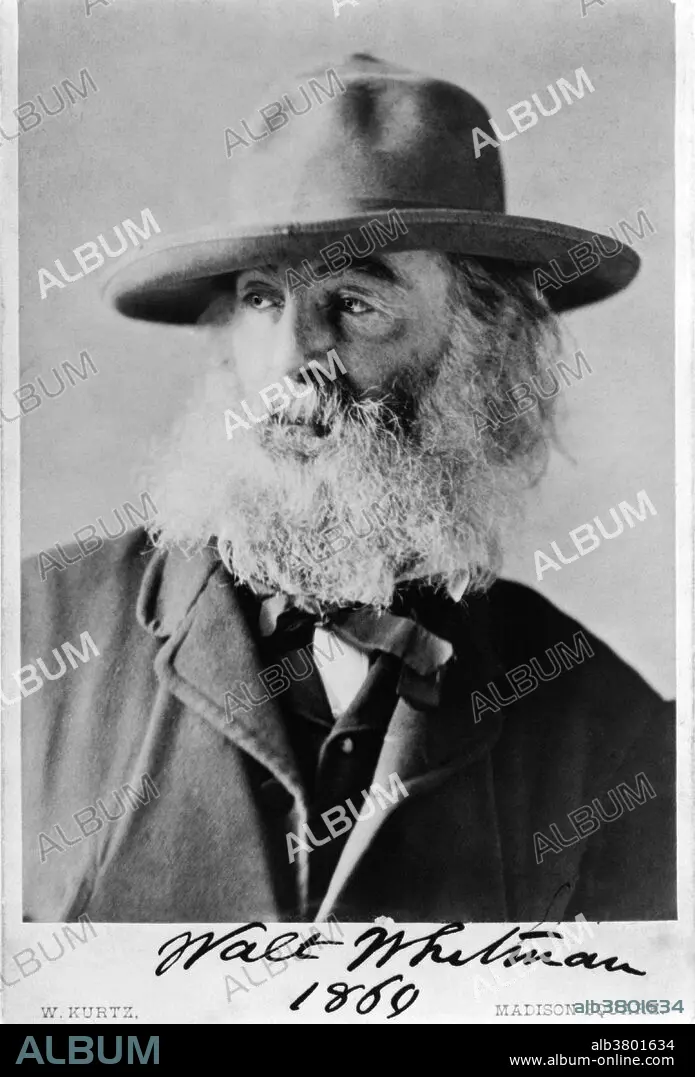
Walt Whitman, American Poet
| Teilen |
|---|
 Pinterest Pinterest |
 Twitter Twitter |
 Facebook Facebook |
 Link kopieren Link kopieren |
 Email Email |
|
Zu einem anderen Lightbox hinzufügen |
|
Zu einem anderen Lightbox hinzufügen |


Haben Sie bereits ein Konto? Anmelden
Sie haben kein Konto? Registrieren
Dieses Bild kaufen.
Nutzung auswählen:

Titel: Walt Whitman, American Poet
Untertitel: Siehe automatische Übersetzung
Portrait of Walt Whitman in 1869. W. Kurtz. Walter "Walt" Whitman (1819-1892) was an American poet, essayist and journalist. A humanist, he was a part of the transition between transcendentalism and realism, incorporating both views in his works. Whitman is among the most influential poets in the American canon, often called the father of free verse. His work was very controversial in its time, particularly his poetry collection Leaves of Grass, which was described as obscene for its overt sexuality. Deeply touched by a visit to a wartime hospital, Whitman spent much of the Civil War as a hospital volunteer, carefully documenting his experiences caring for the wounded. Whitman's work breaks the boundaries of poetic form and is generally prose-like. He used unusual images and symbols in his poetry and wrote openly about death and sexuality, including prostitution.
Portrait of Walt Whitman in 1869. W. Kurtz. Walter "Walt" Whitman (1819-1892) was an American poet, essayist and journalist. A humanist, he was a part of the transition between transcendentalism and realism, incorporating both views in his works. Whitman is among the most influential poets in the American canon, often called the father of free verse. His work was very controversial in its time, particularly his poetry collection Leaves of Grass, which was described as obscene for its overt sexuality. Deeply touched by a visit to a wartime hospital, Whitman spent much of the Civil War as a hospital volunteer, carefully documenting his experiences caring for the wounded. Whitman's work breaks the boundaries of poetic form and is generally prose-like. He used unusual images and symbols in his poetry and wrote openly about death and sexuality, including prostitution.
Bildnachweis: Album / Science Source / Library of Congress
Freigaben (Releases): ? Modellfreigabe: Nein - ? Eigentumsfreigabe: Nein
Rechtefragen?
Rechtefragen?
Bildgröße: 3091 × 4557 px | 40.3 MB
Druckgröße: 26.2 × 38.6 cm | 1216.9 × 1794.1 in (300 dpi)
Schlüsselwörter: AMERIKANER • BERÜHMT • BERÜHMTE PERSÖNLICHKEIT • MANN • NOTABEL • PERSON • PERSöNLICHKEITEN • PERSÖNLICHKEITEN • PORTRAIT • PROMINENZ
