

alb3649795
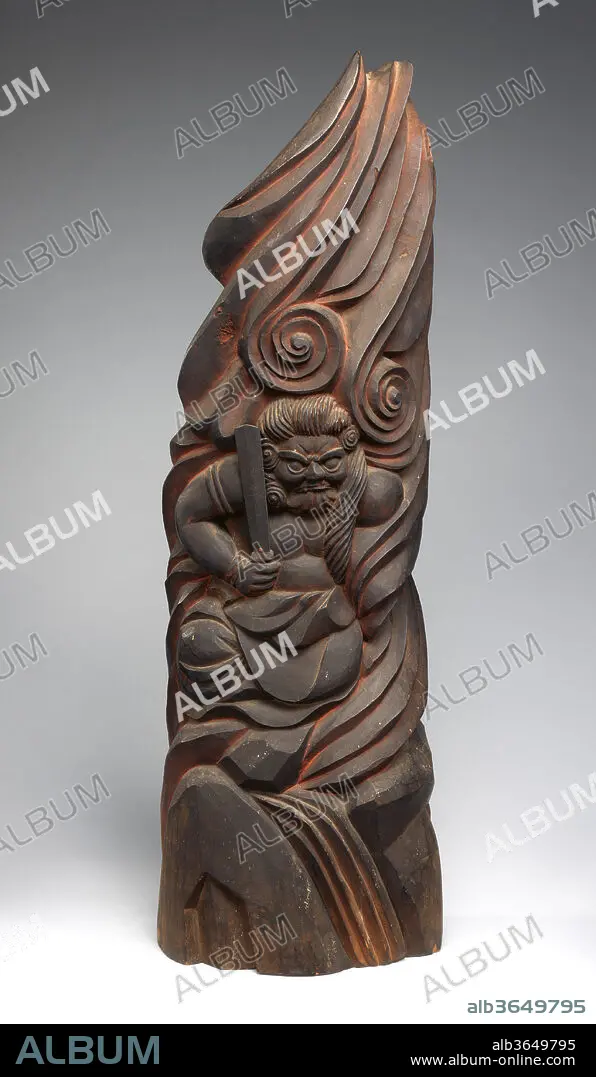
MOKUJIKI SHONIN. Fudo Myoo
| Teilen |
|---|
 Pinterest Pinterest |
 Twitter Twitter |
 Facebook Facebook |
 Link kopieren Link kopieren |
 Email Email |
|
Zu einem anderen Lightbox hinzufügen |
|
Zu einem anderen Lightbox hinzufügen |


Haben Sie bereits ein Konto? Anmelden
Sie haben kein Konto? Registrieren
Dieses Bild kaufen.
Nutzung auswählen:

Autor: MOKUJIKI SHONIN (1718-1810)
Titel: Fudo Myoo
Untertitel: Siehe automatische Übersetzung
Fudo Myoo. Artist: Mokujiki Shonin (Japanese, 1718-1810). Culture: Japan. Dimensions: H. 35 7/16 in. (90 cm); W. 14 9/16 in. (37 cm); D. 9 13/16 in. (25 cm). Date: 1805. Statues of the Buddhist protective deity Fudo Myoo, the "immovable wisdom king," are a familiar sight at temples in Japan. In contrast to meticulously carved works by professionals, this type of roughly hewn sculpture is the creation of an amateur monk-sculptor. Mokujiki was motivated by religious enthusiasm to make thousands of sculptures of Buddhist deities and popular gods of good fortune. Mokujiki's sculptures were rediscovered in the early twentieth century by art critic Yanagi Soetsu (1889-1961), an advocate of the virtues of mingei, literally, "people's art." Yanagi admired the direct, unaffected power of Mokujiki's sculpture asrepresenting the ideal of an indigenous, popular Japanese art. While his technique is referred to as natabori--"hatchet-carved"--Mokujiki actually used round-headed chisels.
Fudo Myoo. Artist: Mokujiki Shonin (Japanese, 1718-1810). Culture: Japan. Dimensions: H. 35 7/16 in. (90 cm); W. 14 9/16 in. (37 cm); D. 9 13/16 in. (25 cm). Date: 1805. Statues of the Buddhist protective deity Fudo Myoo, the "immovable wisdom king," are a familiar sight at temples in Japan. In contrast to meticulously carved works by professionals, this type of roughly hewn sculpture is the creation of an amateur monk-sculptor. Mokujiki was motivated by religious enthusiasm to make thousands of sculptures of Buddhist deities and popular gods of good fortune. Mokujiki's sculptures were rediscovered in the early twentieth century by art critic Yanagi Soetsu (1889-1961), an advocate of the virtues of mingei, literally, "people's art." Yanagi admired the direct, unaffected power of Mokujiki's sculpture asrepresenting the ideal of an indigenous, popular Japanese art. While his technique is referred to as natabori--"hatchet-carved"--Mokujiki actually used round-headed chisels.
Technik/Material: Chisel-carved (natabori) wood
Zeitraum: Edo period (1615-1868)
Museum: Metropolitan Museum of Art, New York, USA
Bildnachweis: Album
Bildgröße: 2559 × 4400 px | 32.2 MB
Druckgröße: 21.7 × 37.3 cm | 1007.5 × 1732.3 in (300 dpi)
Schlüsselwörter: ASIA • ASIATISCHE KUNST • JAPAN • METROPOLITAN MUSEUM OF ART, NEW YORK, USA • MOKUJIKI SHONIN
