

alb3895379
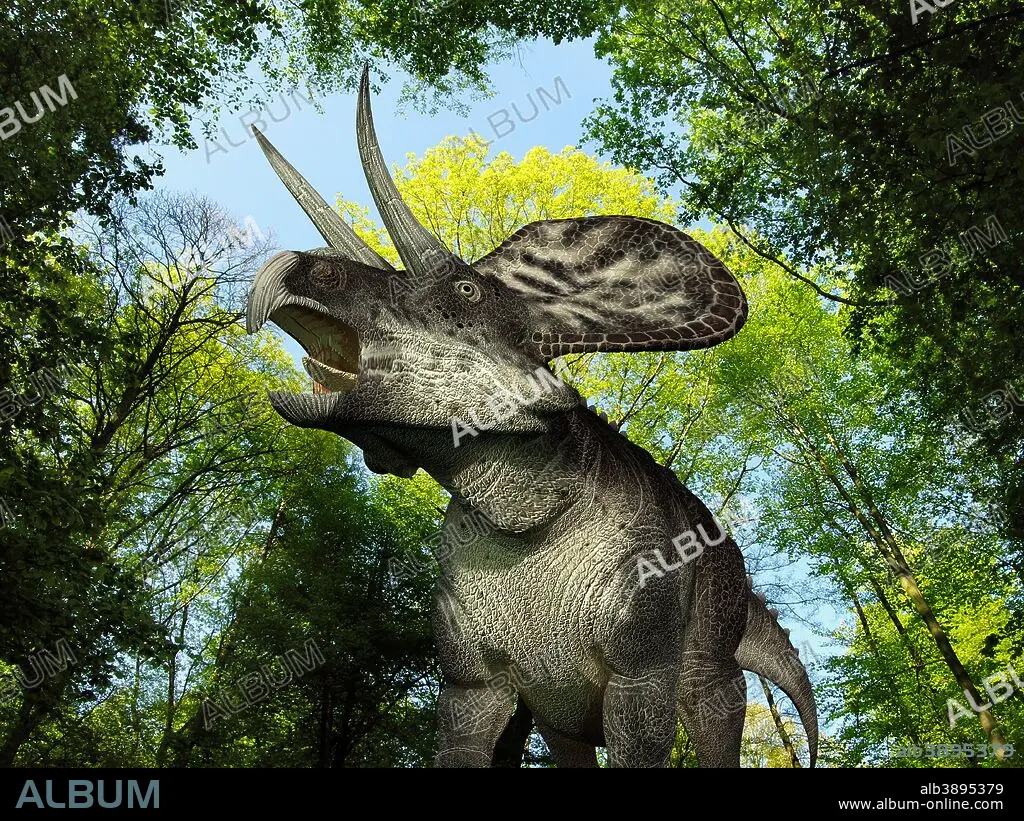
A Zuniceratops wanders a Cretaceous forest.
| Teilen |
|---|
 Pinterest Pinterest |
 Twitter Twitter |
 Facebook Facebook |
 Link kopieren Link kopieren |
 Email Email |
|
Zu einem anderen Lightbox hinzufügen |
|
Zu einem anderen Lightbox hinzufügen |


Haben Sie bereits ein Konto? Anmelden
Sie haben kein Konto? Registrieren
Dieses Bild kaufen.
Nutzung auswählen:

Titel: A Zuniceratops wanders a Cretaceous forest.
Untertitel: Siehe automatische Übersetzung
A 10 foot long, 250 pound Zuniceratops wanders a Cretaceous forest 90 million years ago in what is today New Mexico. . . Like the better known and larger Triceratops, Zuniceratops was a Ceratopsid, a family of four-legged plant-eating dinosaurs characterized by beaks, rows of shearing teeth in the back of the jaw, and elaborate horns and frills. While they resemble defensive shields, the frills are in fact relatively fragile, suggesting that they may have served a purpose other than protecting against a brute force attack. One possibility is that the frills were employed as visual displays in order to intimidate rivals and attract the opposite sex.
A 10 foot long, 250 pound Zuniceratops wanders a Cretaceous forest 90 million years ago in what is today New Mexico. . . Like the better known and larger Triceratops, Zuniceratops was a Ceratopsid, a family of four-legged plant-eating dinosaurs characterized by beaks, rows of shearing teeth in the back of the jaw, and elaborate horns and frills. While they resemble defensive shields, the frills are in fact relatively fragile, suggesting that they may have served a purpose other than protecting against a brute force attack. One possibility is that the frills were employed as visual displays in order to intimidate rivals and attract the opposite sex.
Bildnachweis: Album / Walter Myers/Stocktrek Images
Freigaben (Releases): ? Modellfreigabe: Nein - ? Eigentumsfreigabe: Nein
Rechtefragen?
Rechtefragen?
Bildgröße: 4920 × 3690 px | 51.9 MB
Druckgröße: 41.7 × 31.2 cm | 1937.0 × 1452.8 in (300 dpi)
Schlüsselwörter: BAUM • BESTIE • DINOSAURIER • EVOLUTION • FLORA • FORST • ILLUSTRATION • ILLUSTRATIONS • NATUR • NATURKUNDE • NATURWISSENSCHAFT • OFFENER MUND • PALAEONTOLOGIE • PALAEOZOOLOGIE • PALÄONTOLOGIE • PALÄOZOOLOGIE • PRIMITIV • REPTILIEN • UNGEHEUER • WALD • ZOOLOGIE
