

alb5477730
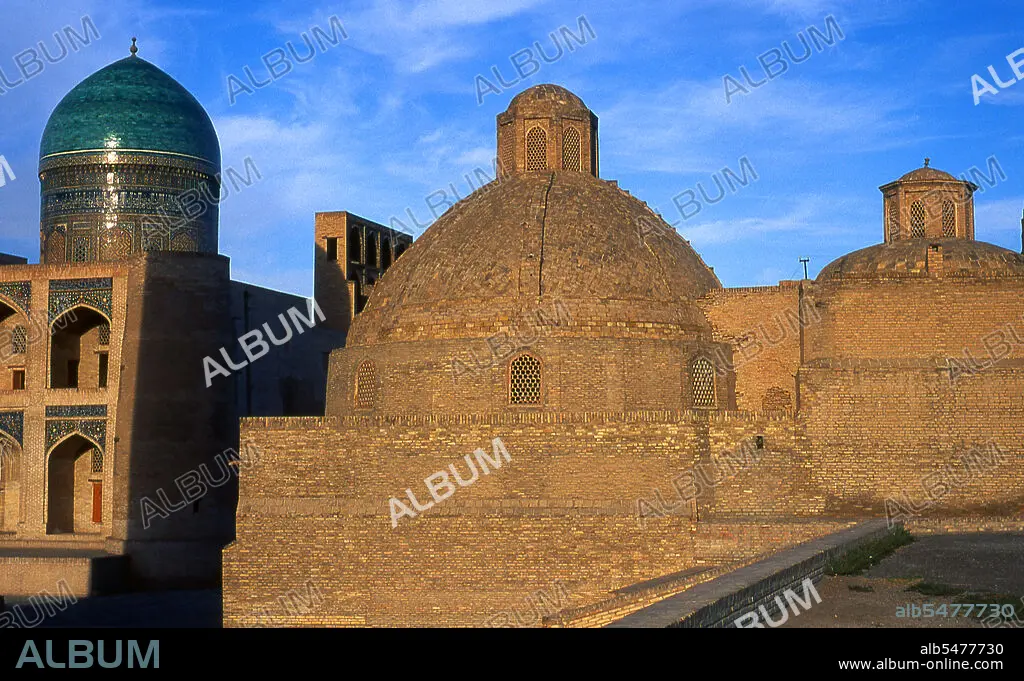
The Mir-i-Arab Madrasah (left) and the domes of the Amir Alim Khan Madrassa, Bukhara.
| Teilen |
|---|
 Pinterest Pinterest |
 Twitter Twitter |
 Facebook Facebook |
 Link kopieren Link kopieren |
 Email Email |
|
Zu einem anderen Lightbox hinzufügen |
|
Zu einem anderen Lightbox hinzufügen |


Haben Sie bereits ein Konto? Anmelden
Sie haben kein Konto? Registrieren
Dieses Bild kaufen.
Nutzung auswählen:

Titel: The Mir-i-Arab Madrasah (left) and the domes of the Amir Alim Khan Madrassa, Bukhara.
Untertitel: Siehe automatische Übersetzung
Emir Said Mir Mohammed Alim Khan (January 3, 1880-April 28, 1944) was the last emir of the Manghit dynasty, the last ruling dynasty of the Emirate of Bukhara in Central Asia. Although Bukhara was a protectorate of the Russian Empire from 1873, the Emir presided over the internal affairs of his emirate as absolute monarch and reigned from January 3, 1911 to August 30, 1920. Bukhara was founded in 500 BCE in the area now called the Ark. However, the Bukhara oasis had been inhabitated long before. The city has been one of the main centres of Persian civilization from its early days in 6th century BCE. From the 6th century CE, Turkic speakers gradually moved in. Bukhara's architecture and archaeological sites form one of the pillars of Central Asian history and art. The region of Bukhara was for a long period a part of the Persian Empire. The origin of its inhabitants goes back to the period of Aryan immigration into the region.
Emir Said Mir Mohammed Alim Khan (January 3, 1880-April 28, 1944) was the last emir of the Manghit dynasty, the last ruling dynasty of the Emirate of Bukhara in Central Asia. Although Bukhara was a protectorate of the Russian Empire from 1873, the Emir presided over the internal affairs of his emirate as absolute monarch and reigned from January 3, 1911 to August 30, 1920. Bukhara was founded in 500 BCE in the area now called the Ark. However, the Bukhara oasis had been inhabitated long before. The city has been one of the main centres of Persian civilization from its early days in 6th century BCE. From the 6th century CE, Turkic speakers gradually moved in. Bukhara's architecture and archaeological sites form one of the pillars of Central Asian history and art. The region of Bukhara was for a long period a part of the Persian Empire. The origin of its inhabitants goes back to the period of Aryan immigration into the region.
Bildnachweis: Album / Pictures From History/Universal Images Group
Freigaben (Releases): ? Modellfreigabe: Nein - ? Eigentumsfreigabe: Nein
Rechtefragen?
Rechtefragen?
Bildgröße: 5195 × 3184 px | 47.3 MB
Druckgröße: 44.0 × 27.0 cm | 2045.3 × 1253.5 in (300 dpi)
Schlüsselwörter: ARCHITEKTUR • ASIEN • ASIEN, KONTINENT • GESCHICHTE • ISLAM • ISLAMISCH • ISLAMISCHE ARCHITEKTUR • KONTINENT, ASIEN • MOHAMMEDANER • MOHAMMEDANERIN • MOSLEM • MOSLEMIN • MUSLIM • MUSLIMIN • RELIGION • UZBEKISTAN • ZEITGESCHICHTE
