

alb3679085
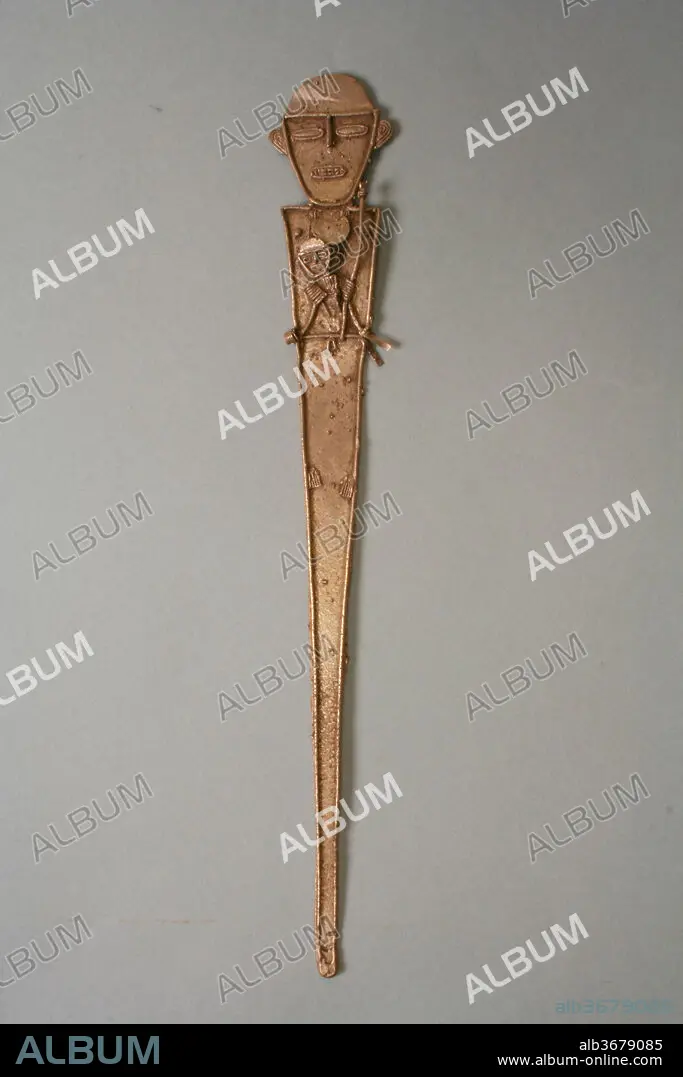
Female Figure (tunjo)
| Teilen |
|---|
 Pinterest Pinterest |
 Twitter Twitter |
 Facebook Facebook |
 Link kopieren Link kopieren |
 Email Email |
|
Zu einem anderen Lightbox hinzufügen |
|
Zu einem anderen Lightbox hinzufügen |


Haben Sie bereits ein Konto? Anmelden
Sie haben kein Konto? Registrieren
Dieses Bild kaufen.
Nutzung auswählen:

Titel: Female Figure (tunjo)
Untertitel: Siehe automatische Übersetzung
Female Figure (tunjo). Culture: Muisca. Dimensions: H. 7 3/4 x W. 1 1/8 x D. 1/8 in. (19.7 x 2.8 x 0.3cm). Date: 10th-16th century. Muisca votive objects, called tunjos, were made in a variety of forms: animate, that is, human figures and animals, and inanimate-weapons, lime containers, and snuff tablets. Human images, always differentiated by sex, are the most common type of tunjo. Most are simple, flat plaques with a great deal of specific detail added onto the surface, as thin gold threads. The figures depict actual Muisca people and activities, for instance, mothers holding children, as on this example. Male figures carry weapons or chew coca. Quality of workmanship and realistic proportions were of less concern to tunjo makers than subject matter. This tunjo depicts a female figure holding a smaller one, possibly a child, in one hand and a baton on the other. A long, multistrand necklace is on her chest and a prominent disk-shaped pectoral under her chin. Her small feet, worked as a series of fine gold threads, appear in the upper half of the tall plaque. Tunjos were buried in groups or thrown into lakes. They occur only rarely in tombs.
Female Figure (tunjo). Culture: Muisca. Dimensions: H. 7 3/4 x W. 1 1/8 x D. 1/8 in. (19.7 x 2.8 x 0.3cm). Date: 10th-16th century. Muisca votive objects, called tunjos, were made in a variety of forms: animate, that is, human figures and animals, and inanimate-weapons, lime containers, and snuff tablets. Human images, always differentiated by sex, are the most common type of tunjo. Most are simple, flat plaques with a great deal of specific detail added onto the surface, as thin gold threads. The figures depict actual Muisca people and activities, for instance, mothers holding children, as on this example. Male figures carry weapons or chew coca. Quality of workmanship and realistic proportions were of less concern to tunjo makers than subject matter. This tunjo depicts a female figure holding a smaller one, possibly a child, in one hand and a baton on the other. A long, multistrand necklace is on her chest and a prominent disk-shaped pectoral under her chin. Her small feet, worked as a series of fine gold threads, appear in the upper half of the tall plaque. Tunjos were buried in groups or thrown into lakes. They occur only rarely in tombs.
Technik/Material: GOLD
Museum: Metropolitan Museum of Art, New York, USA
Bildnachweis: Album
Freigaben (Releases): ? Modellfreigabe: Nein - ? Eigentumsfreigabe: Nein
Rechtefragen?
Rechtefragen?
Bildgröße: 2748 × 4122 px | 32.4 MB
Druckgröße: 23.3 × 34.9 cm | 1081.9 × 1622.8 in (300 dpi)
Schlüsselwörter: KOLUMBIEN • METROPOLITAN MUSEUM OF ART, NEW YORK, USA • SOUTH AMERICA
