

alb3799116
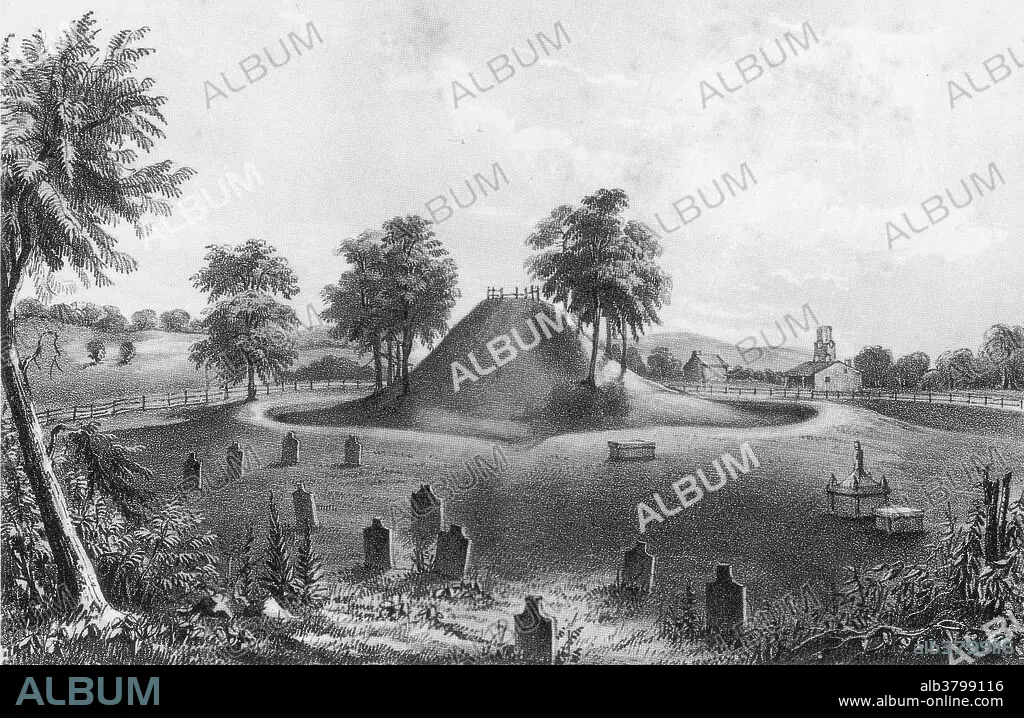
Great Mound at Marietta, 1848
| Teilen |
|---|
 Pinterest Pinterest |
 Twitter Twitter |
 Facebook Facebook |
 Link kopieren Link kopieren |
 Email Email |
|
Zu einem anderen Lightbox hinzufügen |
|
Zu einem anderen Lightbox hinzufügen |


Haben Sie bereits ein Konto? Anmelden
Sie haben kein Konto? Registrieren
Dieses Bild kaufen.
Nutzung auswählen:

Titel: Great Mound at Marietta, 1848
Untertitel: Siehe automatische Übersetzung
Mound building was a central feature of the public architecture of many Native American and Mesoamerican cultures from Chile to Minnesota. Thousands of mounds in America have been destroyed as a result of farming, pot-hunting, amateur and professional archaeology, road-building and construction. Surviving mounds are still found in river valleys, especially along the Mississippi, Tennessee and Ohio Rivers, and as far west as Spiro Mounds in Oklahoma. Mounds were used for burial, to support residential and religious structures, to represent a shared cosmology, and to unite and demarcate community. Common forms include conical mounds, ridge-top mounds, platform mounds, and animal effigy mounds, but there are many variations. Mound building in America is believed to date back to at least 3400 BC in the Southeast. The Adena and the Mississippian cultures are principally known for their mounds, as is the Hopewell tradition. This illustration appeared in Ephraim George Squier and Edwin Davis' book, Ancient Monuments of the Mississippi Valley, 1848. Together they were responsible for the excavations of some 200 prehistoric Indian mounds.
Mound building was a central feature of the public architecture of many Native American and Mesoamerican cultures from Chile to Minnesota. Thousands of mounds in America have been destroyed as a result of farming, pot-hunting, amateur and professional archaeology, road-building and construction. Surviving mounds are still found in river valleys, especially along the Mississippi, Tennessee and Ohio Rivers, and as far west as Spiro Mounds in Oklahoma. Mounds were used for burial, to support residential and religious structures, to represent a shared cosmology, and to unite and demarcate community. Common forms include conical mounds, ridge-top mounds, platform mounds, and animal effigy mounds, but there are many variations. Mound building in America is believed to date back to at least 3400 BC in the Southeast. The Adena and the Mississippian cultures are principally known for their mounds, as is the Hopewell tradition. This illustration appeared in Ephraim George Squier and Edwin Davis' book, Ancient Monuments of the Mississippi Valley, 1848. Together they were responsible for the excavations of some 200 prehistoric Indian mounds.
Bildnachweis: Album / Science Source / New York Public Library
Freigaben (Releases): ? Modellfreigabe: Nein - ? Eigentumsfreigabe: Nein
Rechtefragen?
Rechtefragen?
Bildgröße: 3900 × 2531 px | 28.2 MB
Druckgröße: 33.0 × 21.4 cm | 1535.4 × 996.5 in (300 dpi)
Schlüsselwörter: AMERIKANER • ILLUSTRATION • ILLUSTRATIONS • INDIANER • INDISCH • LITHOGRAPHIE
