

alb3816854
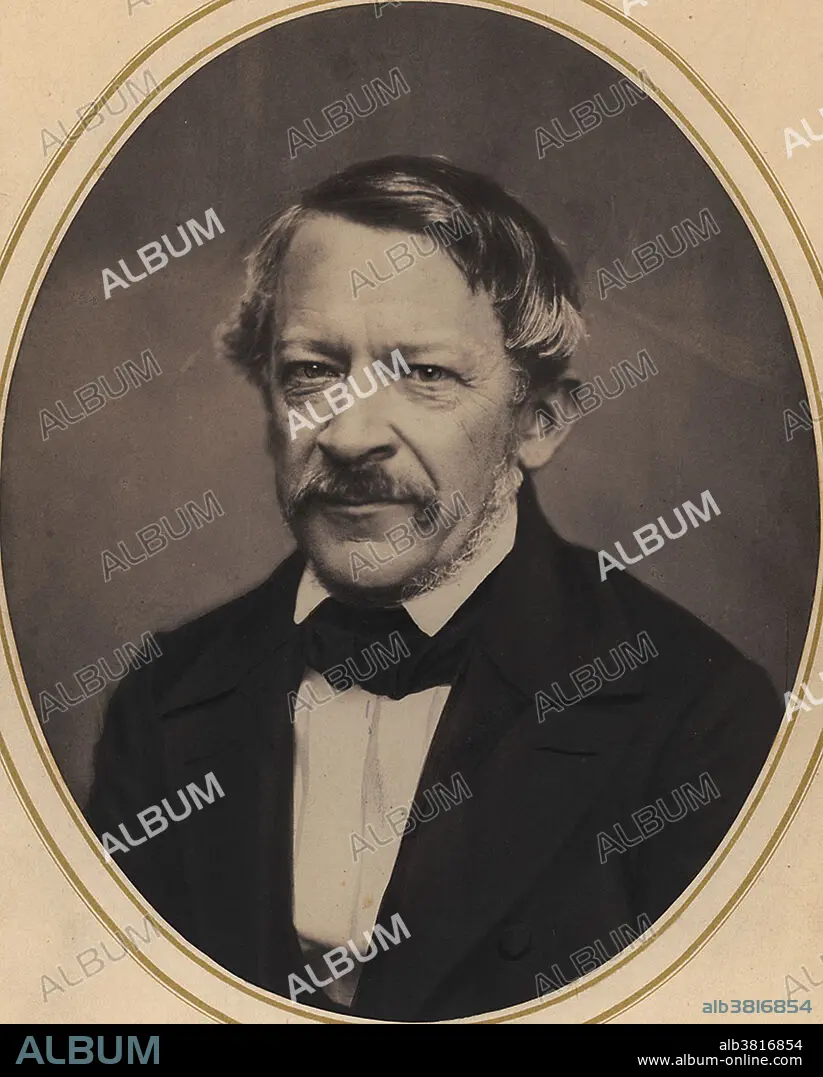
Heinrich Dove, Prussian Meteorologist
| Teilen |
|---|
 Pinterest Pinterest |
 Twitter Twitter |
 Facebook Facebook |
 Link kopieren Link kopieren |
 Email Email |
|
Zu einem anderen Lightbox hinzufügen |
|
Zu einem anderen Lightbox hinzufügen |


Haben Sie bereits ein Konto? Anmelden
Sie haben kein Konto? Registrieren
Dieses Bild kaufen.
Nutzung auswählen:

Titel: Heinrich Dove, Prussian Meteorologist
Untertitel: Siehe automatische Übersetzung
Editorial use only . Heinrich Wilhelm Dove (October 6, 1803 - April 4, 1879) was a Prussian physicist and meteorologist. During his career he published more than 300 papers, some of which delved into experimental physics. He had an important influence over the science of meteorology, and was considered by some to be a pioneer in this field. His primary focus was in climatology. In 1828, he observed that tropical cyclones rotate counterclockwise in the Northern Hemisphere, but clockwise in the Southern. In 1839 he discovered the technique of binaural beats, whereby slightly different frequencies played separately to each ear produced a perception of interference beats at the same rate as would be physically created. He also studied the distribution of heat over the surface of the Earth, the effect of climate on the growth of plants, and was the first to measure the strength of an electrical current in a wire induced by a collapsing magnetic field. He died in 1879 at the
Editorial use only . Heinrich Wilhelm Dove (October 6, 1803 - April 4, 1879) was a Prussian physicist and meteorologist. During his career he published more than 300 papers, some of which delved into experimental physics. He had an important influence over the science of meteorology, and was considered by some to be a pioneer in this field. His primary focus was in climatology. In 1828, he observed that tropical cyclones rotate counterclockwise in the Northern Hemisphere, but clockwise in the Southern. In 1839 he discovered the technique of binaural beats, whereby slightly different frequencies played separately to each ear produced a perception of interference beats at the same rate as would be physically created. He also studied the distribution of heat over the surface of the Earth, the effect of climate on the growth of plants, and was the first to measure the strength of an electrical current in a wire induced by a collapsing magnetic field. He died in 1879 at the
Bildnachweis: Album / Science Source / Smithsonian Institute Library
Freigaben (Releases): ? Modellfreigabe: Nein - ? Eigentumsfreigabe: Nein
Rechtefragen?
Rechtefragen?
Bildgröße: 3000 × 3731 px | 32.0 MB
Druckgröße: 25.4 × 31.6 cm | 1181.1 × 1468.9 in (300 dpi)
Schlüsselwörter: BART • BERÜHMT • BERÜHMTE PERSÖNLICHKEIT • KLIMAFORSCHER • MANN • METEOROLOGE • METEOROLOGIE • NOTABEL • PERSON • PERSöNLICHKEITEN • PERSÖNLICHKEITEN • PORTRAIT • PROMINENZ • ROTATION • TAUBE • TAUBEN • VOGEL: TAUBE
