

alb9071023
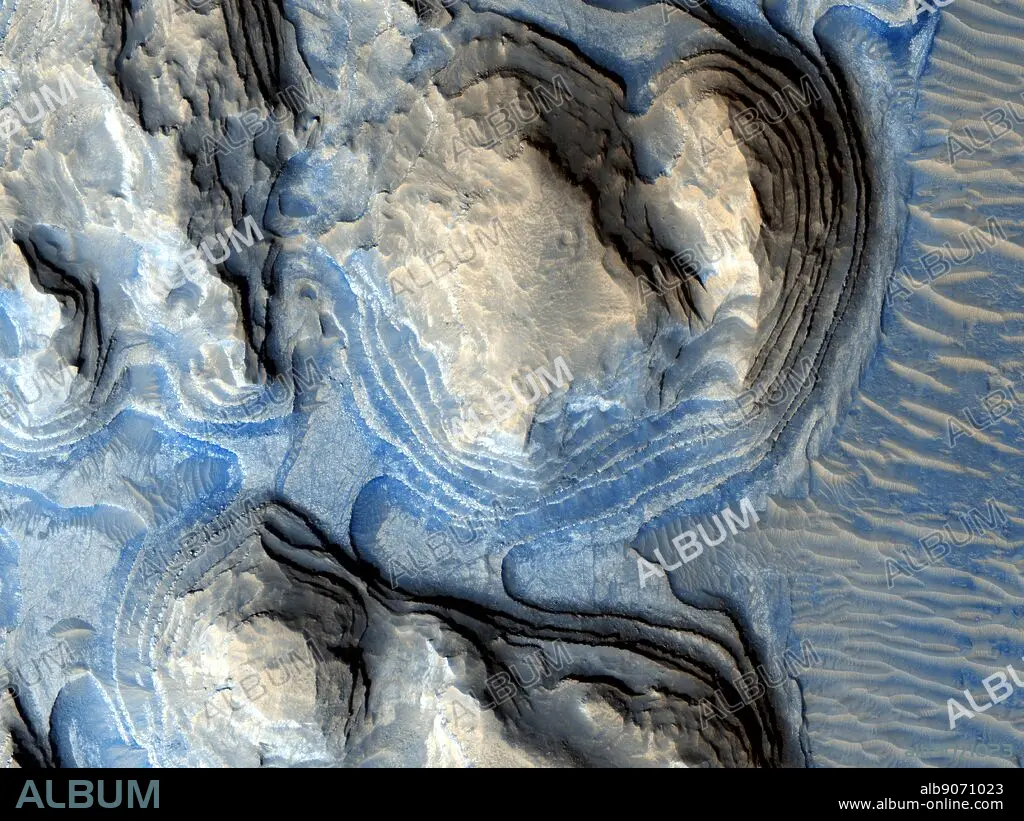
Geologic layering on Mars. image from the HiRISE high-resolution camera on board the Mars Reconnaissance Orbiter (MRO) shows multiple layers of exposed sedimentary rock on Mars in a region known as Arabia Terra. Referred to as cyclic bedding by geologists, this pattern of layering is caused by repeated fluctuations in the amount of sediment available to create new rock layers. This is often caused by long-term changes in the climate of a region, or even by wobbles in a planets rotation which can make certain areas experience long periods of dry climate followed by periods of wetter climate.
| Teilen |
|---|
 Pinterest Pinterest |
 Twitter Twitter |
 Facebook Facebook |
 Link kopieren Link kopieren |
 Email Email |
|
Zu einem anderen Lightbox hinzufügen |
|
Zu einem anderen Lightbox hinzufügen |


Haben Sie bereits ein Konto? Anmelden
Sie haben kein Konto? Registrieren
Dieses Bild kaufen.
Nutzung auswählen:

Untertitel: Siehe automatische Übersetzung
Geologic layering on Mars. image from the HiRISE high-resolution camera on board the Mars Reconnaissance Orbiter (MRO) shows multiple layers of exposed sedimentary rock on Mars in a region known as Arabia Terra. Referred to as cyclic bedding by geologists, this pattern of layering is caused by repeated fluctuations in the amount of sediment available to create new rock layers. This is often caused by long-term changes in the climate of a region, or even by wobbles in a planets rotation which can make certain areas experience long periods of dry climate followed by periods of wetter climate.
Geologic layering on Mars. image from the HiRISE high-resolution camera on board the Mars Reconnaissance Orbiter (MRO) shows multiple layers of exposed sedimentary rock on Mars in a region known as Arabia Terra. Referred to as cyclic bedding by geologists, this pattern of layering is caused by repeated fluctuations in the amount of sediment available to create new rock layers. This is often caused by long-term changes in the climate of a region, or even by wobbles in a planets rotation which can make certain areas experience long periods of dry climate followed by periods of wetter climate.
Bildnachweis: Album / World History Archive
Freigaben (Releases): ? Modellfreigabe: Nein - ? Eigentumsfreigabe: Nein
Rechtefragen?
Rechtefragen?
Bildgröße: 4900 × 3675 px | 51.5 MB
Druckgröße: 41.5 × 31.1 cm | 1929.1 × 1446.9 in (300 dpi)
Schlüsselwörter: ASTRONOMIE • ERKUNDUNG • PLANET ALLE • PLANET • SOLAR • WELTRAUM • WISSENSCH.: ASTRONOMIE
