alb5407599
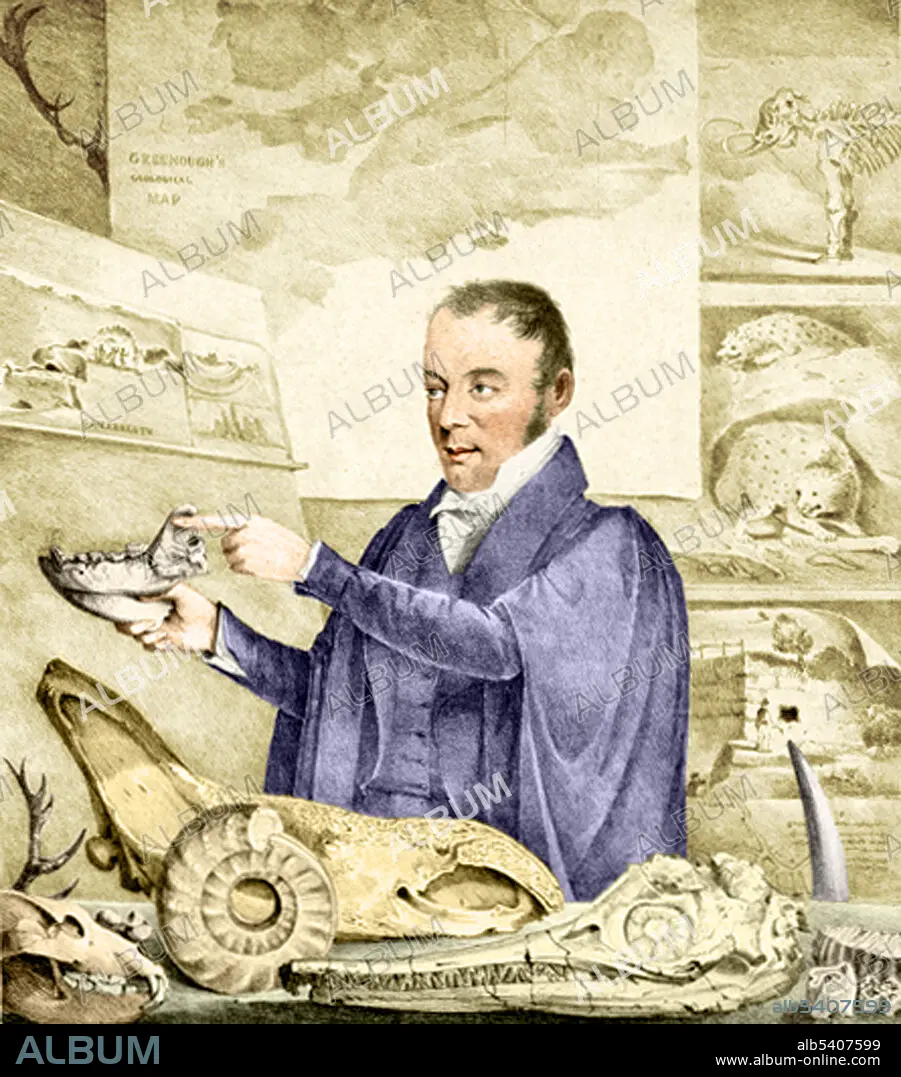
William Buckland, English Palaeontologist
| Teilen |
|---|
 Pinterest Pinterest |
 Twitter Twitter |
 Facebook Facebook |
 Link kopieren Link kopieren |
 Email Email |
|
Zu einem anderen Lightbox hinzufügen |
|
Zu einem anderen Lightbox hinzufügen |


Haben Sie bereits ein Konto? Anmelden
Sie haben kein Konto? Registrieren
Dieses Bild kaufen.
Nutzung auswählen:

Titel:
William Buckland, English Palaeontologist
Untertitel:
Siehe automatische Übersetzung
Buckland giving a lecture on fossils and displaying some of his prize specimens. The long-beaked skull at the front is an Ichthyosaur, a marine reptile that belonged to a separate group from the dinosaurs. William Buckland (March 12, 1784, August, 14 1856) the English geologist and palaeontologist who wrote the first full account of a fossil dinosaur, which he called megalosaurus, or great lizard. He was a pioneer in the use of fossilized faeces, for which he coined the term coprolites, to reconstruct ancient ecosystems. Buckland was a proponent of the Gap Theory that interpreted the biblical account of Genesis as referring to two separate episodes of creation separated by a lengthy period, Early in his career he believed that he had found geologic evidence of the biblical flood, but later became convinced that the glaciation theory of Louis Agassiz provided a better explanation.
Bildnachweis:
Album / Science Source
Freigaben (Releases):
Bildgröße:
3600 x 4093 px | 42.2 MB
Druckgröße:
30.5 x 34.7 cm | 12.0 x 13.6 in (300 dpi)
Schlüsselwörter:
