

alb2128887
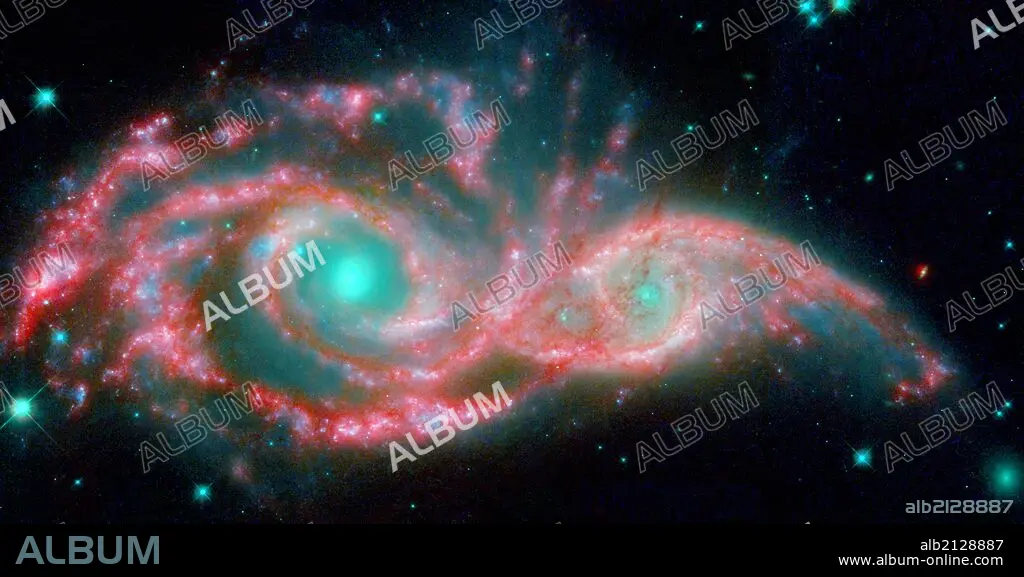
NGC 2207 and IC 2163 met and began a sort of gravitational tango about 40 million years ago. The two galaxies are tugging at each other, stimulating new stars to form. Eventually, this cosmic ball will come to an end, when the galaxies meld into one. The dancing duo is located 140 million light-years away in the Canis Major constellation. Hubble Space Telescope (HST), Spitzer Space Telescope.
| Teilen |
|---|
 Pinterest Pinterest |
 Twitter Twitter |
 Facebook Facebook |
 Link kopieren Link kopieren |
 Email Email |
|
Zu einem anderen Lightbox hinzufügen |
|
Zu einem anderen Lightbox hinzufügen |


Haben Sie bereits ein Konto? Anmelden
Sie haben kein Konto? Registrieren
Dieses Bild kaufen.
Nutzung auswählen:

Titel: NGC 2207 and IC 2163 met and began a sort of gravitational tango about 40 million years ago. The two galaxies are tugging at each other, stimulating new stars to form. Eventually, this cosmic ball will come to an end, when the galaxies meld into one. The dancing duo is located 140 million light-years away in the Canis Major constellation. Hubble Space Telescope (HST), Spitzer Space Telescope.
Untertitel: Siehe automatische Übersetzung
NGC 2207 and IC 2163 met and began a sort of gravitational tango about 40 million years ago. The two galaxies are tugging at each other, stimulating new stars to form. Eventually, this cosmic ball will come to an end, when the galaxies meld into one. The dancing duo is located 140 million light-years away in the Canis Major constellation. Hubble Space Telescope (HST),Spitzer Space Telescope. (Photo by: Universal History Archive/UIG via Getty Images)
NGC 2207 and IC 2163 met and began a sort of gravitational tango about 40 million years ago. The two galaxies are tugging at each other, stimulating new stars to form. Eventually, this cosmic ball will come to an end, when the galaxies meld into one. The dancing duo is located 140 million light-years away in the Canis Major constellation. Hubble Space Telescope (HST),Spitzer Space Telescope. (Photo by: Universal History Archive/UIG via Getty Images)
Bildnachweis: Album / Universal Images Group / Universal Science Images \ UIG
Freigaben (Releases): ? Modellfreigabe: Nein - ? Eigentumsfreigabe: Nein
Rechtefragen?
Rechtefragen?
Bildgröße: 5100 × 2609 px | 38.1 MB
Druckgröße: 43.2 × 22.1 cm | 2007.9 × 1027.2 in (300 dpi)
Schlüsselwörter: ABSTRAKT • ABSTRAKT, STIL • ABSTRAKTE KUNST • ASTRONOMIE • AUSSEN • DRAUSSEN • HORIZONTALE • IM FREIEN (ALLGEMEIN) • SPIRALE • STIL: ABSTRAKT • WELTRAUM • WISSENSCH.: ASTRONOMIE
