

alb3630999
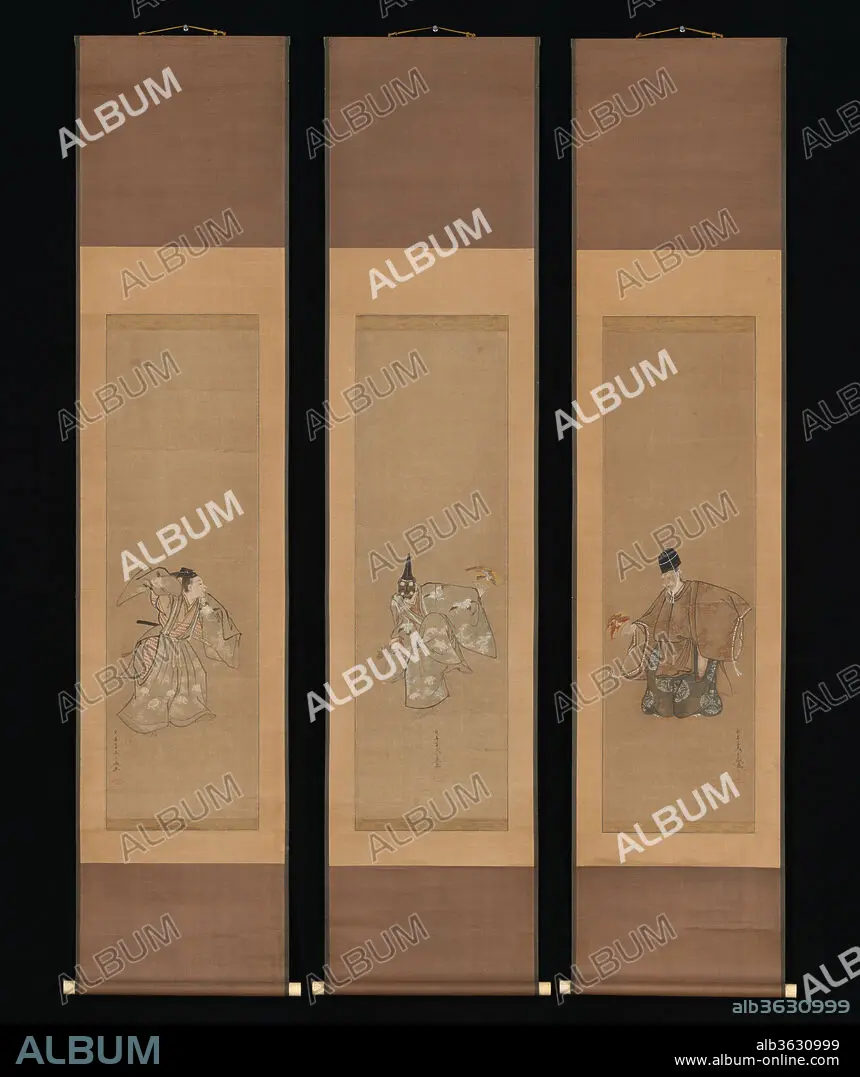
TORIYAMA SEKIEN. The Auspicious Noh Dance Okina
| Teilen |
|---|
 Pinterest Pinterest |
 Twitter Twitter |
 Facebook Facebook |
 Link kopieren Link kopieren |
 Email Email |
|
Zu einem anderen Lightbox hinzufügen |
|
Zu einem anderen Lightbox hinzufügen |


Haben Sie bereits ein Konto? Anmelden
Sie haben kein Konto? Registrieren
Dieses Bild kaufen.
Nutzung auswählen:

Autor: TORIYAMA SEKIEN (1712-1788)
Titel: The Auspicious Noh Dance Okina
Untertitel: Siehe automatische Übersetzung
The Auspicious Noh Dance "Okina". Artist: Toriyama Sekien (Japanese, 1712-1788). Culture: Japan. Dimensions: Image (a): 34 5/16 × 10 3/4 in. (87.2 × 27.3 cm) Overall with mounting (a): 67 5/16 × 15 in. (171 × 38.1 cm) Overall with knobs (a): 67 5/16 × 16 3/4 in. (171 × 42.5 cm) Image (b): 34 1/2 × 10 15/16 in. (87.6 × 27.8 cm) Overall with mounting (b): 67 1/16 × 15 1/16 in. (170.3 × 38.3 cm) Overall with knobs (b): 67 1/16 × 16 5/8 in. (170.3 × 42.2 cm) Image (c): 34 1/2 × 10 11/16 in. (87.6 × 27.2 cm) Overall with mounting (c): 67 5/16 × 15 in. (171 × 38.1 cm) Overall with knobs (c): 67 5/16 × 16 5/8 in. (171 × 42.3 cm). Date: ca. 1790-95. Three dancers perform movements from the ritualized dance called Okina, literally, "Old Man," or Sanbaso. Performed before the formal program of Noh plays begins, it is a dance without narrative content that is reserved for special occasions such as New Year's festivities, prayers for prosperity of the nation, and ceremonies to purify the site of a Shinto shrine. On the right is the protagonist Okina, wearing the white mask of an old man and donning an over-robe (kariginu) decorated with a tortoiseshell pattern, a symbol of longevity. The cranes and tortoises that adorn the costumes of the two other dancers are also emblems of longevity. The black mask and the bells held by the dancer on the center scroll identify him as Sanbaso, "the third old man." On the left is Okina's young male companion, Senzai, meaning "a thousand years of age." The artist Toriyama Sekien was trained in the Kano school, but he also created designs for woodblock prints and book illustrations and was the teacher of the celebrated ukiyo-e artist Kitagawa Utamaro (1753-1806).
The Auspicious Noh Dance "Okina". Artist: Toriyama Sekien (Japanese, 1712-1788). Culture: Japan. Dimensions: Image (a): 34 5/16 × 10 3/4 in. (87.2 × 27.3 cm) Overall with mounting (a): 67 5/16 × 15 in. (171 × 38.1 cm) Overall with knobs (a): 67 5/16 × 16 3/4 in. (171 × 42.5 cm) Image (b): 34 1/2 × 10 15/16 in. (87.6 × 27.8 cm) Overall with mounting (b): 67 1/16 × 15 1/16 in. (170.3 × 38.3 cm) Overall with knobs (b): 67 1/16 × 16 5/8 in. (170.3 × 42.2 cm) Image (c): 34 1/2 × 10 11/16 in. (87.6 × 27.2 cm) Overall with mounting (c): 67 5/16 × 15 in. (171 × 38.1 cm) Overall with knobs (c): 67 5/16 × 16 5/8 in. (171 × 42.3 cm). Date: ca. 1790-95. Three dancers perform movements from the ritualized dance called Okina, literally, "Old Man," or Sanbaso. Performed before the formal program of Noh plays begins, it is a dance without narrative content that is reserved for special occasions such as New Year's festivities, prayers for prosperity of the nation, and ceremonies to purify the site of a Shinto shrine. On the right is the protagonist Okina, wearing the white mask of an old man and donning an over-robe (kariginu) decorated with a tortoiseshell pattern, a symbol of longevity. The cranes and tortoises that adorn the costumes of the two other dancers are also emblems of longevity. The black mask and the bells held by the dancer on the center scroll identify him as Sanbaso, "the third old man." On the left is Okina's young male companion, Senzai, meaning "a thousand years of age." The artist Toriyama Sekien was trained in the Kano school, but he also created designs for woodblock prints and book illustrations and was the teacher of the celebrated ukiyo-e artist Kitagawa Utamaro (1753-1806).
Technik/Material: Triptych of hanging scrolls; ink, color, and gold on paper
Zeitraum: Edo period (1615-1868)
Museum: Metropolitan Museum of Art, New York, USA
Bildnachweis: Album
Bildgröße: 3393 × 4038 px | 39.2 MB
Druckgröße: 28.7 × 34.2 cm | 1335.8 × 1589.8 in (300 dpi)
Schlüsselwörter: ASIA • ASIATISCHE KUNST • JAPAN • METROPOLITAN MUSEUM OF ART, NEW YORK, USA • TINTE • TORIYAMA SEKIEN
