

alb3617539
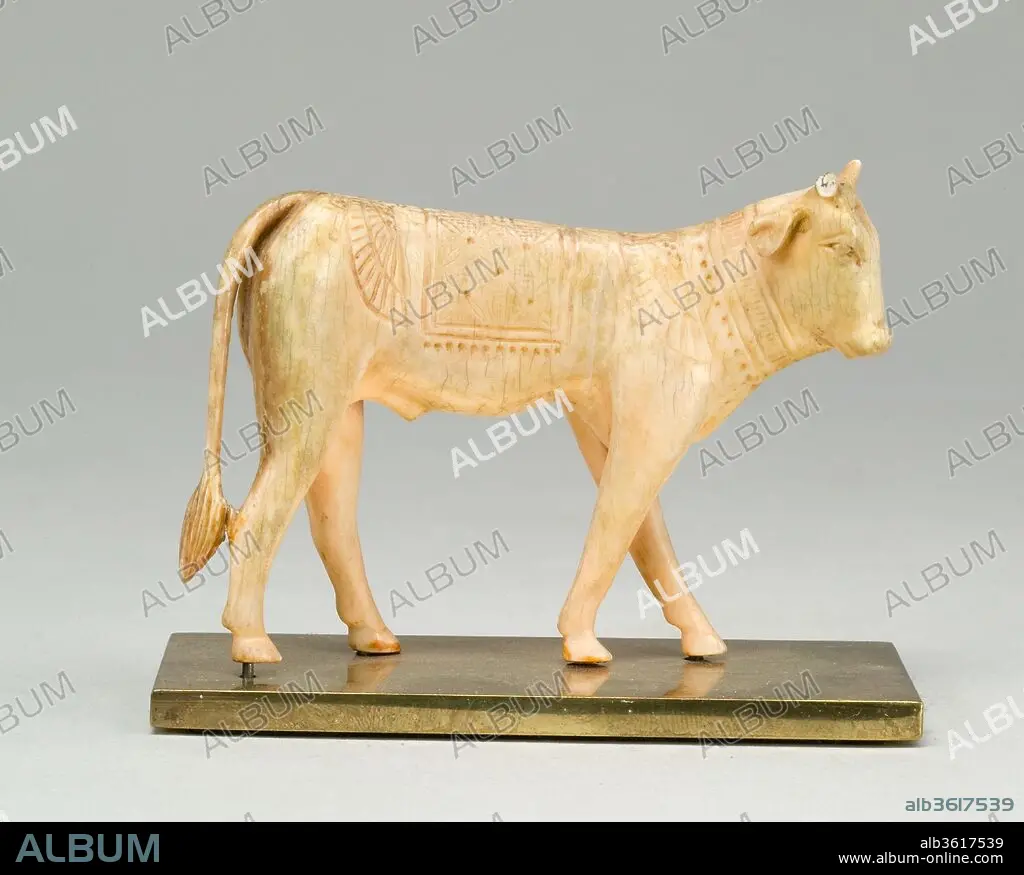
Apis Bull Statuette
| Teilen |
|---|
 Pinterest Pinterest |
 Twitter Twitter |
 Facebook Facebook |
 Link kopieren Link kopieren |
 Email Email |
|
Zu einem anderen Lightbox hinzufügen |
|
Zu einem anderen Lightbox hinzufügen |


Haben Sie bereits ein Konto? Anmelden
Sie haben kein Konto? Registrieren
Dieses Bild kaufen.
Nutzung auswählen:

Titel: Apis Bull Statuette
Untertitel: Siehe automatische Übersetzung
Apis Bull Statuette. Dimensions: L. 8.7 cm (3 7/16 in), w. 2.7 cm (1 1/16 in), H. 6.2 cm (2 7/16 in). Dynasty: Dynasty 26-30. Date: 664-343 B.C.. One of the most important animal deities of ancient Egypt was the sacred Apis bull, whose worship is attested from Dynasty I. Near the Ptah temple at Memphis, Egypt's old capital, a living representative of the Apis bull was stabled. He was paraded out at festive occasions to participate in ceremonies of fertility and regeneration. The bull that played this important role was selected for displaying color patterns, such as a white triangle on the forehead and black patches resembling winged birds on the body. In the ivory figure, the white triangle is indicated by a sunken area on the head, while engravings of a vulture with wings spread and a winged scarab flank an elaborate blanket on the back. When Apis bulls died, they were embalmed and buried with all honors. Beginning with the reign of Amenhotep III (1390-1352 B.C.) in Dynasty 18, the place of Apis burials was a huge and growing underground system of chambers called the Serapeum in the Memphite necropolis, Saqqara. The mothers of Apis bulls had their own cult and burial place.
Apis Bull Statuette. Dimensions: L. 8.7 cm (3 7/16 in), w. 2.7 cm (1 1/16 in), H. 6.2 cm (2 7/16 in). Dynasty: Dynasty 26-30. Date: 664-343 B.C.. One of the most important animal deities of ancient Egypt was the sacred Apis bull, whose worship is attested from Dynasty I. Near the Ptah temple at Memphis, Egypt's old capital, a living representative of the Apis bull was stabled. He was paraded out at festive occasions to participate in ceremonies of fertility and regeneration. The bull that played this important role was selected for displaying color patterns, such as a white triangle on the forehead and black patches resembling winged birds on the body. In the ivory figure, the white triangle is indicated by a sunken area on the head, while engravings of a vulture with wings spread and a winged scarab flank an elaborate blanket on the back. When Apis bulls died, they were embalmed and buried with all honors. Beginning with the reign of Amenhotep III (1390-1352 B.C.) in Dynasty 18, the place of Apis burials was a huge and growing underground system of chambers called the Serapeum in the Memphite necropolis, Saqqara. The mothers of Apis bulls had their own cult and burial place.
Technik/Material: elephant ivory
Zeitraum: LATE PERIOD
Museum: Metropolitan Museum of Art, New York, USA
Bildnachweis: Album
Freigaben (Releases): ? Modellfreigabe: Nein - ? Eigentumsfreigabe: Nein
Rechtefragen?
Rechtefragen?
Bildgröße: 3220 × 2584 px | 23.8 MB
Druckgröße: 27.3 × 21.9 cm | 1267.7 × 1017.3 in (300 dpi)
Schlüsselwörter: AEGYPTISCHE KUNST • AFRICA • ANATOMIE: KNOCHEN • EGYPT • FROM EGYPT • KNOCHEN • METROPOLITAN MUSEUM OF ART, NEW YORK, USA • STATUEN • ÄGYPTISCHE KUNST
