

alb5477827
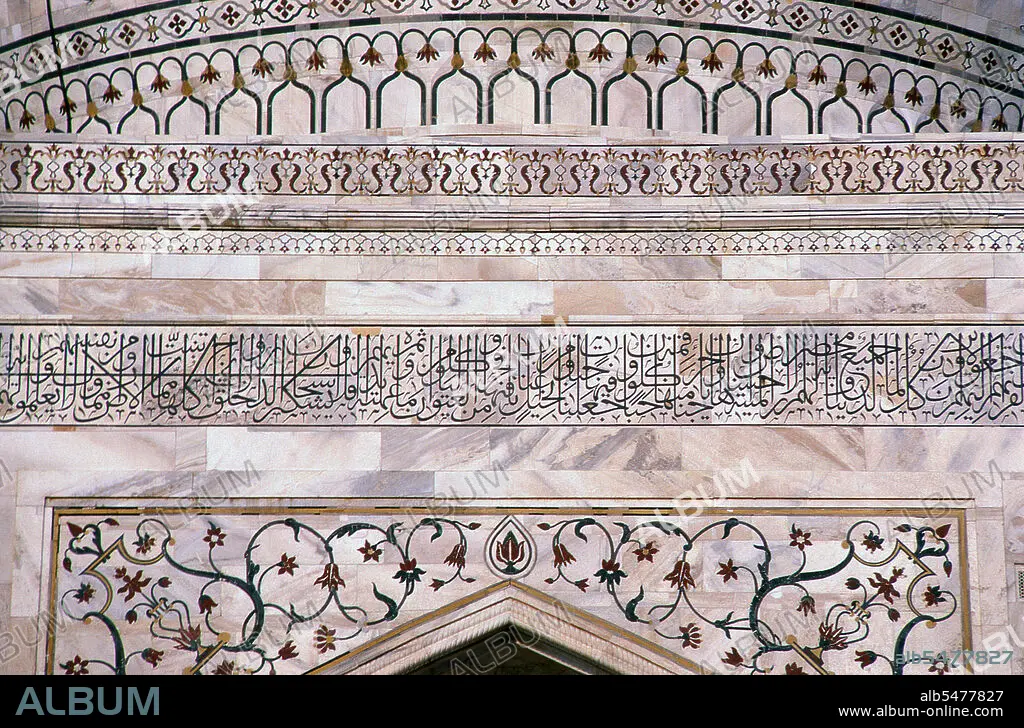
Koranic verse and abstract motifs on the western facade of the Taj Mahal at sunset, Agra, Uttar Pradesh.
| Teilen |
|---|
 Pinterest Pinterest |
 Twitter Twitter |
 Facebook Facebook |
 Link kopieren Link kopieren |
 Email Email |
|
Zu einem anderen Lightbox hinzufügen |
|
Zu einem anderen Lightbox hinzufügen |


Haben Sie bereits ein Konto? Anmelden
Sie haben kein Konto? Registrieren
Dieses Bild kaufen.
Nutzung auswählen:

Titel: Koranic verse and abstract motifs on the western facade of the Taj Mahal at sunset, Agra, Uttar Pradesh.
Untertitel: Siehe automatische Übersetzung
The Taj Mahal was built between 1632 and 1648 by Mughal emperor Shah Jahan (1592 - 1666) in memory of his third wife, Mumtaz Mahal. The Taj Mahal incorporates and expands on design traditions of Persian architecture and earlier Mughal architecture. Specific inspiration came from successful Timurid and Mughal buildings including; the Gur-e Amir (the tomb of Timur, progenitor of the Mughal dynasty, in Samarkand), Humayun's Tomb, Itmad-Ud-Daulah's Tomb (sometimes called the Baby Taj), and Shah Jahan's own Jama Masjid in Delhi. While earlier Mughal buildings were primarily constructed of red sandstone, Shah Jahan promoted the use of white marble inlaid with semi-precious stones, and buildings under his patronage reached new levels of refinement.
The Taj Mahal was built between 1632 and 1648 by Mughal emperor Shah Jahan (1592 - 1666) in memory of his third wife, Mumtaz Mahal. The Taj Mahal incorporates and expands on design traditions of Persian architecture and earlier Mughal architecture. Specific inspiration came from successful Timurid and Mughal buildings including; the Gur-e Amir (the tomb of Timur, progenitor of the Mughal dynasty, in Samarkand), Humayun's Tomb, Itmad-Ud-Daulah's Tomb (sometimes called the Baby Taj), and Shah Jahan's own Jama Masjid in Delhi. While earlier Mughal buildings were primarily constructed of red sandstone, Shah Jahan promoted the use of white marble inlaid with semi-precious stones, and buildings under his patronage reached new levels of refinement.
Bildnachweis: Album / Pictures From History/Universal Images Group
Freigaben (Releases): ? Modellfreigabe: Nein - ? Eigentumsfreigabe: Nein
Rechtefragen?
Rechtefragen?
Bildgröße: 5082 × 3350 px | 48.7 MB
Druckgröße: 43.0 × 28.4 cm | 2000.8 × 1318.9 in (300 dpi)
Schlüsselwörter: ARCHITEKTUR • ASIEN • ASIEN, KONTINENT • GESCHICHTE • GRAB • GRABMAL • GRABNISCHE • GRABSTAETTE • GRAEBER • GRUFT • INDIANER • INDISCH • ISLAM • ISLAMISCH • KALLIGRAPHIE • KONTINENT, ASIEN • KORAN • MAUSOLEUM • MOGUL KULTUR • MOHAMMEDANER • MOHAMMEDANERIN • MOSLEM • MOSLEMIN • MUSLIM • MUSLIMIN • RELIGION • SCHREIN • SHAH JAHAN • TUMBA • TÜRBE • ZEITGESCHICHTE
