

alb5474841
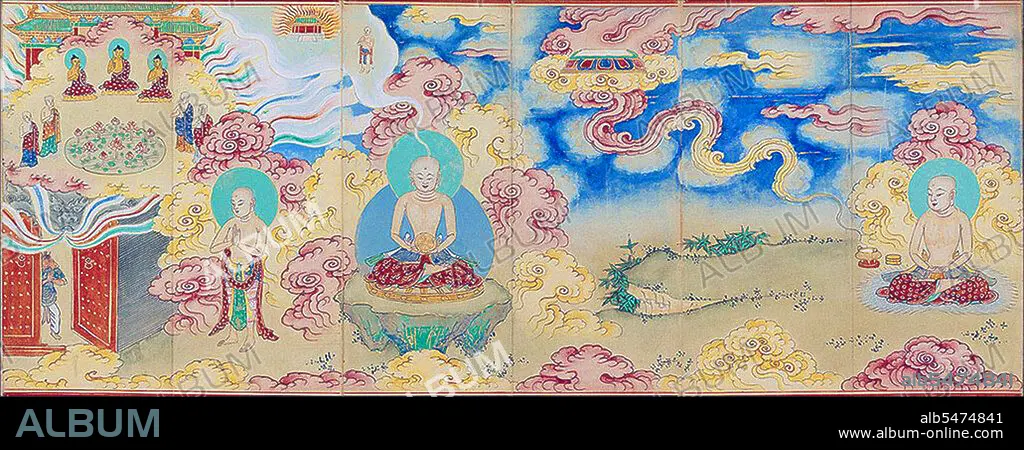
Traditional Buddhist religious painting illustrating bodhisattvas and the heavenly spheres.
| Teilen |
|---|
 Pinterest Pinterest |
 Twitter Twitter |
 Facebook Facebook |
 Link kopieren Link kopieren |
 Email Email |
|
Zu einem anderen Lightbox hinzufügen |
|
Zu einem anderen Lightbox hinzufügen |


Haben Sie bereits ein Konto? Anmelden
Sie haben kein Konto? Registrieren
Dieses Bild kaufen.
Nutzung auswählen:

Titel: Traditional Buddhist religious painting illustrating bodhisattvas and the heavenly spheres.
Untertitel: Siehe automatische Übersetzung
Buddhism in Mongolia derives much of its recent characteristics from Tibetan Buddhism of the Gelugpa school. Traditionally, Mongols worshiped heaven (the 'clear blue sky') and their ancestors, and they followed ancient northern Asian practices of shamanism, in which human intermediaries went into trance and spoke to and for some of the numberless infinities of spirits responsible for human luck or misfortune. Although the emperors of the Yuan Dynasty in the 14th and 15th century had already converted to Tibetan Buddhism, the Mongols returned to their old shamanist ways after the collapse of their empire. In 1578 Altan Khan, a Mongol military leader with ambitions to unite the Mongols and to emulate the career of Chinggis, invited the head of the rising Yellow Sect of Tibetan Buddhism to a summit. They formed an alliance that gave Altan Khan legitimacy and religious sanction for his imperial pretensions and that provided the Buddhist school with protection and patronage.
Buddhism in Mongolia derives much of its recent characteristics from Tibetan Buddhism of the Gelugpa school. Traditionally, Mongols worshiped heaven (the 'clear blue sky') and their ancestors, and they followed ancient northern Asian practices of shamanism, in which human intermediaries went into trance and spoke to and for some of the numberless infinities of spirits responsible for human luck or misfortune. Although the emperors of the Yuan Dynasty in the 14th and 15th century had already converted to Tibetan Buddhism, the Mongols returned to their old shamanist ways after the collapse of their empire. In 1578 Altan Khan, a Mongol military leader with ambitions to unite the Mongols and to emulate the career of Chinggis, invited the head of the rising Yellow Sect of Tibetan Buddhism to a summit. They formed an alliance that gave Altan Khan legitimacy and religious sanction for his imperial pretensions and that provided the Buddhist school with protection and patronage.
Bildnachweis: Album / Pictures From History/Universal Images Group
Freigaben (Releases): ? Modellfreigabe: Nein - ? Eigentumsfreigabe: Nein
Rechtefragen?
Rechtefragen?
Bildgröße: 6800 × 2636 px | 51.3 MB
Druckgröße: 57.6 × 22.3 cm | 2677.2 × 1037.8 in (300 dpi)
Schlüsselwörter: 15. JAHRHUNDERT • 15. JH. • ARHAT • ASIEN • ASIEN, KONTINENT • ASTROLOGIE • BODHISATTVA • BUDA • BUDDHISMUS • BUDDHISTISCH • GEISTLICHER: MOENCH • GEMAELDE • GESCHICHTE • HIMMELREICH • KONTINENT, ASIEN • KUNST • MALEREI • MOENCH • MOENCHE • MÖNCH • NIRVANA • NIRWANA • PHILOSOPH ALLE • RELIGION • TIBET • TIBETANISCH • TUER • TÜR • ZEITGESCHICHTE
