

alb3670292
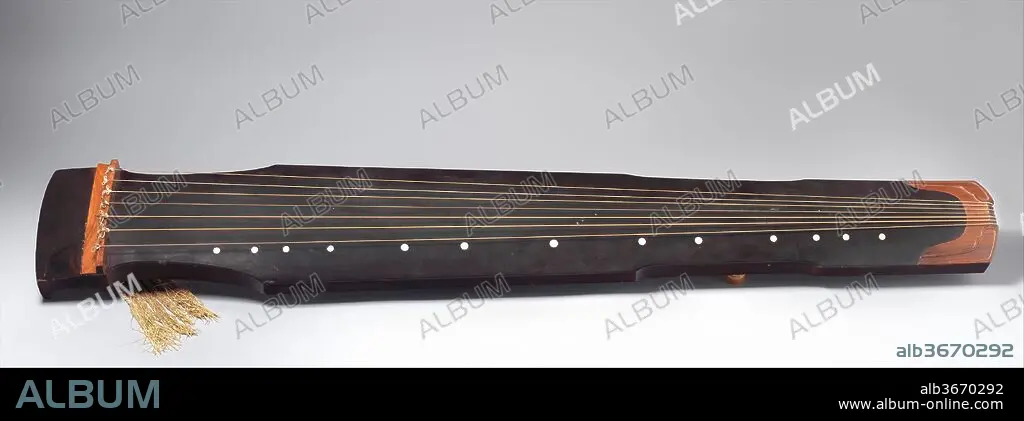
Guqin
| Teilen |
|---|
 Pinterest Pinterest |
 Twitter Twitter |
 Facebook Facebook |
 Link kopieren Link kopieren |
 Email Email |
|
Zu einem anderen Lightbox hinzufügen |
|
Zu einem anderen Lightbox hinzufügen |


Haben Sie bereits ein Konto? Anmelden
Sie haben kein Konto? Registrieren
Dieses Bild kaufen.
Nutzung auswählen:

Titel: Guqin
Untertitel: Siehe automatische Übersetzung
Guqin (?? ). Culture: Chinese. Dimensions: L: 122.8 cm (48-5/16 in.); W: 18.3 cm (7-3/16 in.); Depth: 10.1 cm (3-15/16 in.). Date: 19th century. Endowed with cosmological and metaphysical significance and empowered to communicate the deepest feelings, this zither, beloved of sages and of Confucius, is the most prestigious instrument in China. Han Dynasty (206 B.C.-220 A.D.) writers state that the qin helped to cultivate character, understand morality, supplicate gods and demons, enhance life, and enrich learning. Ming Dynasty (1368-1644) literati who claimed the right to play the qin suggested that it be played outdoors in a mountain setting, a garden or a small pavilion or near an old pine tree (symbol of longevity) while burning incense perfumed the air. A serene moonlit night was considered an appropriate time for performance. Each part of the instrument is identified by an anthropomorphic or zoomorphic name and cosmology is ever present: for example, the upper board of wutong wood symbolizes heaven, the bottom board of zi wood symbolizes earth. Qins over a hundred years old are considered best, the age determined by the pattern of cracks (duanwen) in the lacquer. The 13 studs (hui) indicate finger positions. Strings of varying thicknesses are made of twisted silk.
Guqin (?? ). Culture: Chinese. Dimensions: L: 122.8 cm (48-5/16 in.); W: 18.3 cm (7-3/16 in.); Depth: 10.1 cm (3-15/16 in.). Date: 19th century. Endowed with cosmological and metaphysical significance and empowered to communicate the deepest feelings, this zither, beloved of sages and of Confucius, is the most prestigious instrument in China. Han Dynasty (206 B.C.-220 A.D.) writers state that the qin helped to cultivate character, understand morality, supplicate gods and demons, enhance life, and enrich learning. Ming Dynasty (1368-1644) literati who claimed the right to play the qin suggested that it be played outdoors in a mountain setting, a garden or a small pavilion or near an old pine tree (symbol of longevity) while burning incense perfumed the air. A serene moonlit night was considered an appropriate time for performance. Each part of the instrument is identified by an anthropomorphic or zoomorphic name and cosmology is ever present: for example, the upper board of wutong wood symbolizes heaven, the bottom board of zi wood symbolizes earth. Qins over a hundred years old are considered best, the age determined by the pattern of cracks (duanwen) in the lacquer. The 13 studs (hui) indicate finger positions. Strings of varying thicknesses are made of twisted silk.
Technik/Material: Wood, horn, silk, mother-of-pearl
Museum: Metropolitan Museum of Art, New York, USA
Bildnachweis: Album
Freigaben (Releases): ? Modellfreigabe: Nein - ? Eigentumsfreigabe: Nein
Rechtefragen?
Rechtefragen?
Bildgröße: 4708 × 1693 px | 22.8 MB
Druckgröße: 39.9 × 14.3 cm | 1853.5 × 666.5 in (300 dpi)
Schlüsselwörter: ASIA • CHINA • METROPOLITAN MUSEUM OF ART, NEW YORK, USA • MUSIKINSTRUMENTE • SEIDE • TEXTIL: SEIDE • TEXTILIEN: SEIDE
