

alb5142933
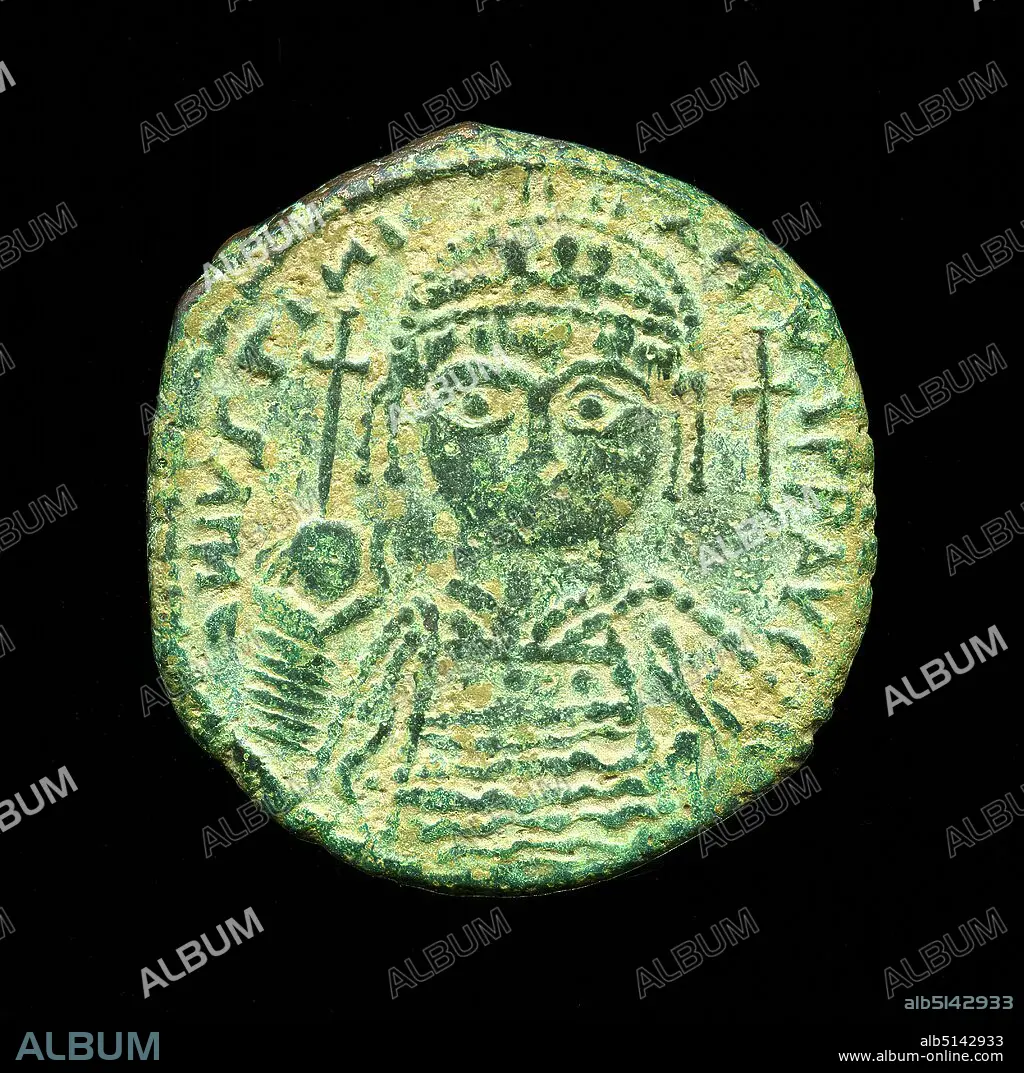
Follis Iustinian I, g bronze, total: diameter: 3 cm, inscription: Obverse: next to the head on the right a cross, circumferential inscription DN IVSTINIANVS PP AUC, coins, numismatics, portrait, portrait of ruler, state portrait, historical person, emperor, late antiquity, Originally the follis was introduced by the Roman emperor Diocletian in his coinage reform around 294 AD. Coined from bronze, the coins were covered with a thin silver film. Since the currency reform of the emperor Anastastius around 498 B.C. they have been large bronze coins. On the value side of the folly, the large letters MY in ligature. In Greek numerals they stand for the value 40. Due to its size, this folly belongs to the group of 'Large Module Folles'. It shows an armored bust of the emperor Iustinian I. with crown and jewelry on the front side (obverse). In his right hand he holds the globe with cross. Next to the head there is a cross on the right. The circumferential inscription facing inwards is DN IVSTINIANVS PP AUC (Dominus noster Iustinianus perpetuus Augustus - Our Lord Iustinian, eternal ruler). The reverse side (lapel) is dominated by the MY stamp, under which a small B can be seen. On the left is the inscription ANNO (in the year), on the right XXIII (23); this is a reference to the minting date in the 23rd year of the emperor's reign 560/1 A.D. In the lower section there is a reference to the mint KYZ(ikos). Iustinian I. - with full name Flavius Petrus Sabbatius Iustinianus - was born around 482 AD in Tauresium and ruled the Imperium Romanum from August 1, 527 AD until his death on November 14, 565 AD. He is considered one of the most important rulers of late antiquity. His reign marked the transition from the ancient Imperium Romanum to the Byzantine Empire. He succeeded in reconquering large parts of the Western Roman Empire, which had been lost to the Ostrogoths and Vandals in 476 AD. At the same time he closed the Neo-Platonic School of Philosophy in Athens in 529 and abol.
| Teilen |
|---|
 Pinterest Pinterest |
 Twitter Twitter |
 Facebook Facebook |
 Link kopieren Link kopieren |
 Email Email |
|
Zu einem anderen Lightbox hinzufügen |
|
Zu einem anderen Lightbox hinzufügen |


Haben Sie bereits ein Konto? Anmelden
Sie haben kein Konto? Registrieren
Dieses Bild kaufen.
Nutzung auswählen:

Untertitel: Siehe automatische Übersetzung
Follis Iustinian I, g bronze, total: diameter: 3 cm, inscription: Obverse: next to the head on the right a cross, circumferential inscription DN IVSTINIANVS PP AUC, coins, numismatics, portrait, portrait of ruler, state portrait, historical person, emperor, late antiquity, Originally the follis was introduced by the Roman emperor Diocletian in his coinage reform around 294 AD. Coined from bronze, the coins were covered with a thin silver film. Since the currency reform of the emperor Anastastius around 498 B.C. they have been large bronze coins. On the value side of the folly, the large letters MY in ligature. In Greek numerals they stand for the value 40. Due to its size, this folly belongs to the group of 'Large Module Folles'. It shows an armored bust of the emperor Iustinian I. with crown and jewelry on the front side (obverse). In his right hand he holds the globe with cross. Next to the head there is a cross on the right. The circumferential inscription facing inwards is DN IVSTINIANVS PP AUC (Dominus noster Iustinianus perpetuus Augustus - Our Lord Iustinian, eternal ruler). The reverse side (lapel) is dominated by the MY stamp, under which a small B can be seen. On the left is the inscription ANNO (in the year), on the right XXIII (23); this is a reference to the minting date in the 23rd year of the emperor's reign 560/1 A.D. In the lower section there is a reference to the mint KYZ(ikos). Iustinian I. - with full name Flavius Petrus Sabbatius Iustinianus - was born around 482 AD in Tauresium and ruled the Imperium Romanum from August 1, 527 AD until his death on November 14, 565 AD. He is considered one of the most important rulers of late antiquity. His reign marked the transition from the ancient Imperium Romanum to the Byzantine Empire. He succeeded in reconquering large parts of the Western Roman Empire, which had been lost to the Ostrogoths and Vandals in 476 AD. At the same time he closed the Neo-Platonic School of Philosophy in Athens in 529 and abol
Follis Iustinian I, g bronze, total: diameter: 3 cm, inscription: Obverse: next to the head on the right a cross, circumferential inscription DN IVSTINIANVS PP AUC, coins, numismatics, portrait, portrait of ruler, state portrait, historical person, emperor, late antiquity, Originally the follis was introduced by the Roman emperor Diocletian in his coinage reform around 294 AD. Coined from bronze, the coins were covered with a thin silver film. Since the currency reform of the emperor Anastastius around 498 B.C. they have been large bronze coins. On the value side of the folly, the large letters MY in ligature. In Greek numerals they stand for the value 40. Due to its size, this folly belongs to the group of 'Large Module Folles'. It shows an armored bust of the emperor Iustinian I. with crown and jewelry on the front side (obverse). In his right hand he holds the globe with cross. Next to the head there is a cross on the right. The circumferential inscription facing inwards is DN IVSTINIANVS PP AUC (Dominus noster Iustinianus perpetuus Augustus - Our Lord Iustinian, eternal ruler). The reverse side (lapel) is dominated by the MY stamp, under which a small B can be seen. On the left is the inscription ANNO (in the year), on the right XXIII (23); this is a reference to the minting date in the 23rd year of the emperor's reign 560/1 A.D. In the lower section there is a reference to the mint KYZ(ikos). Iustinian I. - with full name Flavius Petrus Sabbatius Iustinianus - was born around 482 AD in Tauresium and ruled the Imperium Romanum from August 1, 527 AD until his death on November 14, 565 AD. He is considered one of the most important rulers of late antiquity. His reign marked the transition from the ancient Imperium Romanum to the Byzantine Empire. He succeeded in reconquering large parts of the Western Roman Empire, which had been lost to the Ostrogoths and Vandals in 476 AD. At the same time he closed the Neo-Platonic School of Philosophy in Athens in 529 and abol
Bildnachweis: Album / quintlox
Freigaben (Releases): ? Modellfreigabe: Nein - ? Eigentumsfreigabe: Nein
Rechtefragen?
Rechtefragen?
Bildgröße: 4320 × 4302 px | 53.2 MB
Druckgröße: 36.6 × 36.4 cm | 1700.8 × 1693.7 in (300 dpi)
Schlüsselwörter: ABBINDEN • BESCHRIFTUNG • BRONZE • CROWN • GEISTESKRANKHEIT • GRUPPE • KAISER • KONSUL • KOPF (ANATOMIE) • KOPF • KRANKHEIT: WAHNSINN • KREUZ • LIGATUR (TYPOGRAFIE) • LIGATUR • NUMISMATIK • OSTGOTEN • OSTROEMISCHES REICH • OSTRÖMISCHES REICH • PHILOSOPHIE • PORTRAIT • SCHREIBTISCH • TOD • TODESFALL • TRANSITION • VERIRRT • VERLOREN • WAHNSINN • WANDALEN • WISSENSCH.: PHILOSOPHIE • ZEIT
