

alb3813251
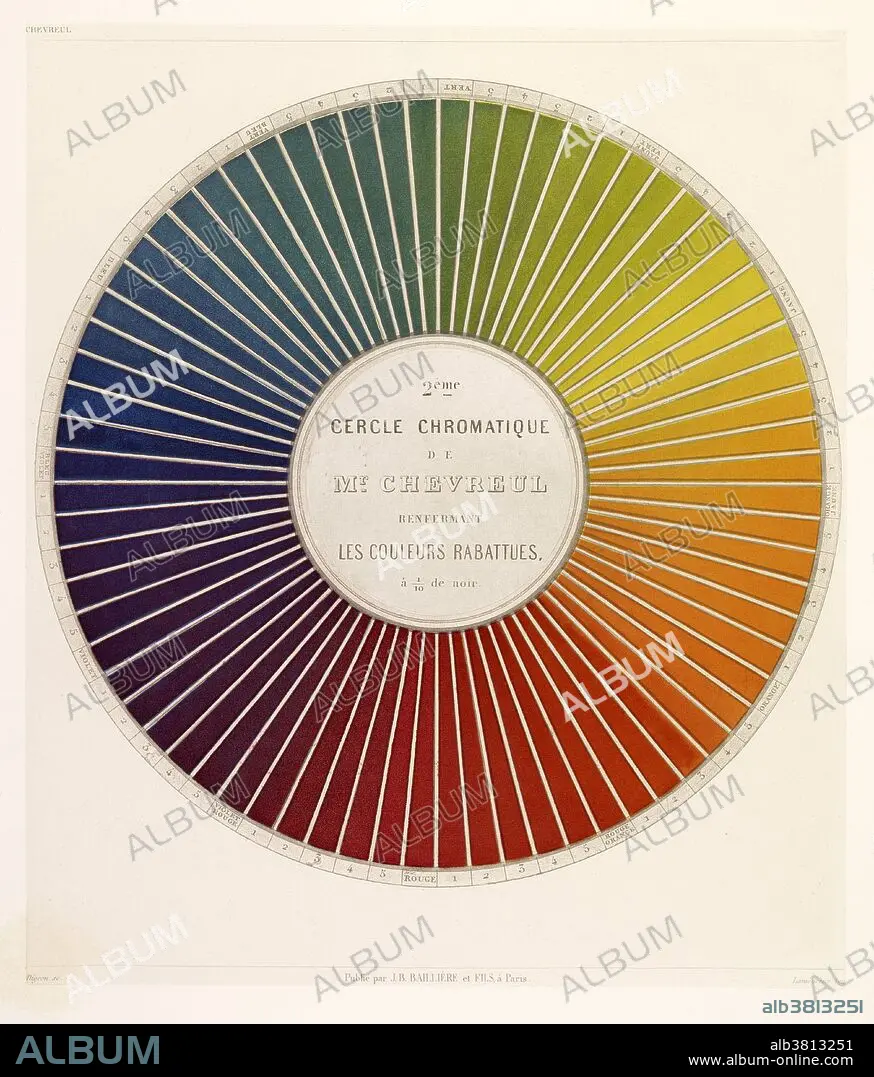
Chevreul's Chromatic Circle
| Share |
|---|
 Pinterest Pinterest |
 Twitter Twitter |
 Facebook Facebook |
 Copy link Copy link |
 Email Email |
|
Add to another lightbox |
|
Add to another lightbox |


Buy this image.
Select the use:

Title: Chevreul's Chromatic Circle
Caption: Chevreul's "chromatic diagram," based on the RYB color model, showing complementary colors and other relationships. Color theory was originally formulated in terms of three "primary" or "primitive" colors -- red, yellow and blue (RYB) -- because these colors were believed capable of mixing all other colors. Michel Eugène Chevreul (1786-1889) was a French industrial chemist who is credited with the discovery of margaric acid and designing an early form of soap made from animal fats and salt. Chevreul was particularly influential in the world of art, since he determined that perceived color was influenced by other surrounding colors. This led to a concept known as simultaneous contrast. He expounded on this idea in "The Law of Simultaneous Color Contrast" (1839), which is one of the founding documents in color theory, along with Johann Wolfgang von Goethe's "Theory of colors" (1810).
Category: ILLUSTRATION • Science: History
Credit: Album / Science Source / Getty Research Institute
Releases: ? Model Release: No - ? Property Release: No
Rights questions?
Rights questions?
Image size: 4706 × 5514 px | 74.2 MB
Print size: 39.8 × 46.7 cm | 1852.8 × 2170.9 in (300 dpi)
Keywords: ART • ARTWORK • CHEVREUL • CHROMATIC • CIRCLE • CIRCULAR • COLOR HARMONY • COLOR PRINCIPLES • COLOR RELATIONSHIPS • COLOR THEORY • COLOR WHEEL • COLOR • COMPLEMENTARY COLORS • DIAGRAM • FRAUNHOFER LINES • FRENCH • HISTORIC • HISTORICAL • HISTORY • HUE • ILLUSTRATION • ILLUSTRATIONS • ILUSTRATION • LAW OF SIMULTANEOUS COLOR CONTRAST • LIGHT • MICHEL EUGèNE CHEVREUL • MULTI-COLORED • MULTI-COLOURED • MULTICOLORED • OPTICS • PERCEIVED COLOR • PHYSICS • ROUND • RYB • SCIENCE: HISTORY • SIMULTANEOUS CONTRAST • SPECTRAL • SPECTRE • SPECTRUM • VISIBLE SPECTRUM
