

alb9412677
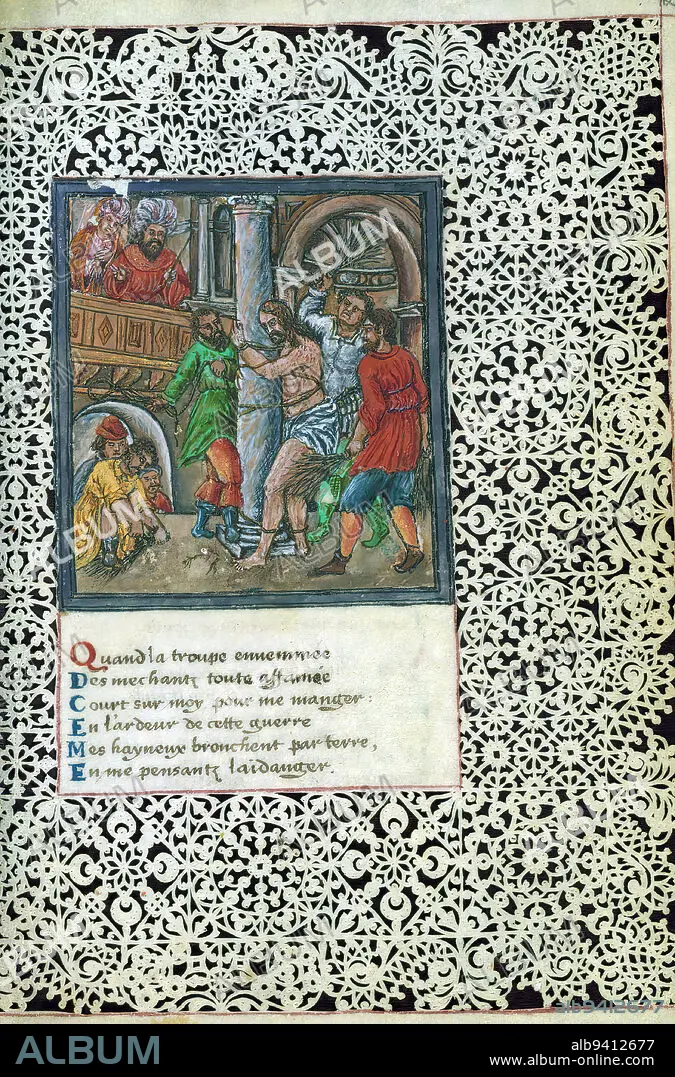
Lace Book of Marie de' Medici, Flagellation of Christ, This Prayerbook was made for Marie de' Medici in the second quarter of the seventeenth century. Beyond its provenance as a personal book owned by the famous queen, it is exceptional for its intricately cut borders, which transform the parchment margins into lace. This effect was created using a technique known as 'canivet,' in which a small knife was used to cut ornate patterns into paper or parchment. An art form that flourished originally among nuns in France, Germany, and the Netherlands beginning in the sixteenth century, it was employed to exceptional effect in several manuscripts connected with Marie de' Medici.
| Share |
|---|
 Pinterest Pinterest |
 Twitter Twitter |
 Facebook Facebook |
 Copy link Copy link |
 Email Email |
|
Add to another lightbox |
|
Add to another lightbox |


Buy this image.
Select the use:

Caption: Lace Book of Marie de' Medici, Flagellation of Christ, This Prayerbook was made for Marie de' Medici in the second quarter of the seventeenth century. Beyond its provenance as a personal book owned by the famous queen, it is exceptional for its intricately cut borders, which transform the parchment margins into lace. This effect was created using a technique known as 'canivet,' in which a small knife was used to cut ornate patterns into paper or parchment. An art form that flourished originally among nuns in France, Germany, and the Netherlands beginning in the sixteenth century, it was employed to exceptional effect in several manuscripts connected with Marie de' Medici.
Credit: Album / quintlox
Releases: ? Model Release: No - ? Property Release: No
Rights questions?
Rights questions?
Image size: 3156 × 4788 px | 43.2 MB
Print size: 26.7 × 40.5 cm | 1242.5 × 1885.0 in (300 dpi)
Keywords: 'CANIVET • 15 15TH XV XVTH FIFTEENTH CENTURY • 15TH CENTURY • 15TH CENTURY; • 15TH • 17TH CENTURY • 17TH CENTURY. • 17TH • 17TH-CENTURY • ADORNMENT • ART FORM • ARTFORM • BEYOND • BINDING • BOOK OF HOURS • BOOK • BOOKBINDING • BOOKS • CARTOUCHE • CHANGE • CHRIST • CHRISTIAN • CHRISTIANS • CREATED USING • CUT ORNATE PATTERNS • DECOR • DECORATION • DECORATIONS • DECORATIVE • DEVOTION • EFFECT • EMPLOYED • EXCEPTIONAL EFFECT • EXCEPTIONAL • FAMOUS QUEEN • FIFTEENTH CENTURY • FLAGELACION • FLAGELLATION • FLANDERS • FLEMISH • FLOG • FLOGGING • FLOURISHED ORIGINALLY • FRANCE • FRANCE. • FRENCH • GERMANY • HERALDRY • ILLUMINATION • INTRICATELY CUT BORDERS • INVENTIVE • JESUS C • JESUS CHRIST • JESUS CHRISTUS • JESUS • KNICK-KNACKS • LA FRANCE • LACE BOOK • LACE • LIBRO • LIBROS • LIVRE D'HEURES • MANUSCRIPT • MARIE DE' MEDICI • MASSBOOK, MISSAL • MINIATURE • MISSAL • MISSAL, MASSBOOK • NETHERLANDS • NOTABLE • NUN • NUNS • ORIGINAL • ORNAMENT • ORNAMENTATION • ORNAMENTS • PAINT • PAINTING • PAINTINGS • PAPER AND PACKAGE PRODUCTS • PAPER • PARCHMENT MARGINS • PARCHMENT • PASSION OF CHRIST • PASSION • PERSONAL BOOK OWNED • PRAYER BOOK • PRAYER • PRAYERBOOK • PROVENANCE • PSALTER • PULLEY • RELIGION: CHRISTIAN • ROLL • SCOURGING • SCROLL • SECOND QUARTER • SEVENTEENTH CENTURY • SEVERAL MANUSCRIPTS CONNECTED • SIGLO XV • SIXTEENTH CENTURY • SMALL KNIFE • TECHNICAL • TECHNIQUE • TECHNOLOGY • TEHNOLOGY • TRANSFORM • WHIP • WHIPPING • XV CENTURY • XVII CENTURY
