alb3803427
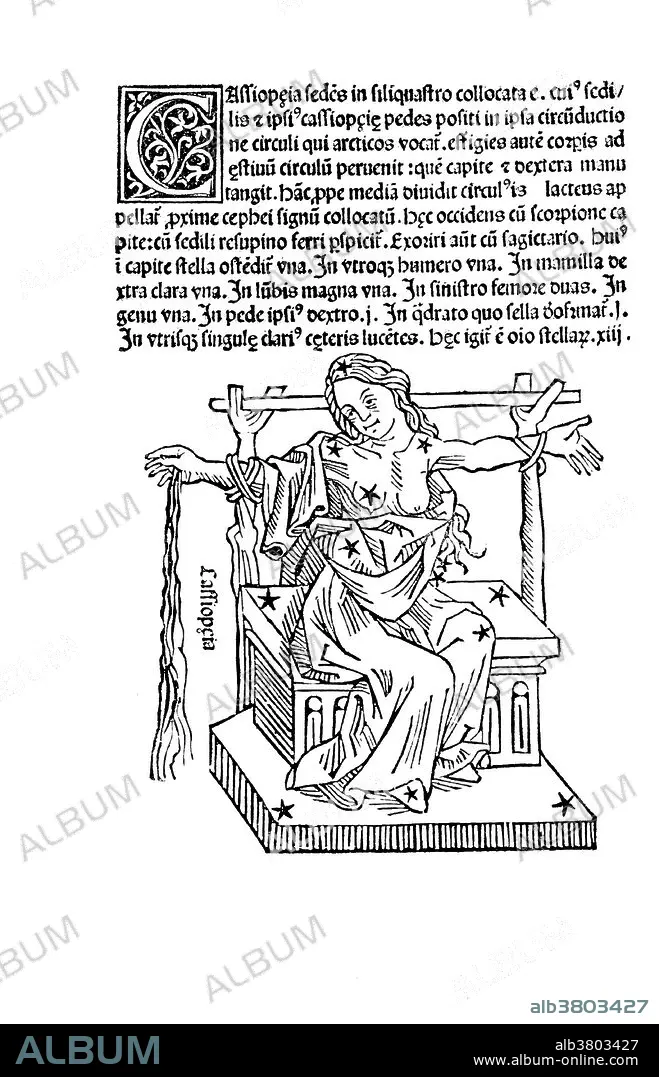
Cassiopeia Constellation, 1482
| Share |
|---|
 Pinterest Pinterest |
 Twitter Twitter |
 Facebook Facebook |
 Copy link Copy link |
 Email Email |
|
Add to another lightbox |
|
Add to another lightbox |


Buy this image.
Select the use:

Title:
Cassiopeia Constellation, 1482
Caption:
Cassiopeia is a constellation in the northern sky, named after the vain queen Cassiopeia in Greek mythology, who boasted about her unrivaled beauty. Cassiopeia was one of the 48 constellations listed by the 2nd century Greek astronomer Ptolemy, and it remains one of the 88 modern constellations defined by the International Astronomical Union. It is easily recognizable due to its distinctive 'W' shape, formed by five bright stars. It is bordered by Andromeda to the south, Perseus to the southeast, and Cepheus to the north. She is opposite the Big Dipper, and from northern latitudes can be seen at her clearest in early November. Poeticon astronomicon is a star atlas whose authorship is disputed. The work was originally attributed to the Roman historian Gaius Julius Hyginus (64 BC - AD 17). The book lists most of the constellations in the same order as Ptolemy's Almagest (2nd century AD) which has led many to believe that a more recent Hyginus created the text. The Poeticon astronomicon was not formally published until 1482, by Erhard Ratdolt. He commissioned a series of woodcuts, but the relative positions of the stars bear little resemblance to the descriptions given by Hyginus in the text or the actual positions of the stars in the sky.
Category:
ILLUSTRATION • black & white • Astronomy & Space • Science: History
Credit:
Album / Science Source / U.S. Naval Observatory Library
Releases:
Image size:
3150 x 4892 px | 44.1 MB
Print size:
26.7 x 41.4 cm | 10.5 x 16.3 in (300 dpi)
Keywords:
1482 • 15TH CENTURY • ART • ARTWORK • ASTERISM • ASTRONOMIA • ASTRONOMICAL • ASTRONOMY & SPACE • ASTRONOMY • BLACK & WHITE • BW • CASSIOPEIA • CELEBRITIES • CELEBRITY • CELESTIAL ATLAS • CELESTIAL BODY • CELESTIAL SPHERE • CELESTIAL • CONSTELLATION • DRAWING • FAMOUS PEOPLE • FAMOUS • HEAVENLY BODY • HEAVENLY • HISTORIC • HISTORICAL • HISTORY • HYGINUS • ILLUSTRATION • ILLUSTRATIONS • ILUSTRATION • IMPORTANT • MEDIEVAL • MIDDLE AGES • NOTABLE • PATTERN OF STARS • POETICON ASTRONOMICON • SCIENCE • SCIENCE: HISTORY • STAR ATLAS • STAR CHART • STAR MAP • WELL-KNOWN • WOODBLOCK PRINT • WOODBLOCK • WOODCARVING • WOODCUT • XYLOGRAPHY
