

alb3667292
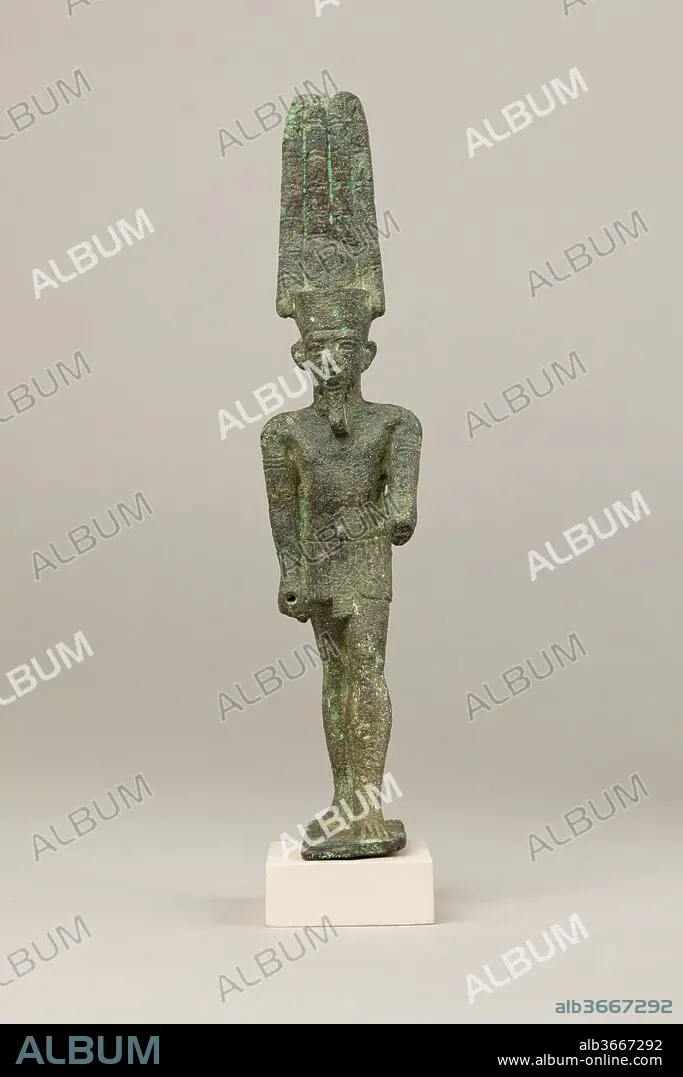
Amun
| Share |
|---|
 Pinterest Pinterest |
 Twitter Twitter |
 Facebook Facebook |
 Copy link Copy link |
 Email Email |
|
Add to another lightbox |
|
Add to another lightbox |


Buy this image.
Select the use:

Title: Amun
Caption: Amun. Dimensions: H. 15.7 cm (6 3/16 in.); W. 3.3 cm (1 5/16 in.); D. 5.2 cm (2 1/16 in.). Date: 664-30 B.C..
Amun was one of Egypt's most celebrated deities, worshipped as a universal, cosmic god and frequently called the king of the gods. In copper alloy he is almost invariably shown, as here, in anthropomorphic form wearing a short kilt and a tall double feather crown with a sun disc, which alludes to his solar and cosmic aspects, including his conflation with the sun god Re. Further elaborations on this statuette include a broad collar and arm bands. His right hand is socketed for the attachment of an attribute.
Amun gained tremendous popularity in the New Kingdom when he became a kind of national god, and this continued into later periods. His cult originated in Thebes and his temple at Karnak remains one of the most stunning achievements of Egyptian cult and architecture, but he was worshipped in temples and shrines throughout Egypt. In the first millennium BC, statuettes of Amun were offered at many sites throughout Egypt, perhaps in part because, according to some common epithets, he was considered to be a god who listened to and helped his people.
Technique/material: Cupreous metal
Period: Late Period-Ptolemaic Period
Museum: Metropolitan Museum of Art, New York, USA
Credit: Album
Releases: ? Model Release: No - ? Property Release: No
Rights questions?
Rights questions?
Image size: 2933 × 4400 px | 36.9 MB
Print size: 24.8 × 37.3 cm | 1154.7 × 1732.3 in (300 dpi)
Keywords: AFRICA • CUPREOUS METAL • EGYPT • EGYPTIAN ART • FIGURINES • FROM EGYPT • LATE PERIOD-PTOLEMAIC PERIOD • METAL • METROPOLITAN MUSEUM OF ART, NEW YORK, USA • SCULPTURE • STATUES
