

alb3650451
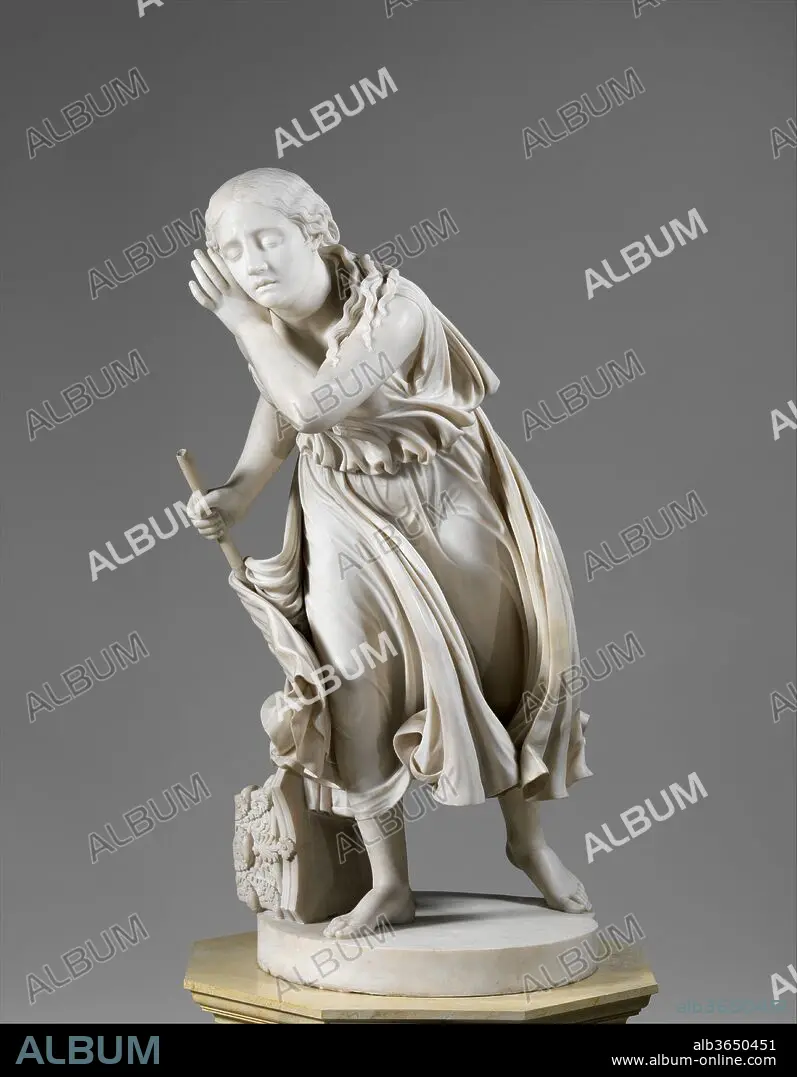
RANDOLPH ROGERS. Nydia, the Blind Flower Girl of Pompeii
| Share |
|---|
 Pinterest Pinterest |
 Twitter Twitter |
 Facebook Facebook |
 Copy link Copy link |
 Email Email |
|
Add to another lightbox |
|
Add to another lightbox |


Buy this image.
Select the use:

Author: RANDOLPH ROGERS (1825-1892)
Title: Nydia, the Blind Flower Girl of Pompeii
Caption: Nydia, the Blind Flower Girl of Pompeii. Artist: Randolph Rogers (American, Waterloo, New York 1825-1892 Rome). Dimensions: 54 x 25 1/4 x 37 in. (137.2 x 64.1 x 94 cm). Date: 1853-54; carved 1859.
"Nydia, the Blind Flower Girl of Pompeii" was the most popular American sculpture of the nineteenth century. According to Rogers, it was replicated 167 times in two sizes. The subject was drawn from "The Last Days of Pompeii" (1834), a widely read novel by Lord Edward Bulwer-Lytton, which ends with the eruption of Mount Vesuvius in a.d. 79. Rogers's evocative portrayal of Nydia highlights her heroic attempt to lead two companions out of the burning, ash-covered city. Her closed eyes and staff allude to her blindness, while the hand raised to her ear refers to her acute sense of hearing. The destruction of Pompeii is symbolized by the broken Corinthian capital beside her right foot.
Technique/material: Marble
Museum: Metropolitan Museum of Art, New York, USA
Credit: Album
Image size: 3309 × 4249 px | 40.2 MB
Print size: 28.0 × 36.0 cm | 1302.8 × 1672.8 in (300 dpi)
