

alb4014120
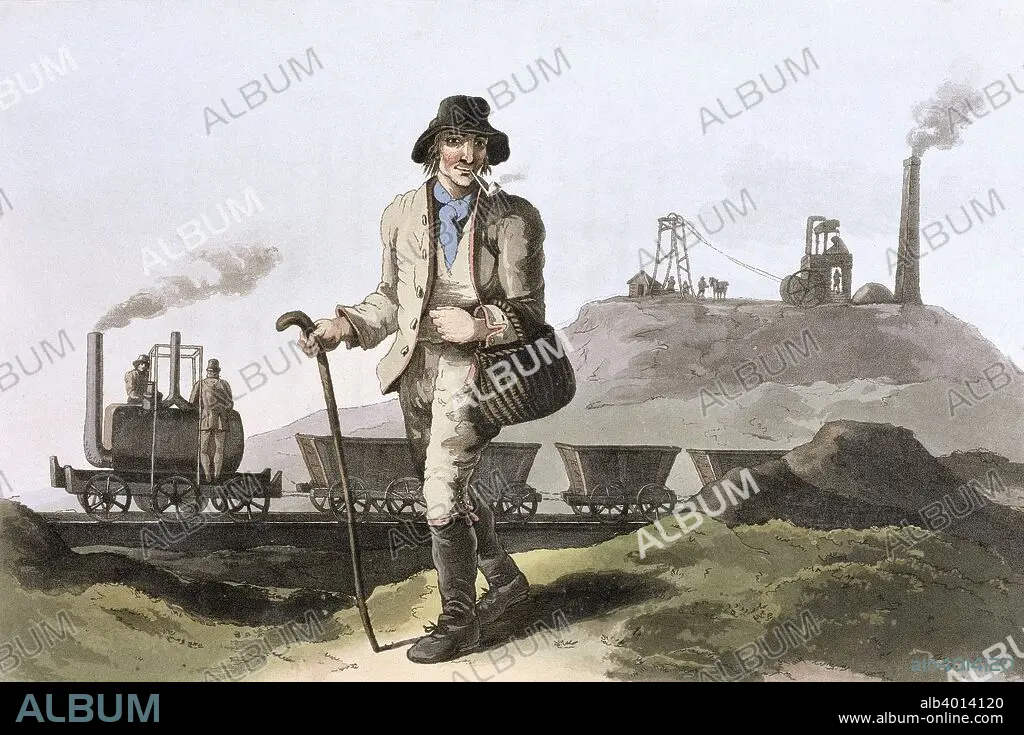
Blenkinsop steam locomotive at Middleton colliery near Leeds, West Yorkshire, 1814. Artist: Robert Havell
| Share |
|---|
 Pinterest Pinterest |
 Twitter Twitter |
 Facebook Facebook |
 Copy link Copy link |
 Email Email |
|
Add to another lightbox |
|
Add to another lightbox |


Buy this image.
Select the use:

Title: Blenkinsop steam locomotive at Middleton colliery near Leeds, West Yorkshire, 1814. Artist: Robert Havell
Caption: Blenkinsop steam locomotive at Middleton colliery near Leeds, West Yorkshire, 1814. From Costume of Yorkshire by George Walker, 1814. Mining engineer and inventor John Blenkinsop (1783-1831) designed the first practicable steam locomotive, the 'Salamanca', in 1812. It operated by means of a rack and pinion system. Richard Trevithick had built a steam locomotive in 1805 for Wylam colliery, but it had been too heavy for the cast iron rails it was meant to run on. Middleton colliery laid iron edge rails, which were stronger than those used at Wylam. Blenkinsop went on to build three further locomotives for the colliery, which carried on operating on the railway into the 1830s. In the meantime, further improvements in rail design meant that heavier adhesion locomotives could be used, superseding Blenkinsop's rack and pinion engines.
Credit: Album / Heritage Images / Historica Graphica Collection
Releases: ? Model Release: No - ? Property Release: No
Rights questions?
Rights questions?
Image size: 5126 × 3415 px | 50.1 MB
Print size: 43.4 × 28.9 cm | 2018.1 × 1344.5 in (300 dpi)
Keywords: 19TH CENTURY BC • BRITAIN • BRITISH • CENTURY • CLOTHES • COAL INDUSTRY • COAL MINE • COAL MINING • COAL TRUCK • COLLIERY • COLOR • COLOUR • CONCEPT • COSTUME • COUNTRY • DRESS • ENGLAND • ENGLISH • EVENT • EVENTS • FLUSH • GEORGE OF SEACROFT • GEORGE WALKER OF SEACROFT • GEORGE WALKER • GUY • HAT • HAVELL • INDUSTRIAL REVOLUTION • INDUSTRY • INNOVATION • INNOVATIONS • INVENTION • LOCATION • MALE • MAN • MECHANISM • MEN • MIDDLETON COLLIERY • MIDDLETON RAILWAY • PEOPLE • RACK AND PINION • RAILWAY • ROBERT HAVELL • ROBERT THE ELDER • SCIENCE • STEAM ENGINE • STEAM LOCOMOTIVE • STEAM POWER • STEAM • STEAM-ENGINE • STEAMENGINE • TECHNOLOGY • TRAIN • TRANSPORT • TRANSPORTATION • WALKER • WEST YORKSHIRE
