

alb5533930
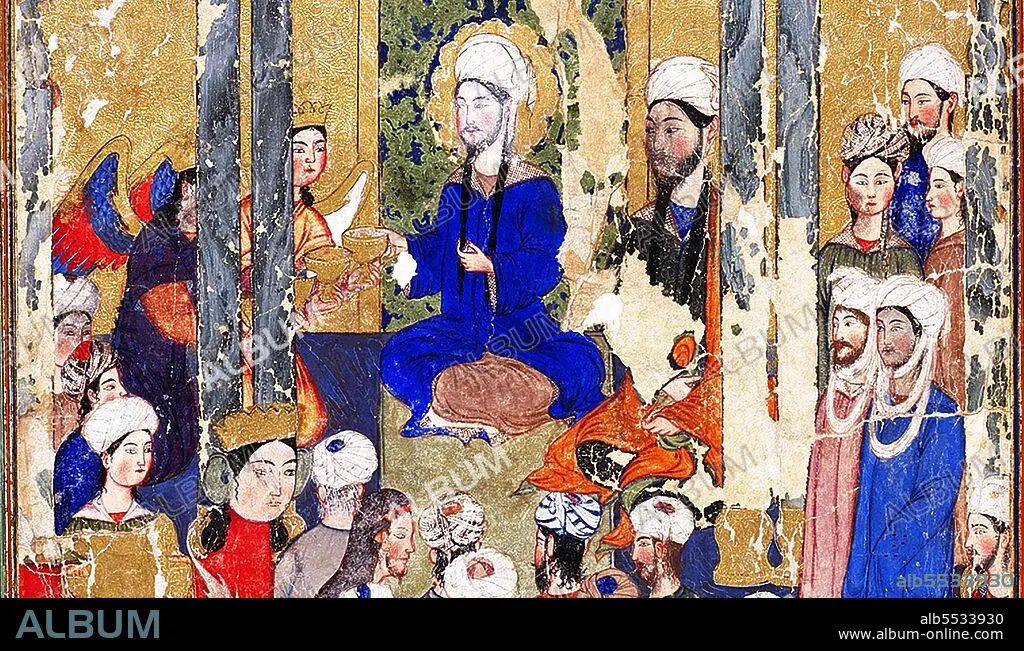
Turkey / Iran: The Prophet Muhammad sits with the Abrahamic prophets in Jerusalem, surrounded by angels (detail). From a Mirajnama (Book of Ascension) held in Istanbul's Topkapi Palace, Tabriz, c. 1320
| Share |
|---|
 Pinterest Pinterest |
 Twitter Twitter |
 Facebook Facebook |
 Copy link Copy link |
 Email Email |
|
Add to another lightbox |
|
Add to another lightbox |


Buy this image.
Select the use:

Title: Turkey / Iran: The Prophet Muhammad sits with the Abrahamic prophets in Jerusalem, surrounded by angels (detail). From a Mirajnama (Book of Ascension) held in Istanbul's Topkapi Palace, Tabriz, c. 1320
Caption: The Miraj forms part of the Night Journey that the prophet of Islam, Muhammad took during a single night around the year 621 CE. In the journey, Muhammad travels on the steed Buraq to 'the farthest mosque' where he leads other prophets in prayer. He then ascends to heaven where he speaks to God, who gives Muhammad instructions to take back to the faithful regarding the details of prayer. Representations of the Prophet Muhammad are controversial, and generally forbidden in Sunni Islam (especially Hanafiyya, Wahabi, Salafiyya). Shia Islam and some other branches of Sunni Islam (Hanbali, Maliki, Shafi'i) are generally more tolerant of such representational images, but even so the Prophet's features are generally veiled or concealed by flames as a mark of deep respect.
Credit: Album / Pictures From History/Universal Images Group
Releases: ? Model Release: No - ? Property Release: No
Rights questions?
Rights questions?
Image size: 5100 × 2978 px | 43.5 MB
Print size: 43.2 × 25.2 cm | 2007.9 × 1172.4 in (300 dpi)
Keywords: ANT. OR.: IRAN • ARAB • ARABE • ARABIA • ARABIAN • ARABIC • ARABS • ART • ARTS • ASIA IMAGE • ASIA PICTURES • ASIA • ASIAN IMAGE • ASIAN IMAGES • ASIAN PICTURES • ASIAN • BURAQ • HISTORIA UNIVERSAL • HISTORIA • HISTORICAL IMAGES • HISTORICAL PICTURES • HISTORICAL • HISTORY IMAGES • HISTORY PICTURES • HISTORY • HISTORY. • IRAN • IRANIAN • ISLAM • ISLAMISM • ISRA • LEGEND • MIDDLE EAST • MINIATURE • MIRAJ • MUHAMMAD • MUSLIM WORLD • MUSLIM • MYTH: PERSIAN • NABI • PAINT • PAINTING • PAINTINGS • PERSIA • PERSIAN ART • PERSIAN MYTH • PERSIAN • PROPHET MUHAMMAD • PROPHET, THE • RASUL ALLAH • RELIGION • SCRIPTS • WRITING
