

alb3798747
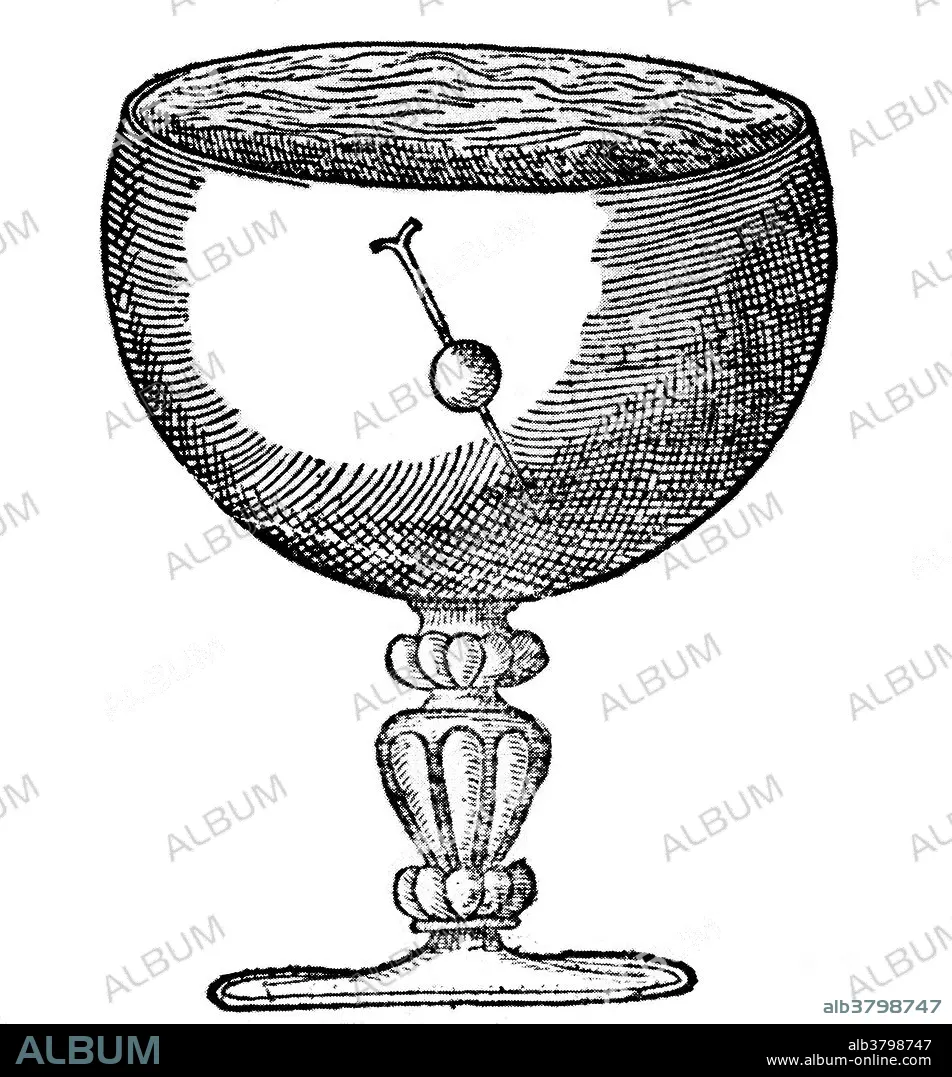
Gilbert's Experiment Showing Magnetic Dip
| Share |
|---|
 Pinterest Pinterest |
 Twitter Twitter |
 Facebook Facebook |
 Copy link Copy link |
 Email Email |
|
Add to another lightbox |
|
Add to another lightbox |


Buy this image.
Select the use:

Title: Gilbert's Experiment Showing Magnetic Dip
Caption: Illustration from De Magnete by Gilbert, published in 1600 showing a magnetic needle slanting at the dip angle when suspended in water with just enough buoyancy to keep it hovering. Magnetic dip is the angle made with the horizontal by the compass needle of a vertically held compass. This angle varies at different points on the Earth's surface. Magnetic dip results from the tendency of a magnet to align itself with lines of force. As the Earth's magnetic lines of force are not parallel to the surface, the north end of a compass needle will point downward on the northern hemisphere (positive dip) or upward on the southern hemisphere (negative dip). William Gilbert (May 24, 1544 - November 30, 1603) was an English physician, physicist and natural philosopher. He was the first to argue that the center of the Earth was iron, and he considered an important and related property of magnets was that they can be cut, each forming a new magnet with north and south poles. He invented the first electrical measuring instrument, the electroscope, in the form of a pivoted needle he called the versorium. He died in 1603 at the age of 59. His cause of death is thought to have been the bubonic plague.
Category: ILLUSTRATION • Science: History
Credit: Album / Science Source / New York Public Library
Releases: ? Model Release: No - ? Property Release: No
Rights questions?
Rights questions?
Image size: 3600 × 3874 px | 39.9 MB
Print size: 30.5 × 32.8 cm | 1417.3 × 1525.2 in (300 dpi)
Keywords: 16 16TH XVI XVITH SIXTEENTH CENTURY • 16 CENTURY • 16TH CENTURY • 16TH • 17TH CENTURY • ART • ARTWORK • BW • DE MAGNETE • DIP ANGLE • DRAWING • EARTH'S MAGNETIC FIELD • ENGLISH • EUROPEA • EUROPEAN • EUROPEANS • EXPERIENCE • EXPERIMENT CONSTRUCTION = SETTING UP EXPERIMENT • EXPERIMENT CONSTRUCTION • EXPERIMENT • FATHER OF ELECTRICAL ENGINEERING • GEOMAGNETIC FIELD • GEOMAGNETISM • GEOPHYSICS • GILBERT • GLASS • GOBLET • HISTORIC • HISTORICAL • HISTORY • ILLUSTRATION • ILLUSTRATIONS • ILUSTRATION • MAGNET • MAGNETIC DIP • MAGNETIC FIELD • MAGNETIC INCLINATION • MAGNETIC LINES OF FORCE • MAGNETIC NEEDLE • MAGNETIC • MAGNETISM • PHYSICIST • PHYSICS • SCIENCE • SCIENCE: HISTORY • SETTING UP EXPERIMENT • WILLIAM GILBERT • WOODBLOCK PRINT • WOODBLOCK • WOODCARVING • WOODCUT • XVI CENTURY • XYLOGRAPHY
