

alb9696207
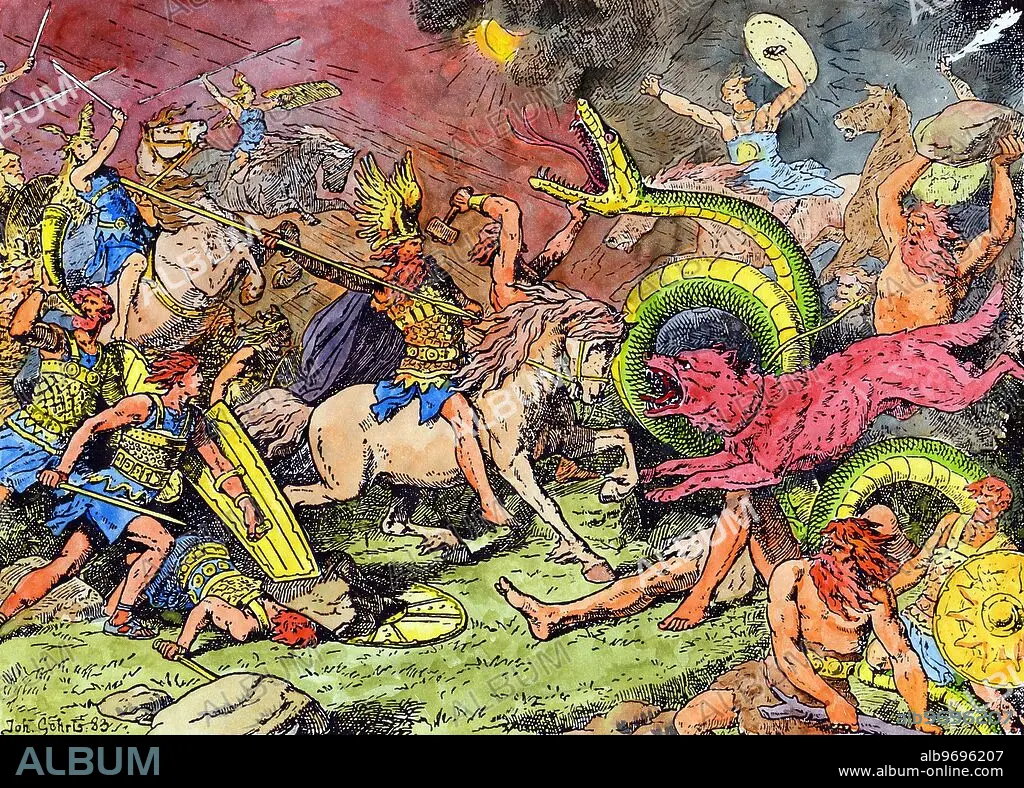
TEUTONIC MYTHOLOGY - RAGNAROK - AESIR. Ragnarok, the so-called Day of Doom, of the Teutonic mythology, which is really the Doomsday of the Gods, sometimes called, less dramatically, and less accurately, the Twilight of the Gods. Hand-coloured engraving after the painting by Johannes Gerhts, 1883. The story of the dramatic conflicts, leading to the End, or Ragnarok, is told in the Voluspa, wherein is told the destruction of the Aesir, or the entourage of the god Odin. The period of discontent and conflict begins with seven Fimbul winters, in which the light and warmth of the sun are occulted. This severe cold is followed by a period of War between All, the so-called Wolf Age - so-called because the Sun is now obscured by the wolf Fenrir (visible to the right of Gehrts painting). So terrible is the conflict, that the Earth itself shudders, and the sea floods the earth. The last of the front giants, Hyrm pilots the ship Nagalfar, the equivalent of the biblical Ark. In Gehrts' picture, Odin (with winged helm, to the fore), leads the Aesir against the Muspel, or Fire Giants, but (as the painting indicates) is shortly killed by the wolf Fenrir. Behind Odin, on foot, is Thor with his magical hammer, gripping the Serpent of Midgard (Jormungard) by the neck. It is said that the only survivors of the conflict were Vidar and Vali, and the two sons of Thor.
| Share |
|---|
 Pinterest Pinterest |
 Twitter Twitter |
 Facebook Facebook |
 Copy link Copy link |
 Email Email |
|
Add to another lightbox |
|
Add to another lightbox |


Buy this image.
Select the use:

Caption: TEUTONIC MYTHOLOGY - RAGNAROK - AESIR. Ragnarok, the so-called Day of Doom, of the Teutonic mythology, which is really the Doomsday of the Gods, sometimes called, less dramatically, and less accurately, the Twilight of the Gods. Hand-coloured engraving after the painting by Johannes Gerhts, 1883. The story of the dramatic conflicts, leading to the End, or Ragnarok, is told in the Voluspa, wherein is told the destruction of the Aesir, or the entourage of the god Odin. The period of discontent and conflict begins with seven Fimbul winters, in which the light and warmth of the sun are occulted. This severe cold is followed by a period of War between All, the so-called Wolf Age - so-called because the Sun is now obscured by the wolf Fenrir (visible to the right of Gehrts painting). So terrible is the conflict, that the Earth itself shudders, and the sea floods the earth. The last of the front giants, Hyrm pilots the ship Nagalfar, the equivalent of the biblical Ark. In Gehrts' picture, Odin (with winged helm, to the fore), leads the Aesir against the Muspel, or Fire Giants, but (as the painting indicates) is shortly killed by the wolf Fenrir. Behind Odin, on foot, is Thor with his magical hammer, gripping the Serpent of Midgard (Jormungard) by the neck. It is said that the only survivors of the conflict were Vidar and Vali, and the two sons of Thor.
Credit: Album / Charles Walker / TopFoto
Releases: ? Model Release: No - ? Property Release: No
Rights questions?
Rights questions?
Image size: 2608 × 1871 px | 14.0 MB
Print size: 22.1 × 15.8 cm | 1026.8 × 736.6 in (300 dpi)
