

alb5144626
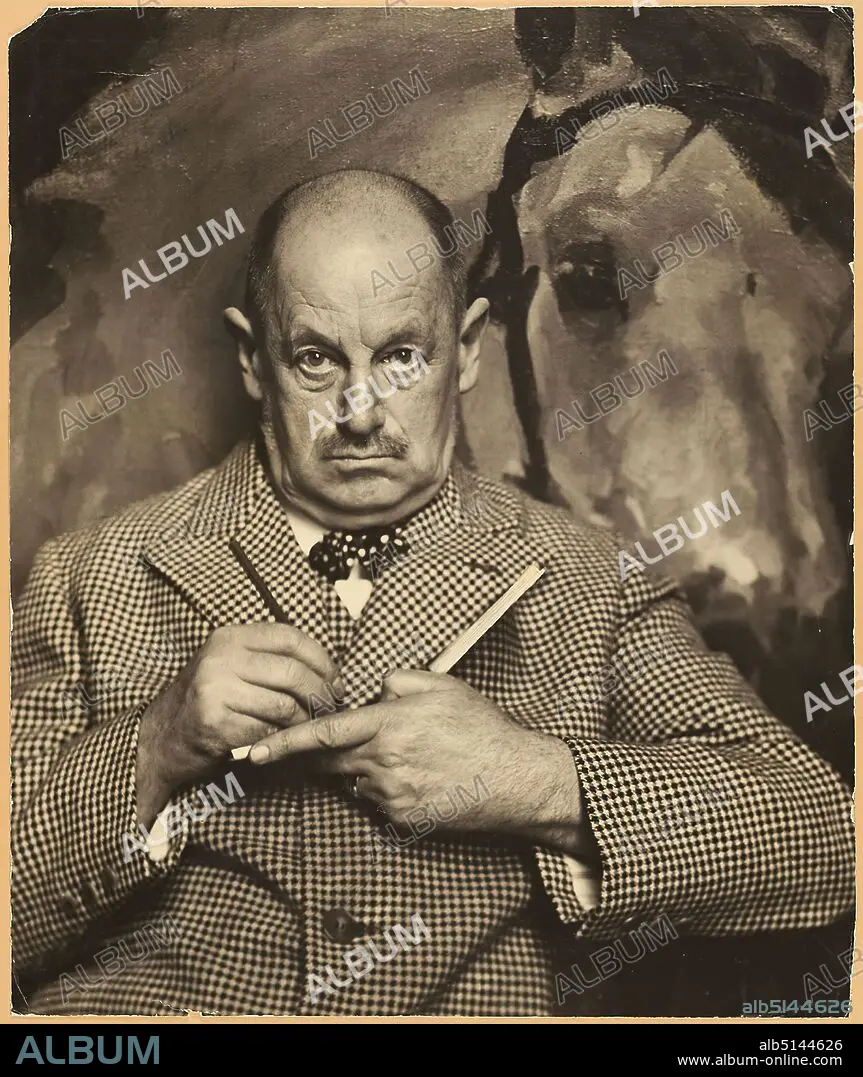
Hugo Erfurth, Max Feldbauer, Staatliche Landesbildstelle Hamburg, collection on the history of photography, silver gelatin paper, black and white positive process, image size: height: 67.7 cm; width: 56.5 cm, label: cardboard verso top left: in typescript: Hugo Erfurth /Max Feldbauer, handwritten with black felt-tip pen, supplemented: c. 1920; Hugo Erfurth, Dresden/Cologne, Max Feldbauer, c. 1920, stamp: cardboard verso and center: handwritten in lead supplemented: cabinet 14/15, upper drawer, portrait photography, portrait, artist, painting, horse, book, At the beginning of the 20th century, Hugo Erfurth is one of the most famous professional photographers in Germany, along with Rudolph Dührkoop and Nicola Perscheid. After completing an apprenticeship as a photographer, he opened his own studio in Dresden at the age of only 22. Soon Erfurth orientated himself towards the up-and-coming pictorialist photography, participated in numerous amateur photographic exhibitions from 1894 onwards and managed to make a name for himself both as an artistically ennobled amateur and successful professional photographer. Portraits are central to his work, which he began taking in 1906 in his new studio, a classicist palace, in a stylishly elegant ambience, appealing to the wealthy bourgeoisie. He also produced numerous portraits of famous personalities, including Käthe Kollwitz, Otto Dix and Joachim Ringelnatz. While his studies around 1905 still show full-length figures depicted in an atmospheric way, from the 1920s onward the focus is on the face, which is photographed against a simple monochrome background. Here, his pictorial approach corresponds to the portrait of classical modernism, whereby the technique of oil printing emphasizes the softness and materiality of the pigments and at the same time places the portraits in the art-photographic tradition. Erfurth is a co-founder of the Gesellschaft Deutscher Lichtbildner (1919), teaches at the Leipzig Academy and moves from Dre.
| Share |
|---|
 Pinterest Pinterest |
 Twitter Twitter |
 Facebook Facebook |
 Copy link Copy link |
 Email Email |
|
Add to another lightbox |
|
Add to another lightbox |


Buy this image.
Select the use:

Caption: Hugo Erfurth, Max Feldbauer, Staatliche Landesbildstelle Hamburg, collection on the history of photography, silver gelatin paper, black and white positive process, image size: height: 67.7 cm; width: 56.5 cm, label: cardboard verso top left: in typescript: Hugo Erfurth /Max Feldbauer, handwritten with black felt-tip pen, supplemented: c. 1920; Hugo Erfurth, Dresden/Cologne, Max Feldbauer, c. 1920, stamp: cardboard verso and center: handwritten in lead supplemented: cabinet 14/15, upper drawer, portrait photography, portrait, artist, painting, horse, book, At the beginning of the 20th century, Hugo Erfurth is one of the most famous professional photographers in Germany, along with Rudolph Dührkoop and Nicola Perscheid. After completing an apprenticeship as a photographer, he opened his own studio in Dresden at the age of only 22. Soon Erfurth orientated himself towards the up-and-coming pictorialist photography, participated in numerous amateur photographic exhibitions from 1894 onwards and managed to make a name for himself both as an artistically ennobled amateur and successful professional photographer. Portraits are central to his work, which he began taking in 1906 in his new studio, a classicist palace, in a stylishly elegant ambience, appealing to the wealthy bourgeoisie. He also produced numerous portraits of famous personalities, including Käthe Kollwitz, Otto Dix and Joachim Ringelnatz. While his studies around 1905 still show full-length figures depicted in an atmospheric way, from the 1920s onward the focus is on the face, which is photographed against a simple monochrome background. Here, his pictorial approach corresponds to the portrait of classical modernism, whereby the technique of oil printing emphasizes the softness and materiality of the pigments and at the same time places the portraits in the art-photographic tradition. Erfurth is a co-founder of the Gesellschaft Deutscher Lichtbildner (1919), teaches at the Leipzig Academy and moves from Dre
Personalities: HUGO ERFURTH • JOACHIM RINGELNATZ • MAX FELDBAUER • NICOLA PERSCHEID
Credit: Album / quintlox
Releases: ? Model Release: No - ? Property Release: No
Rights questions?
Rights questions?
Image size: 3640 × 4320 px | 45.0 MB
Print size: 30.8 × 36.6 cm | 1433.1 × 1700.8 in (300 dpi)
Keywords: 1894 ONWARDS • 1905 • 1906 • 1920 • 1920S ONWARD • 20 20TH XX XXTH TWENTIETH CENTURY • 20 XX TWENTIETH CENTURY • 20TH CENTURY • 20TH • AGE • ÂGÉS • APPEALING • APPRENTICESHIP • ARCHIVE • ARCHIVES • ART COLLECTION • ART-PHOTOGRAPHIC TRADITION • ARTFORM • ARTIST • ARTISTE • ARTISTICALLY ENNOBLED AMATEUR • ATMOSPHERIC WAY • BEGAN TAKING • BLACK FELT-TIP PEN • BLACK PERSON • BLACK RACE • BLACK • BOOK • BOOKS • BUILDS UP • C • CABINET 14 • CALLING • CARDBOARD VERSO TOP LEFT • CARDBOARD VERSO • CATHRIN HAUSWALD • CENTER • CENTRAL • CLASSICAL MODERNISM • CLASSICIST PALACE • CO-FOUNDER • COLLECTION • COLOGNE STUDIO • COLOGNE • COMPLETING • DESTROYED • DRESDEN • EQUUS CABALLUS • ERFURTH RESCUED • ERFURTH • FACE • FAMOUS PERSONALITIES • FAMOUS PROFESSIONAL PHOTOGRAPHERS • FOCUS • FOCUSING • FOTOGRAFIA • FULL-LENGTH FIGURES DEPICTED • GAIENHOFEN • GERMANY • GESELLSCHAFT DEUTSCHER LICHTBILDNER • HANDWRITTEN • HISTORIA UNIVERSAL • HISTORIA • HISTORY • HISTORY. • HORSE'S • HORSE • HORSES HORSE • HORSES • HUGO ERFURTH • IN TYPESCRIPT • JOACHIM RINGELNATZ • KÄTHE KOLLWITZ • LABEL • LAKE CONSTANCE • LEAD SUPPLEMENTED • LEIPZIG ACADEMY • LIBRO • LIBROS • MANAGED • MATERIALITY • MAX FELDBAUER • MOMENT IN TIME • MOVES • NAME • NEGRA • NEW STUDIO • NICOLA PERSCHEID • NUMEROUS AMATEUR PHOTOGRAPHIC EXHIBITIONS • OIL PRINTING EMPHASIZES • OLD • OPEN • OPENED • OTTO DIX • OWN STUDIO • PAINT • PAINTING • PAINTINGS • PARTICIPATED • PHOTO • PHOTOGRAPH • PHOTOGRAPHED • PHOTOGRAPHER • PHOTOGRAPHIE • PHOTOGRAPHY • PHOTOS • PICTORIAL APPROACH CORRESPONDS • PIGMENTS • PORTAIT • PORTRAIT PHOTOGRAPHY • PORTRAIT • PORTRAITS • POTRAIT • PRODUCED NUMEROUS PORTRAITS • RIDING • RUDOLPH DÜHRKOOP • SECOND WORLD WAR • SILVER GELATIN PAPER • SIMPLE MONOCHROME BACKGROUND • SOFTNESS • SOON ERFURTH ORIENTATED • STAATLICHE LANDESBILDSTELLE HAMBURG • STAMP • STUDIES • STYLISHLY ELEGANT AMBIENCE • SUCCESSFUL PROFESSIONAL PHOTOGRAPHER • SUPPLEMENTED • TECHNICAL • TECHNIQUE • TECHNOLOGY • TEHNOLOGY • THE • TIME PLACES • TOWARDS • TWENTIETH CENTURY • UP-AND-COMING PICTORIALIST PHOTOGRAPHY • UPPER DRAWER • VISAGE • WEALTHY BOURGEOISIE • WHEREBY • WHITE POSITIVE PROCESS • WORK
