

alb3609798
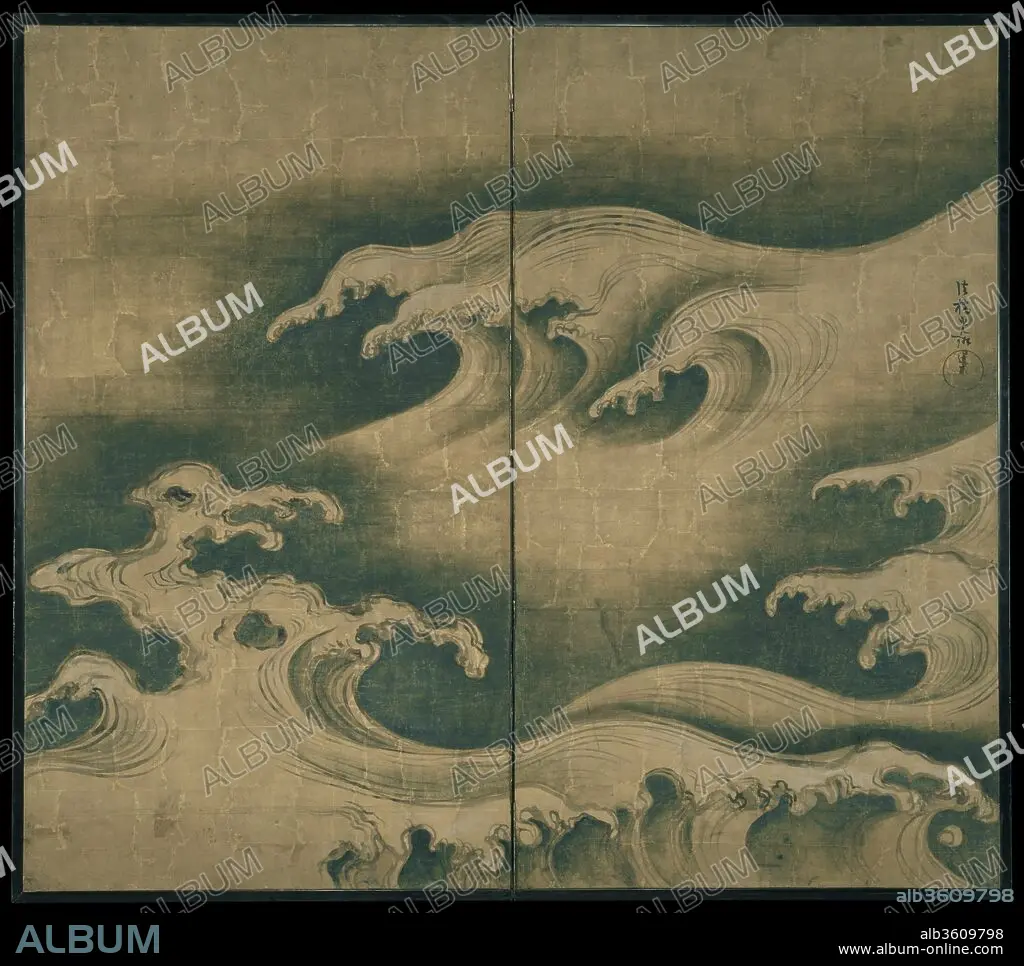
OGATA KORIN. Rough Waves
| Share |
|---|
 Pinterest Pinterest |
 Twitter Twitter |
 Facebook Facebook |
 Copy link Copy link |
 Email Email |
|
Add to another lightbox |
|
Add to another lightbox |


Buy this image.
Select the use:

Author: OGATA KORIN (1658-1716)
Title: Rough Waves
Caption: Rough Waves. Artist: Ogata Korin (Japanese, 1658-1716). Culture: Japan. Dimensions: Image: 57 11/16 x 65 1/8 in. (146.5 x 165.4 cm)
Overall: 59 1/4 x 66 1/2 in. (150.5 x 168.9 cm). Date: ca. 1704-9.
Many artists and poets of the East and West alike have striven to capture the transitory and fleeting image of swelling waves. Korin's rendition--one of Japan's most striking representations of this amorphous, ungraspable form--has a strangely menacing feel, due no doubt to the long, tentacle-like fingers of foam, punctured here and there by openings. Outlined in ink using the ancient Chinese technique of drawing with two brushes held together in one hand, the clawlike waves are peculiarly reminiscent of dragons' talons. The immediate inspiration for the screen may have been images by Sesson Shukei (ca. 1504-ca. 1589), whose extant works include a number of dynamic and mysterious renderings of waves.
The screen bears a seal reading "Dosu," the name Korin adopted in 1704. Recent research suggests that the screen was executed between 1704 and 1709, when Korin was residing in Edo (now Tokyo).
Technique/material: Two-panel folding screen; ink, color, and gold leaf on paper
Period: Edo period (1615-1868)
Museum: Metropolitan Museum of Art, New York, USA
Credit: Album
Image size: 4002 × 3568 px | 40.9 MB
Print size: 33.9 × 30.2 cm | 1575.6 × 1404.7 in (300 dpi)
Keywords: ASIA • ASIAN ART • EDO PERIOD (1615-1868) • FOLDING SCREENS • FURNITURE • GOLD LEAF • GOLD • GOLDFOIL • INK • JAPAN • METAL • METROPOLITAN MUSEUM OF ART, NEW YORK, USA • OGATA KORIN • PANELS • PAPER • SCREENS • TWO-PANEL FOLDING SCREEN; INK, COLOR, AND GOLD LEAF ON PAPER
