

alb4185097
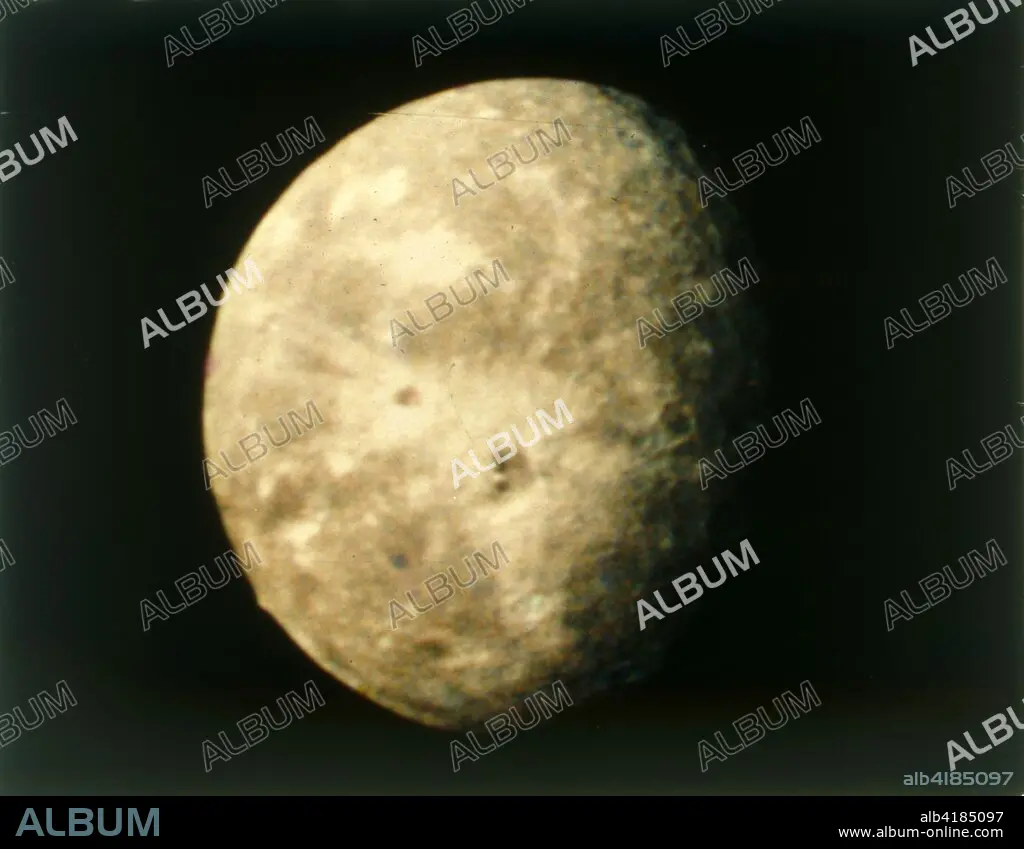
Oberon, moon of Uranus, from Voyager 2, 24 January 1986. Creator: NASA.
| Share |
|---|
 Pinterest Pinterest |
 Twitter Twitter |
 Facebook Facebook |
 Copy link Copy link |
 Email Email |
|
Add to another lightbox |
|
Add to another lightbox |


Buy this image.
Select the use:

Title: Oberon, moon of Uranus, from Voyager 2, 24 January 1986. Creator: NASA.
Caption: Oberon, moon of Uranus, from Voyager 2, 24 January 1986. This image of Oberon is the best the unmanned Voyager 2 spacecraft acquired of Uranus' outermost moon. The picture was taken from a distance of 660,000 kilometers (410,000 miles). The colour was reconstructed from images taken through the narrow-angle camera's violet, clear and green filters. The picture shows features as small as 12 km (7 miles) on the moon's surface. Clearly visible are several large impact craters in Oberon's icy surface surrounded by bright rays similar to those seen on Jupiter's moon Callisto. Quite prominent near the centre of Oberon's disk is a large crater with a bright central peak and a floor partially covered with very dark material. This may be icy, carbon-rich material erupted onto the crater floor sometime after the crater formed. Also visible is a large mountain, about 6 km (4 miles) high.
Credit: Album / Heritage Images / Heritage Space
Releases: ? Model Release: No - ? Property Release: No
Rights questions?
Rights questions?
Image size: 5298 × 4120 px | 62.4 MB
Print size: 44.9 × 34.9 cm | 2085.8 × 1622.0 in (300 dpi)
Keywords: 1980S • 20TH CENTURY • 80S • AEROSPACE • ASTRONAUTICS • ASTRONOMIA • ASTRONOMY • CENTURY • COLOR • COLOUR • CRATER (GEOLOGY) • CRATER • CRATER, VOLCANO • CRATERS • DECADE • EIGHTIES • EIGHTIES, THE • FLUSH • GALAXY • GEOGRAFIA • GEOGRAPHICAL FEATURE • GEOGRAPHY • GEOLOGIA • GEOLOGY • LUNA • LUNAR • MOON • MOUNTAIN RANGE • MOUNTAIN • MOUNTAINS • NASA • NATIONAL AERONAUTICS AND SPACE ADMINISTRATION • OBERON • OUTERSPACE • PHOTOGRAPH • PLANET • PLANETS • RANGE • SCIENCE • SIERRA • SOLAR SYSTEM • SPACE (COSMOS) • SPACE EXPLORATION • SPACE TRAVEL • SPACE • SPACECRAFT • SPATIAL • UNIVERSE • URANUS IV • URANUS • VOYAGER 2
