

alb3823455
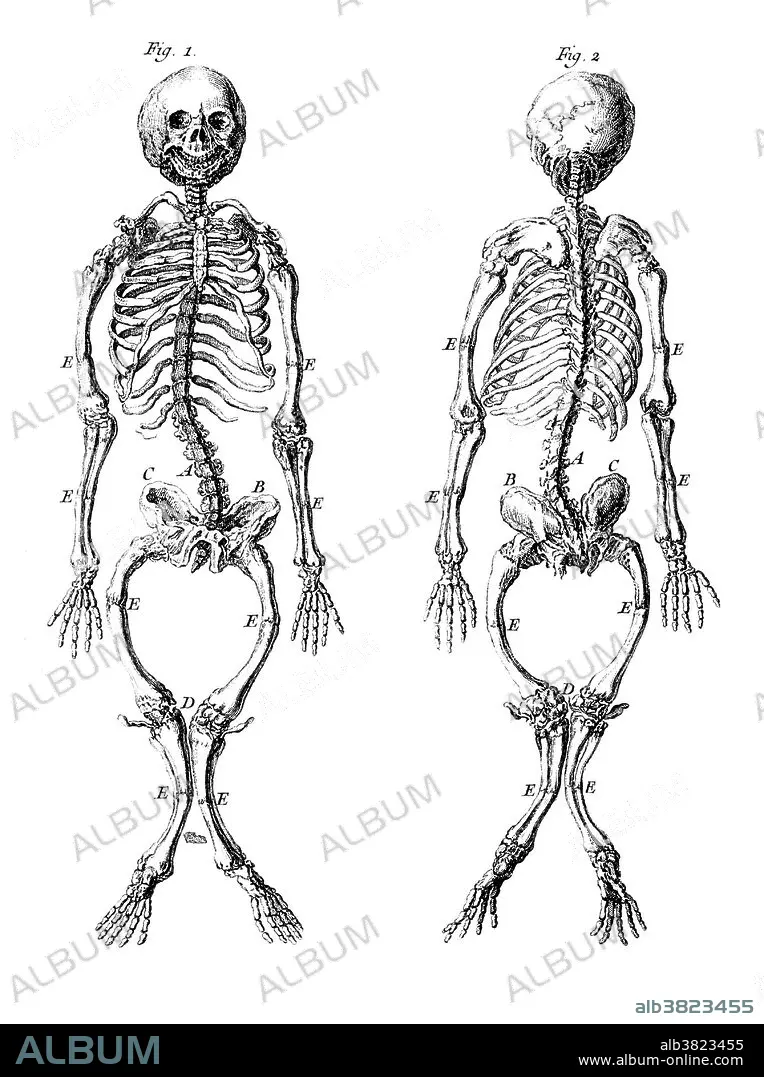
Rickets Skeleton, 1749
| Share |
|---|
 Pinterest Pinterest |
 Twitter Twitter |
 Facebook Facebook |
 Copy link Copy link |
 Email Email |
|
Add to another lightbox |
|
Add to another lightbox |


Buy this image.
Select the use:

Title: Rickets Skeleton, 1749
Caption: A rachitic skeleton, measuring two feet two inches in length, seen from the front and the back. Rickets is among the most frequent childhood diseases in many developing countries. The predominant cause is a vitamin D deficiency, but lack of adequate calcium in the diet may also lead to rickets. A sufficient amount of ultraviolet B light in sunlight each day and adequate supplies of calcium and phosphorus in the diet can prevent rickets. Darker-skinned people need to be exposed longer to the ultraviolet rays. The replacement of vitamin D has been proven to correct rickets using these methods of ultraviolet light therapy and medicine. Engraving, 1749.
Category: ILLUSTRATION • black & white • Medical: History
Credit: Album / Science Source / Wellcome Images
Releases: ? Model Release: No - ? Property Release: No
Rights questions?
Rights questions?
Image size: 3245 × 4350 px | 40.4 MB
Print size: 27.5 × 36.8 cm | 1277.6 × 1712.6 in (300 dpi)
Keywords: 1749 1740S • 18TH CENTURY • 18TH CENTURY, THE • 18TH CENTURY. • 18TH • ABNORMAL • ART • ARTWORK • BANDINESS • BANDY-LEG • BLACK & WHITE • BONE DISEASE • BONE DISORDER • BOW LEGGED • BOW LEGS • BOW-LEGGED • BOW-LEGGEDNESS • BOWED LEGS • BOWLEGGED • BOWLEGS • BW • CALCIUM DEFICIENCY • CALCIUM DEFICIENT • CHILDHOOD DISEASE • DEFORMATION • DEFORMED • DISEASE • DISORDER • DRAWING • ENGRAVING • FULL FIGURE • GENU VARUM • HISTORIC • HISTORICAL • HISTORY • HUMAN BONES • ILLUSTRATION • ILLUSTRATIONS • ILUSTRATION • MALFORMATION • MALFORMED • MALNUTRITION • MEDICAL • MEDICAL: HISTORY • MEDICINAL • MEDICINE • MESS • MESSY • OSTEOMALACIA • PAEDIATRICS • PATHOLOGY • PEDIATRICS • RICKETS • SCIENCE • SKELETAL DISEASE • SKELETAL DISORDER • SKELETAL • SKELETON • TIBIA VARA • UNHEALTHY • VITAMIN D DEFICIENCY • VITAMIN DEFICIENCY • VITAMIN DEFICIENT • XVIII CENTURY
