

alb5479621
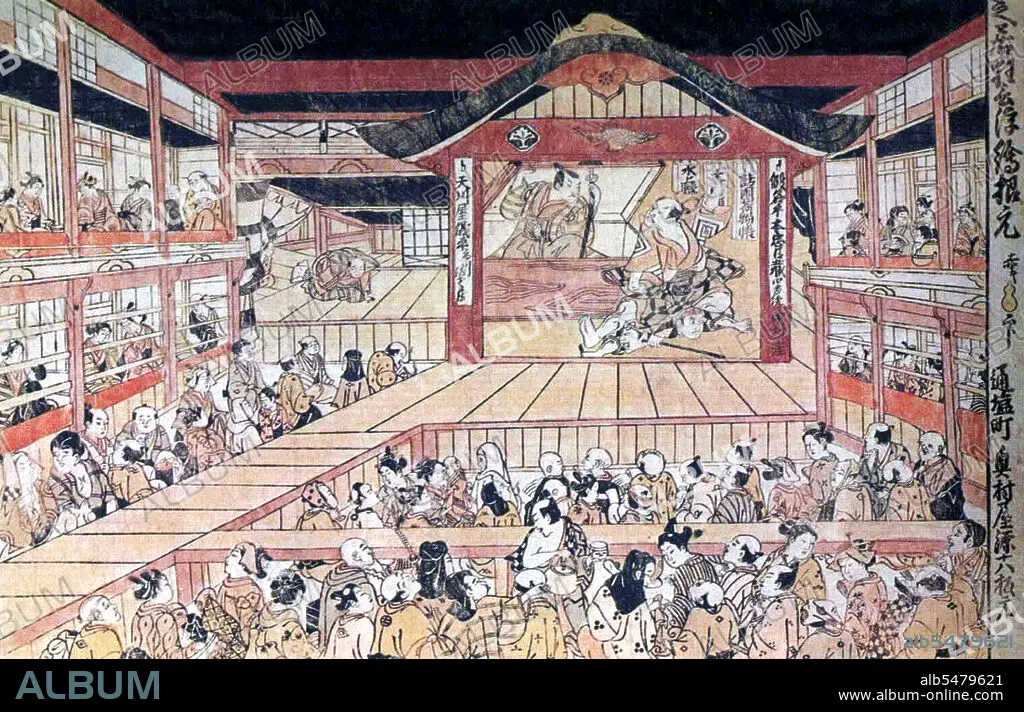
Ukiyo-e painting of a Kabuki theatre in old Edo (Tokyo), Tokugawa,18th century.
| Share |
|---|
 Pinterest Pinterest |
 Twitter Twitter |
 Facebook Facebook |
 Copy link Copy link |
 Email Email |
|
Add to another lightbox |
|
Add to another lightbox |


Buy this image.
Select the use:

Title: Ukiyo-e painting of a Kabuki theatre in old Edo (Tokyo), Tokugawa,18th century.
Caption: Kabuki is a classical Japanese dance-drama. Kabuki theatre is known for the stylization of its drama and for the elaborate make-up worn by some of its performers. The individual kanji characters, from left to right, mean sing, dance, and skill. Kabuki is therefore sometimes translated as the art of singing and dancing'. These are, however, ateji characters which do not reflect actual etymology. The kanji of 'skill' generally refers to a performer in kabuki theatre. Since the word kabuki is believed to derive from the verb kabuku, meaning 'to be out of the ordinary', kabuki can be interpreted as 'avant-garde' theatre.
Credit: Album / Pictures From History/Universal Images Group
Releases: ? Model Release: No - ? Property Release: No
Rights questions?
Rights questions?
Image size: 5023 × 3231 px | 46.4 MB
Print size: 42.5 × 27.4 cm | 1977.6 × 1272.0 in (300 dpi)
Keywords: ACTING • ACTOR (FEMALE) • ACTOR • ACTORS • ACTRESS (FICTION) • ACTRESS • AMUSEMENT • ART • ARTS • ASIA • ASIAN • COMEDIAN • COMICAL • DIVERSION • DIVERTISSEMENT • ENTERTAINMENT • ENTERTAINMENTS • HISTORIA UNIVERSAL • HISTORIA • HISTORICAL • HISTORY • HISTORY. • JAPAN • JAPANESE • KABUKI • LEGEND • PAINT • PAINTING • PAINTINGS • STYLE • UKIYO-E • WOODBLOCK
