

alb5469981
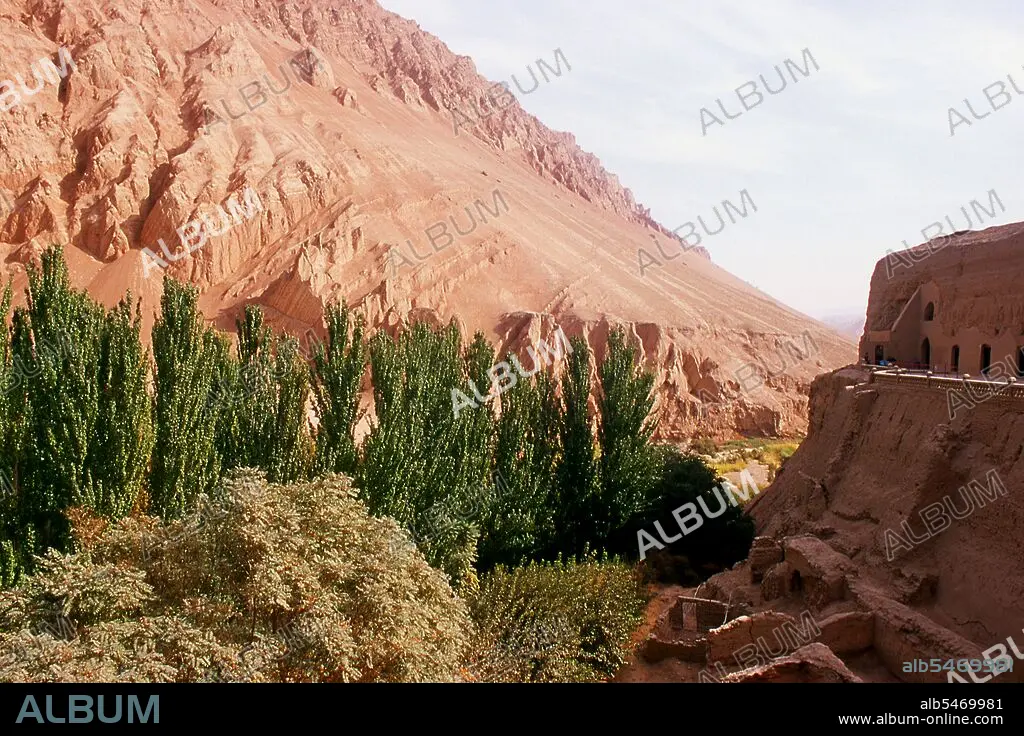
China: Bezeklik Thousand Buddha Caves, Turfan, Xinjiang Province
| Share |
|---|
 Pinterest Pinterest |
 Twitter Twitter |
 Facebook Facebook |
 Copy link Copy link |
 Email Email |
|
Add to another lightbox |
|
Add to another lightbox |


Buy this image.
Select the use:

Title: China: Bezeklik Thousand Buddha Caves, Turfan, Xinjiang Province
Caption: The Bezeklik Thousand Buddha Caves (Bozikeli Qian Fo Dong) are complex of Buddhist cave grottos dating from the 5th to the 9th centuries. There are 77 rock-cut caves at the site. Some ceilings are painted with a large Buddha surrounded by other figures, including Indians, Persians and Europeans. The quality of the murals vary with some being artistically naive while others are masterpieces of religious art. The Turpan Oasis was a strategically significant centre on Xinjiang’s Northern Silk Route, site of the ancient cities of Yarkhoto (Jiaohe) and Karakhoja (Gaochang). Chinese armies first entered Turpan in the 2nd century BC, during the reign of Han Emperor Wu Di (141-87) when the oasis was a centre of Indo-European Tocharian culture. Turpan retained a distinctly Buddhist character until the time of the Chagatai Khanate in the 13th century, when Islam gradually became the dominant religion.
Credit: Album / Pictures From History/Universal Images Group
Releases: ? Model Release: No - ? Property Release: No
Rights questions?
Rights questions?
Image size: 5100 × 3400 px | 49.6 MB
Print size: 43.2 × 28.8 cm | 2007.9 × 1338.6 in (300 dpi)
Keywords: ART • ARTFORM: FRESCO • ARTS • ASIA IMAGES • ASIA PICTURES • ASIA • ASIAN IMAGE • ASIAN IMAGES • ASIAN PICTURES • ASIAN • BEZEKLIK CAVES • BOUTIQUE • BUDDHISM • BUDDHISM, BHUTANESE • BUDDHIST • CAVE • CAVERN • CAVES • CAVITY • CENTRAL ASIA • CHINA • CHINE • CHINESE • COMMERCE • CULT, BUDDHIST • DAVID HENLEY • ECONOMY • FRESCO • FRESCOES • FRESCOS • FRESH • GALLERY 021 • GROTTE • GROTTO • HISTORIA UNIVERSAL • HISTORIA • HISTORICAL IMAGES • HISTORICAL PICTURES • HISTORICAL • HISTORY IMAGES • HISTORY PICTURES • HISTORY • HISTORY. • LEGEND • MURAL PAINTING • MURAL • MURALS • MUSLIM WORLD • PAINT • PAINTING • PAINTINGS • PORCELAIN • RELIGION • SAN JIAO • SILK ROAD • SILK ROUTE • TRADE ROUTES • TRADE • TRADING • TULUFAN • TURPAN • WALL PAINTING • WALLPAINTING • XINJIANG
