alb8370507
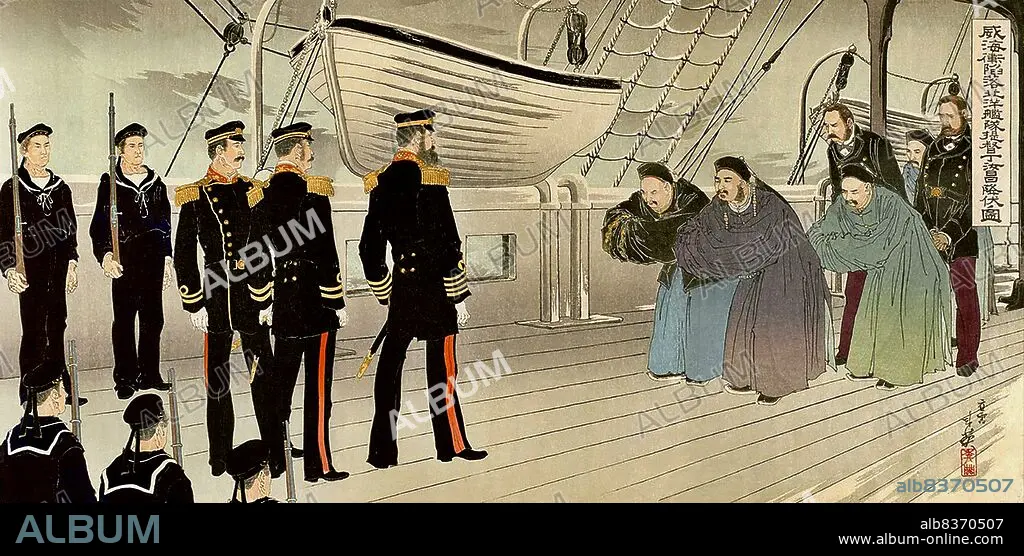
Japan: Meiji Period woodblock print depicting the surrender of Chinese forces after the Battle of Weihaiwei, by Mizuno Toshikata (1866-1908),1895
| Share |
|---|
 Pinterest Pinterest |
 Twitter Twitter |
 Facebook Facebook |
 Copy link Copy link |
 Email Email |
|
Add to another lightbox |
|
Add to another lightbox |


Buy this image.
Select the use:

Title:
Japan: Meiji Period woodblock print depicting the surrender of Chinese forces after the Battle of Weihaiwei, by Mizuno Toshikata (1866-1908),1895
Caption:
The First Sino-Japanese War (1 August 1894 - 17 April 1895) was waged between Qing Dynasty China and the Japanese Empire, primarily over control of the Korean peninsula. In China, the war is commonly known as the War of Jiawu, while in Japan it is called the Japan-Qing War, and in Korea, the Qing-Japan War.
. The war lasted 8 months altogether, and saw more than six months of unbroken victories and success by the Japanese land and naval forces against the numerically superior but militarily inferior Chinese army. The Japanese eventually took over the Chinese port city of Weihaiwei and forced the Qing government to sue for peace in February 1895, though the war would continue until April.
. The Sino-Japanese War highlighted the stark failure of the Qing Empire to modernise and advance its armed forces, and resulted in regional dominance in East Asia shifting for the first time from China to Japan. The Korean peninsula, Joseon, was removed from the Chinese sphere of influence and fell under Japanese vassalage instead.
. The war lasted 8 months altogether, and saw more than six months of unbroken victories and success by the Japanese land and naval forces against the numerically superior but militarily inferior Chinese army. The Japanese eventually took over the Chinese port city of Weihaiwei and forced the Qing government to sue for peace in February 1895, though the war would continue until April.
. The Sino-Japanese War highlighted the stark failure of the Qing Empire to modernise and advance its armed forces, and resulted in regional dominance in East Asia shifting for the first time from China to Japan. The Korean peninsula, Joseon, was removed from the Chinese sphere of influence and fell under Japanese vassalage instead.
Credit:
Album / Universal Images Group / Pictures From History
Releases:
Image size:
5100 x 2507 px | 36.6 MB
Print size:
43.2 x 21.2 cm | 17.0 x 8.4 in (300 dpi)
Keywords:
1895 • 19 CENTURY • 19TH CENTURY • 19TH CENTURY. • 19TH • 19TH-CENTURY • ADMIRAL • ART • ARTS • ASAN • ASIA • ASIAN • BATTLE OF WEIHAIWEI • CHINA • CHINE • CHINESE EMPIRE • CHINESE • COMMANDER • CONFLICT • CONFLICTS • DING RUCHANG • FIRST SINO-JAPANESE WAR • GUERRA • HUNDRED YEARS WAR • IMPERIAL JAPAN • ITO SUKEYUKI • JAPAN • JAPAN-QING WAR • JAPANESE EMPIRE • JAPANESE • JIAWU • JOSEON • KOREA • KOREAN • LEGEND • MEIJI ERA • MEIJI PERIOD • MEIJI • MIZUNO TOSHIKATA • NINETEENTH CENTURY • PORCELAIN • QING DYNASTY • QING • QING-JAPAN WAR • SINO-JAPANESE WAR • SUKEYUKI ITO • TOSHIKATA MIZUNO • UKIYO-E • WAR OF JIAWU • WAR • WARFARE • WARS • WOOD BLOCK • WOODBLOCK • XIX CENTURY
