

alb4283739
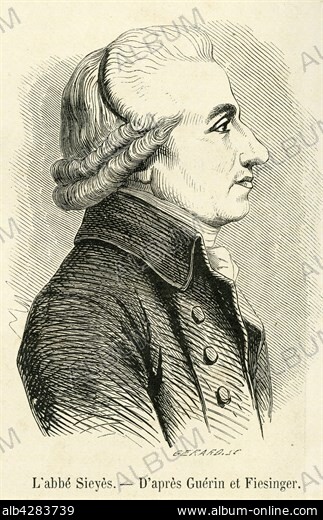
Portrait of Abbot Sieyès
| Share |
|---|
 Pinterest Pinterest |
 Twitter Twitter |
 Facebook Facebook |
 Copy link Copy link |
 Email Email |
|
Add to another lightbox |
|
Add to another lightbox |


Buy this image.
Select the use:

Title: Portrait of Abbot Sieyès
Caption: Revolution. Abbot Sieyès. Emmanuel-Joseph Sieyès, born on the 3rd May 1748 at Fréjus and died on the 20th June 1836, was a french politician, essayist and man of the Church. The son of a tax official and postmaster, he completed his studies at Saint-Sulpice in Paris, and became a Priest in 1774. He played an active role in the French Revolution from the off, (with the publication of his document "What is the Third Estate? in 1789 and which had a significant impact on the population, and he participated in the coup d'état on the 18th Brumaire). In 1789, he was elected to a position of deputy of the Third Estate of the Estates General, and it was him who proposed, on the 17th June 1789, the conversion of the meeting room of the Third Estate into a National Assembly. He played a role in the drafting of the Tennis Court Oath and worked on the composition of the Constitution. Elected into three of the departments which composed the Constitution, he voted in support for the death of the King. He retired his position as priest as a result of the terms in place in the regime at the time (see the section of the Constitution regarding the civilian clergy). During the preparations for Constitution of the Third Year, on the 20th July 1795, (the 2nd of the month of Thermidor in the Republican calendar), he gave a famous speech during which he advocated the support of a Constitutional Jury, the first point of action of the wide range of acts the State had intended to be acted upon regarding the Constitution. In 1795, he refused to accept the post of Director to which he had been elected. In 1798, he was sent as ambassador to Berlin. In 1799, he entered into the Directory, then played a role in the preparations for the coup d'Etat on the 18th Brumaire and he became the President of the Senate on the same date. Between 1815 and 1830, he was exiled after accusations of regicide in Brussels. He returned to France in 1830. 19th Century engraving.
Credit: Album / Photo12/Hachedé
Releases: ? Model Release: No - ? Property Release: No
Rights questions?
Rights questions?
Image size: 2976 × 4605 px | 39.2 MB
Print size: 25.2 × 39.0 cm | 1171.7 × 1813.0 in (300 dpi)
