

alb5529560
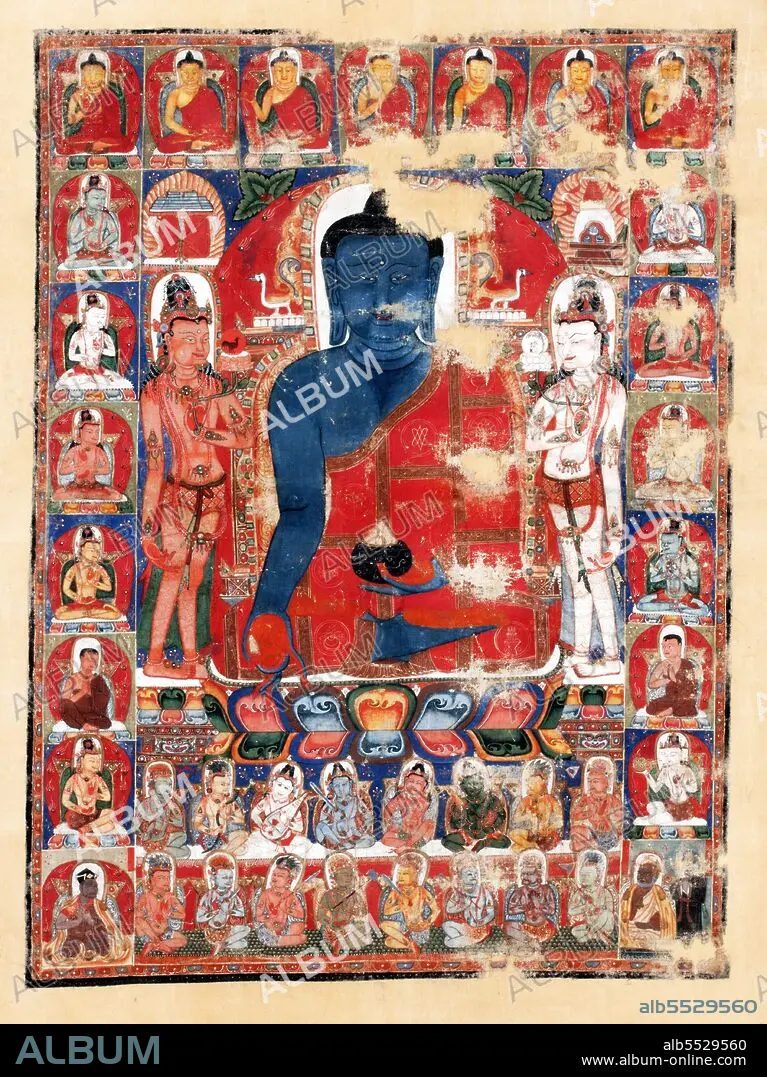
China: Bhaisajyaguru, Mahayana Buddha of healing and medicine. Kara Khoto, Inner Mongolia,13th century.
| Share |
|---|
 Pinterest Pinterest |
 Twitter Twitter |
 Facebook Facebook |
 Copy link Copy link |
 Email Email |
|
Add to another lightbox |
|
Add to another lightbox |


Buy this image.
Select the use:

Title: China: Bhaisajyaguru, Mahayana Buddha of healing and medicine. Kara Khoto, Inner Mongolia,13th century.
Caption: Kara Khoto city was founded in 1032 and became a thriving center of Tangut Empire trade in the 11th century. There are remains of 30-foot (9.1 m)-high ramparts and 12-foot (3.7 m)-thick outer walls. The outer walls ran for some 421 m (1,381 ft) east-west by 374 m (1,227 ft) north-south. The walled fortress was first taken by Genghis Khan in 1226, but—contrary to a widely circulated misunderstanding—the city continued to flourish under Mongol overlordship. During Kublai Khan's time, the city was expanded, reaching a size three times bigger than during the Tangut Empire. Togoontemur Khan concentrated his preparation for reconquest of China at Khara-Khoto. The city was located on the crossroads connecting Karakorum, Xanadu and Kumul. In The Travels of Marco Polo, Marco Polo describes a visit to a city called Etzina or Edzina, which has been identified with Khara-Khoto.
Credit: Album / State Hermitage Museum/Pictures from History/Universal Images Group
Releases: ? Model Release: No - ? Property Release: No
Rights questions?
Rights questions?
Image size: 3600 × 4809 px | 49.5 MB
Print size: 30.5 × 40.7 cm | 1417.3 × 1893.3 in (300 dpi)
Keywords: ART • ARTS • ASIA PICTURES • ASIA • ASIAN IMAGE • ASIAN IMAGES • ASIAN PICTURES • ASIAN • BODHISATTVA • BUDDHISM • BUDDHISM, BHUTANESE • BUDDHIST • CHINA • CHINE • CHINESE • CULT, BUDDHIST • HISTORIA UNIVERSAL • HISTORIA • HISTORICAL IMAGES • HISTORICAL PICTURES • HISTORICAL • HISTORY IMAGES • HISTORY PICTURES • HISTORY • HISTORY. • INNER MONGOLIA • KHARA-KHOTO • LEGEND • MUSLIM WORLD • PAINT • PAINTING • PAINTINGS • PORCELAIN • RELIGION • SAN JIAO • SILK ROAD • SILK ROUTE • UNESCO CHINA • UNESCO WORLD HERITAGE SITE
